How to Water New Sod (First 30 Days)
New sod has almost no roots in the soil yet, so it dries out fast and rots if it stays saturated. This guide gives the schedule for each week, the depth per watering and the minutes to set on your timer.

By Daniel Reeves, PE, CID
Irrigation Design Engineer
Short answer
Soak new sod right after laying, water it daily for the first 10 to 14 days, then move to deeper waterings every other day and twice a week by day 30.
How to water new sod in your yard depends on soil, sprinkler output and weather. In hot or windy weather, split the daily watering into 2 or 3 short runs. Early runs need only about 0.23 inch (6 mm) on loam to keep the sod mat damp; later runs go deeper, about 0.69 inch (18 mm), to pull roots down.
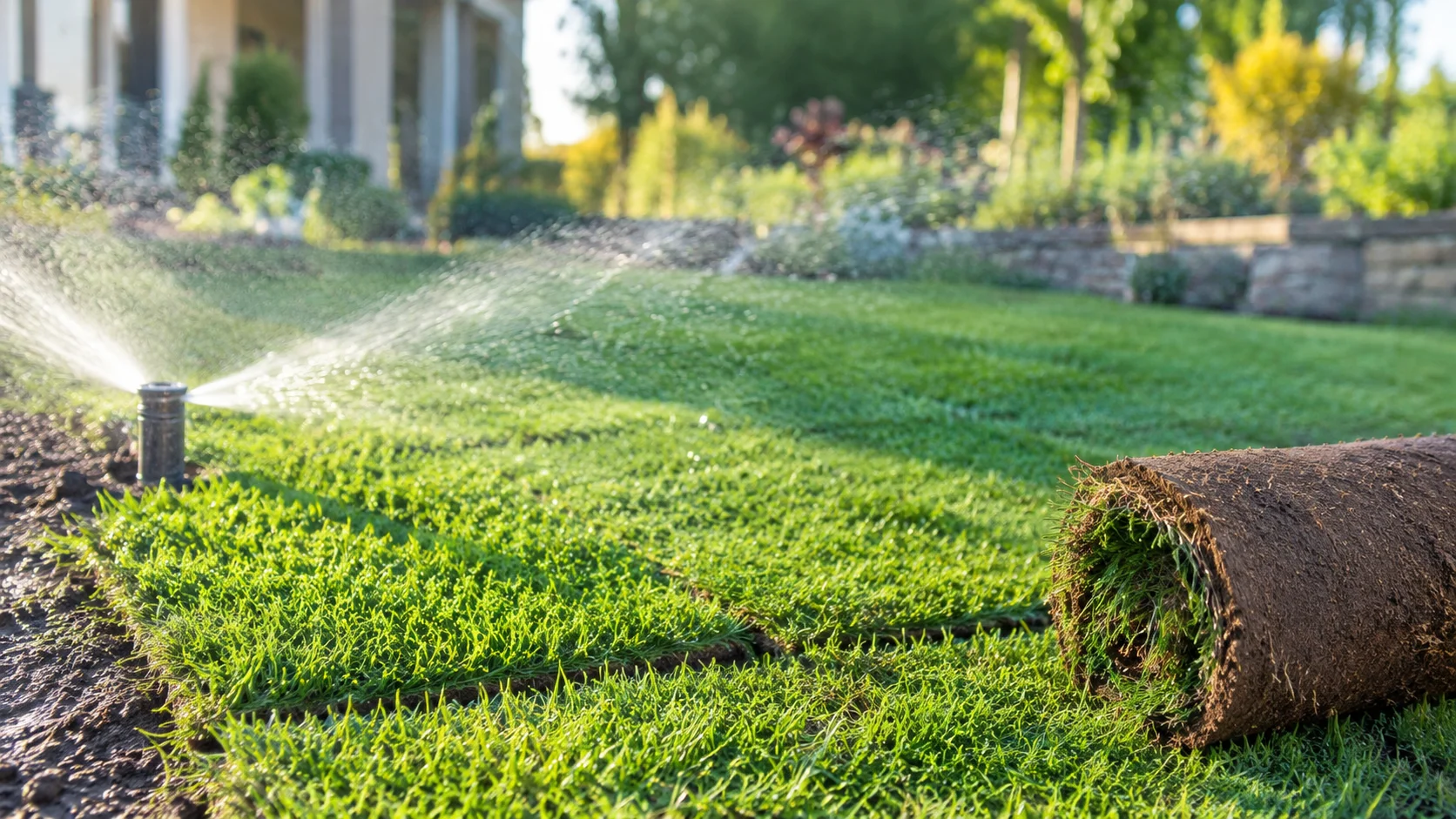
Most advice for new sod stops at keep it wet, so the sod watering calculator turns that into days, waterings and minutes for your yard. Sod is cut only 0.25 to 0.5 inch (6 to 13 mm) thick and carries very little soil,1 so until its roots reach your ground it depends on the water held in that mat. The schedule has to change as the roots grow.
Below you will find a week-by-week plan for the first 30 days, the formula that turns inches into minutes, a worked example for 2,400 sq ft on loam, and the checks for when to cut back.
Key takeaways
- Sod is cut 0.25 to 0.5 inch (6 to 13 mm) thick with little soil, so the mat dries out fast.
- Water every day for the first 10 to 14 days, 2 or 3 times a day in hot or windy weather, until the sod resists lifting.
- On loam, a light watering is about 0.23 inch (6 mm), the day-one soak about 0.91 inch (23 mm) and a deep watering about 0.69 inch (18 mm).
- Minutes = depth applied ÷ precipitation rate × 60, so measure your sprinkler's rate instead of guessing.
- Water every other day in days 15 to 21 and twice a week in days 22 to 30, and keep watering regularly through the first summer.
How long does new sod take to root?
New sod roots into the soil beneath it in about 10 to 14 days when the weather is favorable.2 Nebraska Extension gives the same window for good conditions and suggests checking progress between day 7 and day 10.1 Heat, wind, cool nights and thicker sod can each push the date later.
Rooting is shallow at first. In the first few weeks, turfgrass roots reach only the top few inches of soil,3 so you are managing a small reservoir: the mat plus the upper inch or two of soil. That is why new sod needs frequent, light watering first and deeper, less frequent watering once roots move down.
Season changes the workload. Nebraska prefers sodding in early spring or early fall because irrigation needs are lower than in summer,1 and UC suggests mid-spring to midsummer for warm-season grasses and early spring or fall for cool-season grasses.3
How much water does new sod need on day one?
Start before the first roll goes down. Nebraska recommends lightly moistening the soil where the sod will lie, laying sod within 24 hours of harvest, and watering the whole area thoroughly after rolling.1
The target is wet sod on wet soil with no dry gap between. For planning, wet the soil to about 4 inches (100 mm). UC lists plant-available water of 1.50 to 2.30 inches per foot for loams,4 a midpoint near 1.9 inches per foot, or 0.16 inch per inch of depth. Wetting 4 inches of dry loam takes 4 × 0.16 = 0.64 inch held in the soil.
Sprinklers do not wet every square foot equally, so divide by distribution uniformity (DU), where 1.0 is perfectly even. A DU of 0.70 is a fair planning figure for an untested lawn, and the distribution uniformity calculator returns your own from catch-can readings. The day-one depth is 0.64 ÷ 0.70 = 0.91 inch (23 mm): 36 minutes at 1.5 inches per hour, or 109 minutes at 0.5.
Tip: probe after the first soak
Push a screwdriver through the sod after the day-one watering. It should slide into moist soil with little effort. UC recommends a screwdriver probe to judge how deep moisture reaches.5 If it stops at dry soil under the mat, run another cycle.
How to water new sod during the first 30 days
The table is a starting schedule for loam. The frequencies follow extension guidance; the depths are calculated with the method in the next section, so they shift with your soil and sprinklers.
New sod watering plan for loam, day 0 to day 30
| Period | Waterings | Depth each (loam) | What to check |
|---|---|---|---|
| Day 0 (laying day) | Moisten the soil before laying; one full soak after rolling | 0.91 in (23 mm) | Sod and soil beneath it are wet, with no dry streaks at seams |
| Days 1–7 | Once a day in mild weather; 2 or 3 times a day in hot or windy weather | 0.23 in (6 mm) | Mat and top inch of soil stay damp; edges never dry out |
| Days 8–14 | Light watering daily, replaced by a deep watering every 2nd or 3rd day | 0.23 in (6 mm) light; 0.69 in (18 mm) deep | Lift test between day 7 and 10; soil moist to 6 in after a deep watering |
| Days 15–21 | Every other day | 0.46 in (12 mm) | Sod resists lifting; soil moist to about 4 in |
| Days 22–30 | Twice a week, every 3 to 4 days | 0.69 in (18 mm) | Soil moist to 6 in; no blue-gray color between waterings |
Planning values for loam: 0.16 inch of water per inch of soil depth (midpoint of the UC range),4 DU 0.70, no rain. If the sod still lifts easily, stay on the previous row until it holds.
Days 1 to 7. UC advises daily watering, and 2 or 3 times a day in hot weather.5 Iowa State specifies morning watering with an extra afternoon watering in warm weather.2 Keep every run light: the goal is a damp mat, not a soaked profile.
Days 8 to 14. While the sod still lifts, keep the daily pattern and add UC's deeper watering every second or third day, enough to moisten the soil to 6 inches without saturating it.5 Once the sod resists lifting, water less often and apply more each time.1
Days 15 to 30. K-State advises extending the interval as roots deepen,6 and UC says twice a week is usually enough once the lawn is established.5 Iowa State puts the end of the regular sod routine at about three weeks;2 in practice that means dropping to the deep twice-a-week schedule, not switching the system off.
How do you convert inches of water into minutes?
Every row in the table comes from one formula.
Formula
Minutes = wetting depth × water per inch of soil × share refilled ÷ DU ÷ precipitation rate × 60
Wetting depth is in inches. Water per inch of soil is UC inches per foot ÷ 12. Share refilled is the fraction of that layer's water used since the last watering: 1.0 for the day-one soak and light waterings, 0.5 for deep waterings. DU is a decimal; precipitation rate is in inches per hour.
- Pick the wetting depth. Use 4 inches for the day-one soak and days 15 to 21, 1 inch for light waterings and 6 inches for deep waterings.
- Find your soil's water per inch. Divide the UC value for your texture by 12. For loam, 1.9 ÷ 12 = 0.16. The available water capacity calculator estimates it for other soils.
- Divide by DU. Divide the water to hold by 0.70 unless you have a measured DU. The result is the depth to apply.
- Measure the precipitation rate. Set out straight-sided cans and run the zone for 15 minutes, as in a catch-can test, then use the sprinkler precipitation rate calculator to get inches per hour. The sprinkler precipitation rate chart shows typical ranges.
- Convert to minutes. Divide the depth to apply by the rate and multiply by 60. The how long to water lawn calculator does this for every zone.
Minutes per watering for loam at three precipitation rates
| Watering | Depth applied | At 0.5 in/hr | At 1.0 in/hr | At 1.5 in/hr |
|---|---|---|---|---|
| Day-one soak | 0.91 in (23 mm) | 109 min | 55 min | 36 min |
| Light, days 1–14 | 0.23 in (6 mm) | 28 min | 14 min | 9 min |
| Mid, days 15–21 | 0.46 in (12 mm) | 55 min | 28 min | 18 min |
| Deep, days 8–30 | 0.69 in (18 mm) | 83 min | 41 min | 28 min |
Depths include DU 0.70. If a run is longer than the soil can absorb before puddling, split it into cycles.
Enter area, soil, sprinkler type and weather. The calculator returns waterings per day and minutes per zone.
Worked example: 2,400 sq ft of sod on loam
Take a 40 ft by 60 ft lawn of new sod on loam, with catch cans showing 1.5 inches an hour and an untested DU of 0.70.
- Area40 × 60 = 2,400 sq ft (223 m²)
- Soil water per inch of depth1.9 in/ft ÷ 12 = 0.16 in/in
- Day-one water to hold (4 in)4 × 0.16 = 0.64 in
- Day-one depth applied0.64 ÷ 0.70 = 0.91 in
- Day-one run time0.91 ÷ 1.5 × 60 = 36 min
- Day-one volume2,400 × 0.91 × 0.623 ≈ 1,361 gal
- Light watering depth (1 in)1 × 0.16 ÷ 0.70 = 0.23 in
- Light run time0.23 ÷ 1.5 × 60 = 9 min
- Deep watering depth (6 in, half refilled)6 × 0.16 × 0.5 ÷ 0.70 = 0.69 in
- Deep run time0.69 ÷ 1.5 × 60 = 28 min
36 minutes on day one, 9 minutes per light watering, 28 minutes per deep watering
Metric: the day-one soak is 23 mm over 223 m², about 5,150 liters. One light watering a day for week one is 7 × 0.23 = 1.61 in (41 mm), about 2,407 gal (9,100 liters).
Check the result against the soil. If 36 minutes at 1.5 inches an hour causes puddles, split it into three 12-minute cycles. The inches of water to gallons calculator converts any depth and area to volume, useful on a metered supply.
How do soil, slope and weather change the schedule?
Soil sets how much a watering can hold and how fast it soaks in. The table repeats the calculation above for three soil groups, using the midpoint of each UC range.4
Planning depths for new sod by soil texture
| Soil | Water held per foot | Day-one soak (4 in) | Light watering (1 in) | Handling |
|---|---|---|---|---|
| Sand, loamy sand | 0.75–1.25 in (19–32 mm) | 0.46 in (12 mm) | 0.11 in (3 mm) | Drains fast and the mat dries first; use the extra afternoon watering in warm weather |
| Loam | 1.50–2.30 in (38–58 mm) | 0.91 in (23 mm) | 0.23 in (6 mm) | The baseline schedule above |
| Clay | 1.60–2.50 in (41–64 mm) | 0.97 in (25 mm) | 0.24 in (6 mm) | Slow to absorb; split each run into 2 or 3 cycles |
Midpoints of the UC ranges (1.0, 1.9 and 2.05 in/ft), DU 0.70. Clay's soak is split into cycles, not shortened.
UC notes that sandy soils dry out quickly, while clay soils sometimes need low application rates or 2 or more applications a day to prevent puddling and runoff.3 The cycle and soak calculator sets the cycle length, and the soil infiltration rate calculator estimates how fast your ground accepts water.
Weather moves the frequency, not the depth. On hot, dry or windy days UC calls for 2 or 3 waterings a day,5 so split the day's watering into short runs of the same length. Edges, seams and strips beside pavement dry first, so check them daily.
How do you check that new sod has rooted?
Nebraska Extension describes the test: after 7 to 10 days, grip the blades with both hands and lift straight up. When the sod resists, usually within 10 to 14 days in good weather, water less often and apply more each time.1
- Start at day 7 to 10. Test in 3 or 4 places, including a corner, an edge and the sunniest spot.
- Lift gently. Hold the blades with both hands and pull straight up, checking for resistance without tearing seams.
- Read the result. If it lifts easily, keep the daily schedule and test again in 3 days. If it resists everywhere, move to the next row of the table.
Resistance also marks the first mowing. Nebraska recommends 3.0 inches (76 mm) or higher for Kentucky bluegrass and 3.5 inches (89 mm) or higher for tall fescue, removing no more than a third of the blade, with irrigation scheduled so the turf is firm at mowing time.1 UC adds that the soil should be fairly dry so young turf is not torn out.3
Signs your new sod is too dry or too wet
Too dry
Too wet
- The mat feels spongy underfoot a day after watering.
- The screwdriver comes out muddy at 6 inches the day before the next watering.
- Water pools or runs onto pavement; shorten the run and add cycles.
What time of day should you water new sod?
Make the main watering early in the morning. Iowa State specifies morning watering for new sod,2 and UC advises against evening watering to prevent disease.5 The extra warm-weather watering belongs in the afternoon, when Nebraska says evaporation is greatest.1 Keep it light: 0.23 inch on loam, about 9 minutes at 1.5 inches an hour.
Rain counts only if you measure it. A gauge reading of 0.25 inch (6 mm) covers a light watering, and 0.5 inch (13 mm) covers a deep one, because rain falls evenly and needs no uniformity correction. The effective rainfall calculator estimates how much of a storm your soil keeps.
If you water with a hose-end sprinkler, measure its output with cans; the hose-end sprinkler output calculator turns can readings into inches per hour. Some water providers limit watering days or hours, so ask about a new-sod exemption before you lay sod. Local rules override any schedule here.
What changes after day 30?
By day 30 most sod has rooted well enough to follow an established-lawn schedule. UC says watering twice a week is usually enough once the lawn is established.5 The aim now is depth: UC recommends irrigating deeply enough to wet 6 to 8 inches of soil and letting the top 1 to 2 inches dry between waterings.3
Keep watching through the first summer. K-State notes that sodded cool-season grasses need regular watering through the first summer after planting, and warm-season grasses need it during establishment too.6 Nebraska warns that a lawn sodded in spring or summer will not handle drought well in its first year.1
Once established, cool-season grasses need about 25 percent more water than warm-season grasses in the same location,3 so the lawn watering schedule calculator is worth rerunning for your grass type. UC starts regular fertilization about 6 weeks after planting.3
Frequently asked questions
Can you overwater new sod?
Yes. Soil that stays saturated under the sod slows rooting, and UC notes that too much water keeps roots from growing deep. Signs include a spongy mat, puddles after a run, and a screwdriver that comes out muddy at 6 inches the day before the next watering. Shorten the runs or drop the extra afternoon watering until the soil firms up.
Should I water new sod after it rains?
Count the rain only if you measured it. A gauge reading of 0.25 inch covers a light watering on loam, and 0.5 inch covers a deeper one. Smaller showers do not replace a watering, so push a screwdriver into the soil under the sod before skipping a run. If the soil under the sod is still damp, wait for the next scheduled watering.
Can you walk on new sod while it roots?
Keep traffic off until the sod is rooted. Nebraska Extension says to keep traffic off new sod until it is well established, and the lift test at day 7 to 10 shows when roots are holding. Use a walking mower for the first three to five mowings.
What if I am away during the first two weeks?
Arrange for someone to cover it, because the first 10 to 14 days cannot be skipped. Put the zones on a timer with a rain sensor, or ask a neighbor to check the sod each day and reset the system. If nobody can help, delay installation until you are home, since sod that dries out can die in sections.
Why are the edges and seams of my new sod turning brown?
Edges and seams dry first because they are exposed to sun and wind, and Nebraska Extension notes that sod shrinks as it dries, which opens gaps. Water those strips by hand or add a short extra run, and check that every sprinkler head reaches the perimeter. Keep the seams damp so they do not widen.
When can you mow new sod for the first time?
Mow once the sod resists a firm lift, usually 10 to 14 days after laying in good weather. Set the mower at 3.0 to 3.5 inches, remove no more than a third of the blade, and mow when the soil is fairly dry. Schedule watering so the turf is firm at mowing time, which keeps the mower from tearing the young sod loose.
Sources
- Reicher, Z. and Amundsen, K. (2012). Establishing Lawns From Sod. Nebraska Extension Turf Fact Sheet. University of Nebraska–Lincoln.
- Iowa State University Extension and Outreach. How should I water a newly sodded lawn? Yard and Garden. Iowa State University.
- Le Strange, M. and Reynolds, C.A. (2016). Pest Notes: Weed Management in Lawns. UC Statewide IPM Program, Publication 74113. University of California Agriculture and Natural Resources.
- UC Center for Landscape & Urban Horticulture. Soil Water Holding Characteristics. University of California Agriculture and Natural Resources. Adapted from Schwankl and Prichard (2009).
- Reynolds, C.A. and Flint, M.L. Irrigating new lawns. The UC Guide to Healthy Lawns. UC Statewide IPM Program. University of California Agriculture and Natural Resources.
- Upham, W., Nolting, E. and Sell, P. (2008). Watering New Lawns. MF-2802. Kansas State University Agricultural Experiment Station and Cooperative Extension Service.
Written by Daniel Reeves, PE, CID. Figures in this article were calculated from the cited sources and checked against our lawn watering calculator. Read how we calculate and our editorial policy. Spotted an error? Tell us.