How to Water New Grass Seed (Day-by-Day Schedule)
New seed has no roots to reach deeper water, so the top inch must never dry out, yet soaking it washes seed away. This guide gives a day-by-day schedule with run times by sprinkler type.

By Daniel Reeves, PE, CID
Irrigation Design Engineer
Short answer
Water new grass seed lightly 2 to 4 times a day so the top inch (25 mm) of soil stays damp, then water less often and deeper once seedlings reach 1 to 2 inches tall.12
How to water new grass seed also depends on heat, wind and soil. A typical light run applies about 0.07 inch (1.8 mm), roughly 8 minutes on a 0.5 in/hr (12.7 mm/hr) rotor. Hold that pattern through germination, then taper to every other day and, after two or three mowings, to deep watering about 3 times a week.
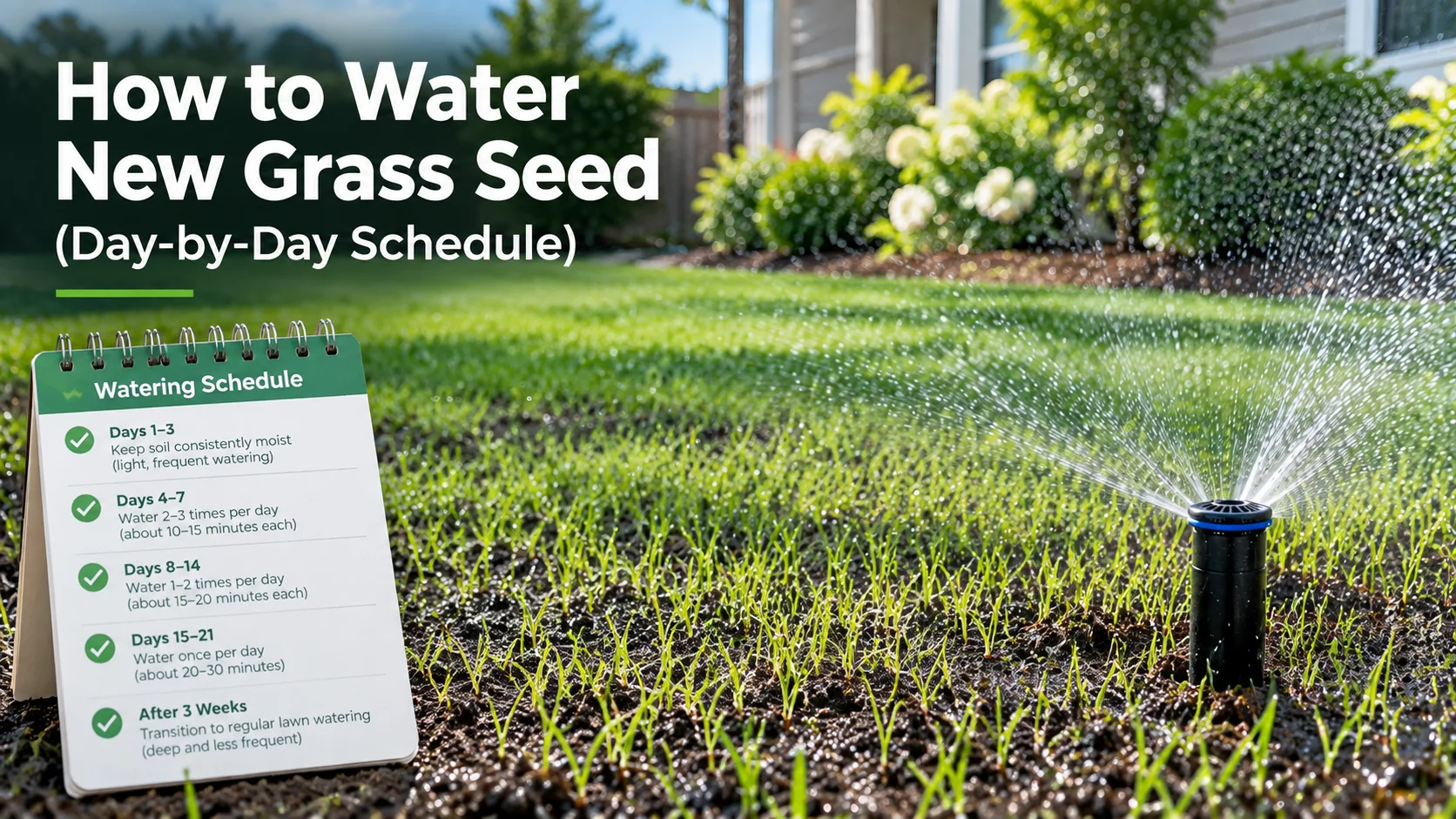
The grass seed watering calculator returns a schedule for your seed, soil and sprinkler type. This guide shows the method behind it, so you can check the result against your own yard.
Common advice stops at "water lightly and often." That leaves out how much a light run is, how the schedule tapers over the first six weeks, and how many minutes it means on your controller. Here you get a day-by-day schedule, a formula with a worked example, germination times by seed, and the signs that tell you to adjust.
Key takeaways
- Keep the top inch (25 mm) of soil damp from seeding day until seedlings are 1 to 2 inches (25 to 50 mm) tall. If the seedbed dries during germination, seedlings are likely to die.
- A light run applies about 0.07 inch (1.8 mm). Three of them a day cover a 0.15-inch day of water loss at 70 percent uniformity.
- Minutes per run = applied depth ÷ precipitation rate × 60: about 8 minutes on a 0.5 in/hr rotor and about 3 minutes on a 1.5 in/hr spray head.
- Perennial ryegrass sprouts in 3 to 7 days, tall fescue in 6 to 12 and Kentucky bluegrass in 14 to 21. UC says frequent light watering can be needed for up to 30 days.
- Taper in steps: 3 runs a day, then 2, then every other day, then about 3 deep waterings of 0.4 inch (10 mm) a week after 2 or 3 mowings.
- Sand needs shorter, more frequent runs. Clay and slopes need runs split into cycles.
How to water new grass seed: keep the top inch damp
Seed is raked in only 1/16 to 1/8 inch (1.5 to 3 mm) deep, so every seedling starts in a thin layer that can dry out within hours on a sunny, windy day.6 Iowa State Extension says to keep the upper 1 inch (25 mm) of soil moist and notes that seedlings are very susceptible to drying injury.2 UC adds that seedlings are likely to die if the soil dries out during germination.1
The target has an upper limit too. UC calls for frequent, light irrigation that keeps the soil moist but not soaked.6 Too much water per run floods the seedbed, floats seed into low spots and pushes water below the seed zone, where the seedlings cannot use it. Two numbers organize the rest of this guide: how much water one run should apply, and how many runs the day needs.
How long does new grass seed take to germinate?
The frequent-watering phase lasts at least as long as the slowest seed in your mix takes to sprout. Iowa State notes that most turfgrass seed germinates in 2 to 3 weeks when soil is 55°F (13°C) or warmer, and University of Tennessee Extension lists the times below.23 UC says several light waterings a day may be needed for up to 30 days.1
Days to germinate by turfgrass seed
| Seed | Days to germinate |
|---|---|
| Perennial ryegrass | 3–7 |
| Tall fescue | 6–12 |
| Fine fescues (chewings, red) | 6–14 |
| Kentucky bluegrass | 14–21 |
| Bermudagrass, common (hulled seed) | 10–20 |
| Bermudagrass, unhulled seed | 14–21 or longer |
Times assume enough moisture and warm soil. Cool soil, shade and dry spells lengthen them.3
Blends sprout unevenly. Perennial ryegrass can show green inside a week while Kentucky bluegrass from the same bag is still invisible at day 14. Keep the full schedule until the slowest species has sprouted, not until the first green appears.
How much water does a seedbed need each day?
A bare, wet seedbed loses water from the surface, and it loses it fast. For planning, treat the daily loss as the reference evapotranspiration (ETo) for the day multiplied by 1.0. That factor is a planning assumption, not a measured value for your site, and it errs toward keeping the seed safe. ETo is about 0.10 inch (2.5 mm) on a cool, cloudy day, 0.15 inch (3.8 mm) in mild sun and 0.25 inch (6.4 mm) in hot, dry wind. Look up yours with the reference ET calculator.
Sprinklers do not wet the ground evenly, so divide the loss by distribution uniformity (DU). A DU of 0.7 is a fair figure if you have not tested; the distribution uniformity calculator turns catch-can readings into your own number. At an ETo of 0.15 inch and a DU of 0.7, your sprinklers must apply 0.15 ÷ 0.7 = 0.21 inch a day.
Soil sets how much one run can apply. Plant-available water per foot of soil, divided by 12, gives the water held in each inch of depth.4 The top inch holds between 0.06 and 0.21 inch depending on texture, so runs must be short. The available water capacity calculator estimates it for your own soil.
Water held in the top inch of soil, and the run size that fits it
| Soil | Plant-available water per foot | Held in the top 1 inch | Run size and runs on a 0.15-inch day |
|---|---|---|---|
| Sands and loamy sands | 0.75–1.25 in (19–32 mm) | 0.06–0.10 in (1.6–2.6 mm) | About 0.05 in (1.3 mm); 5 runs |
| Loams and silt loams | 1.50–2.30 in (38–58 mm) | 0.13–0.19 in (3.2–4.9 mm) | About 0.07 in (1.8 mm); 3 runs |
| Clay loams to clays | 1.60–2.50 in (41–64 mm) | 0.13–0.21 in (3.4–5.3 mm) | About 0.07 in (1.8 mm); 3 runs, split if water puddles |
Water per foot is the UC range for each texture group; water held in the top inch is that value divided by 12.4 Run sizes stay well under what the top inch holds, which leaves margin for uneven coverage. Runs per day = 0.15 ÷ 0.7 = 0.21 in applied, divided by run size and rounded up (sand: 0.21 ÷ 0.05 = 4.3, so 5).
Day-by-day watering schedule for new grass seed
The schedule below suits tall fescue or a ryegrass blend on loam in mild, sunny weather: ETo about 0.15 inch a day and DU 0.7. The weekly column shows the taper, which follows the seedbed turning into a rooted lawn.
Day-by-day watering schedule for tall fescue or ryegrass seed on loam
| Days | Stage | Runs | Applied per run | Applied per week |
|---|---|---|---|---|
| Day 0 | Seeding day, right after raking the seed in | 1–2 that day | 0.07 in (1.8 mm) | Not applicable |
| Days 1–14 | Seed absorbing water, then first sprouts | 3 a day | 0.07 in (1.8 mm) | 1.47 in (37 mm) |
| Days 15–21 | Seedlings 1 to 2 in (25 to 50 mm) tall | 2 a day | 0.10 in (2.5 mm) | 1.4 in (36 mm) |
| Days 22–28 | Established seedlings, before the first mowing | Every other day | 0.35 in (8.9 mm) | About 1.2 in (31 mm) |
| Days 29–42 | After 2 or 3 mowings | 3 a week | 0.40 in (10 mm) | 1.2 in (30 mm) |
Planning values for ETo of 0.15 in/day and DU of 0.7; amounts are sprinkler-applied depth, so they include the uniformity correction. Weekly totals: 3 × 0.07 × 7 = 1.47 in; 2 × 0.10 × 7 = 1.4 in; 3.5 × 0.35 ≈ 1.2 in; 3 × 0.40 = 1.2 in. The last two rows use a lawn factor of 0.8 in place of the seedbed factor of 1.0: 0.15 × 7 × 0.8 ÷ 0.7 = 1.2 in. Move to the last row after the mowings, not on a date. For Kentucky bluegrass or bermudagrass, hold the second row until sprouts appear and shift the later rows by the same number of days. UC says every other day may be enough once seedlings are established, and Iowa State says one thorough weekly watering can be adequate after 2 or 3 mowings; the 3 a week here is the planning value for a 0.15-inch day.12
Spread the runs across daylight hours. With three runs, 7 a.m., 11 a.m. and 3 p.m. keeps the top inch damp through the driest part of the day. UC advises against evening watering to prevent disease.1
Adjust the count for the weather. On a cool, cloudy day (ETo 0.10 inch), two 0.07-inch runs cover the loss, since 0.10 ÷ 0.7 = 0.14 inch. On a hot, windy day (ETo 0.25 inch), apply 0.25 ÷ 0.7 = 0.36 inch in four runs of about 0.09 inch.
Tip: check at mid-afternoon
Push a finger into the seedbed at 3 p.m. If the top inch is dry by then, add a run or move one earlier. Morning checks miss the driest hours.
Caution: local watering rules
Many cities limit watering days or hours. Ask your water utility whether a new-lawn exemption exists before you seed, because a seedbed cannot follow a twice-a-week schedule.
How many minutes per run for your sprinkler?
Run time depends on how fast your sprinklers apply water, so the same 0.07-inch run takes 3 minutes on one zone and 10 on another.
Formula
Minutes per run = applied depth per run ÷ precipitation rate × 60
Applied depth per run = (ETo ÷ DU) ÷ runs per day. ETo is in inches per day, DU is a decimal and the precipitation rate is in inches per hour.
- Find the daily loss. Take the day's ETo and multiply by 1.0.
- Correct for uniformity. Divide by DU, using 0.7 if you have not tested.
- Pick the run size. Use about 0.05 inch for sand and 0.07 inch for loam and clay, then divide the daily amount by the run size and round up to get runs per day.
- Measure your precipitation rate. Run a catch-can test, or work it out from nozzle flow and spacing with the sprinkler precipitation rate calculator. The sprinkler precipitation rate chart lists typical values.
- Convert to minutes. Divide the run size by the rate and multiply by 60.
Minutes per run by precipitation rate and applied depth
| Precipitation rate | 0.05 in (1.3 mm) | 0.07 in (1.8 mm) | 0.10 in (2.5 mm) |
|---|---|---|---|
| 0.4 in/hr (10 mm/hr) | 7.5 min | 10.5 min | 15 min |
| 0.5 in/hr (12.7 mm/hr) | 6 min | 8.4 min | 12 min |
| 1.0 in/hr (25 mm/hr) | 3 min | 4.2 min | 6 min |
| 1.5 in/hr (38 mm/hr) | 2 min | 2.8 min | 4 min |
Minutes = applied depth ÷ precipitation rate × 60. The rates are examples; measure yours, because real output varies with nozzle, pressure and spacing.
Enter grass type, soil, sprinkler type and weather. The calculator returns runs per day and minutes per zone for each stage.
Worked example: 3,000 sq ft of tall fescue on loam
Take a 3,000 sq ft (279 m²) tall fescue seedbed on loam in early fall. ETo is 0.15 inch a day (3.8 mm), the gear rotors apply 0.5 inch an hour (12.7 mm/hr), and DU is an untested 0.7.
- Daily water loss0.15 in × 1.0 = 0.15 in
- Applied after uniformity0.15 ÷ 0.7 = 0.21 in
- Run size (loam)0.07 in, under the 0.13 in the top inch holds
- Runs per day0.21 ÷ 0.07 = 3 runs
- Minutes per run0.07 ÷ 0.5 × 60 = 8.4 min
- Daily volume3,000 × 0.21 × 0.623 ≈ 392 gal
- First-week volume392 × 7 ≈ 2,750 gal
3 runs a day, about 8 minutes each
Metric: 0.21 in is 5.3 mm a day, or 1.8 mm per run. Over 279 m² that is about 1,490 liters a day and about 10,400 liters in the first week.
Check the result against the weather. Each run delivers 0.07 inch, and at 70 percent uniformity about 0.049 inch reaches the soil on average, so three runs put back 0.147 inch against a 0.15-inch loss. If 8 minutes puddles, run two 4-minute cycles instead.
How soil, slope and weather change the schedule
Sandy soil
Sand holds 0.06 to 0.10 inch in the top inch, so 0.05 inch is the practical ceiling for a run. At an ETo of 0.15 inch that means 5 runs a day, because 0.21 ÷ 0.05 = 4.3, rounded up. A thin mulch layer, no more than 1/4 inch (6 mm) thick, slows surface drying.6
Clay soil and slopes
Clay and compacted soil absorb water slowly, so a run can puddle or run off before the top inch is wet. Slopes make it worse. Split each run into two or three shorter cycles with a gap between them; the cycle and soak calculator sets the cycle length. To see how fast your soil takes water, use the soil infiltration rate calculator.
Sun, wind and shade
Full sun and wind push the loss toward the hot-day figure, while shaded corners stay damp longer. Judge each zone with its own finger test, because one program rarely suits both a sunny south slope and a shaded north bed.
Rain
Count only the rain that soaks in. A steady rain of 0.1 inch (2.5 mm) or more can replace a run or two, and the effective rainfall calculator estimates how much of a storm your seedbed keeps. Brief showers do not cancel the mid-afternoon check.
Signs your new seed is too dry or too wet
The calendar gives the starting point and the seedbed corrects it. Check every day for the first three weeks.
Too dry
- The top inch is pale and crumbly by mid-afternoon.
- Seedlings look gray or wilted in the afternoon heat.
- Bare patches repeat in the same spots, often on slopes and edges.
- Some areas are still bare well after the germination window in the table above.
Too wet
- Water pools or runs onto pavement during a run.
- Seed and mulch collect in drifts in low spots.
- The soil smears or sticks to your shoe.
- The surface is still glossy and soft hours after the last run.
If the symptoms show up in only one zone, change that zone alone. Adjust one thing at a time, then watch the next two days before changing it again.
When to cut back and switch to deep watering
Iowa State advises gradually reducing the frequency and watering more deeply once seedlings are 1 to 2 inches (25 to 50 mm) tall.2 Do not jump from daily runs to a weekly soak. Follow the schedule: 2 runs a day, then every other day, then about 3 deep waterings a week.
The goal of the final stage is to wet the top 6 to 8 inches (15 to 20 cm) of soil, which UC says promotes healthy root growth.5 Probe with a screwdriver to see how deep the last watering went.1 Once the lawn is on the long-term program, the lawn watering schedule calculator gives days per week and the how long to water lawn calculator gives minutes per zone. New sod follows a different taper; use the sod watering calculator for that.
Frequently asked questions
Can you overwater new grass seed?
Yes. UC calls for light irrigation that keeps the soil moist but not soaked. Runs that apply more than the top inch can hold, about 0.13 to 0.19 inch on loam, send water below the seed or across the surface. The result is puddles, seed washed into low spots and soggy ground. Shorten the run and add another one instead.
What happens if new grass seed dries out?
UC says seedlings are likely to die if the soil dries out during germination, and Iowa State describes seedlings as very susceptible to drying injury. If a spot dried out, restart the full schedule at once. Wait until the rest of the seedbed has sprouted before judging losses, then reseed bare patches with the same species and keep them on the frequent schedule.
Should you water new grass seed at night?
Avoid evening runs. UC advises against watering new lawns in the evening because it promotes disease. Start the first run near sunrise and finish the last by mid-afternoon, which still keeps the top inch damp through the driest hours. On a hot, windy day that needs four runs, space them about three hours apart, starting at 6 a.m.
Can I use a hose instead of sprinklers on new grass seed?
Yes, with a fine spray or a sprinkler rather than a hard jet, which moves seed and cuts channels. Find your hose-end sprinkler's rate with a catch can. At 1 inch per hour, a 0.07-inch run takes about 4 minutes, because 0.07 divided by 1.0, times 60, is 4.2. Move the sprinkler so every spot gets the same number of runs.
Do I still need to water new grass seed under straw or mulch?
Yes. A thin mulch layer, no more than 1/4 inch (6 mm) thick, slows surface drying but does not replace watering. UC suggests it for summer seeding to protect seed and hold moisture. Keep the same runs and check under the mulch with a finger. If the soil beneath is dry, add a run.
Should I still water new grass seed on cool, cloudy days?
Yes. The top inch still has to stay damp, but evaporation falls. On a cool, cloudy day with reference evapotranspiration near 0.10 inch, two 0.07-inch runs cover the loss, since 0.10 divided by 0.7 is 0.14 inch applied. Skip the late run only if an afternoon finger test shows the top inch is still damp.
Sources
- UC Statewide IPM Program. Irrigating new lawns. The UC Guide to Healthy Lawns. University of California Agriculture and Natural Resources.
- Iowa State University Extension and Outreach. How should I water a newly seeded lawn? Yard and Garden. Last updated March 1, 2022.
- University of Tennessee Extension. Turfgrass Establishment: Seeding (W160-B). Seed germination intervals by species.
- UC Center for Landscape & Urban Horticulture. Soil Water Holding Characteristics. University of California Agriculture and Natural Resources. Adapted from Schwankl and Prichard (2009).
- UC Statewide IPM Program. How to water. The UC Guide to Healthy Lawns. University of California Agriculture and Natural Resources.
- UC Statewide IPM Program. Seed, fertilize, and irrigate. The UC Guide to Healthy Lawns. University of California Agriculture and Natural Resources.
Written by Daniel Reeves, PE, CID. Figures in this article were calculated from the cited sources and checked against our lawn watering calculator. Read how we calculate and our editorial policy. Spotted an error? Tell us.