How to Water Hydroseed
Newly sprayed hydroseed needs light water several times a day, then less often and deeper as the grass grows. This guide gives the schedule for each stage, the gallons per 1,000 square feet and the sprinkler minutes to match.

By Daniel Reeves, PE, CID
Irrigation Design Engineer
Short answer
Wait about 24 hours, then water hydroseed 2 to 4 light times a day, 1/8 to 1/4 inch (3 to 6 mm) in total, until sprouts reach 1 to 2 inches (25 to 50 mm).
That is how to water hydroseed through its first weeks. Once sprouts are 1 to 2 inches tall, cut back gradually and water deeper, ending at 1 or 2 deep waterings a week after the second or third mowing. Hot, windy weather pushes you toward 4 runs a day, and any runoff means the run is too long.
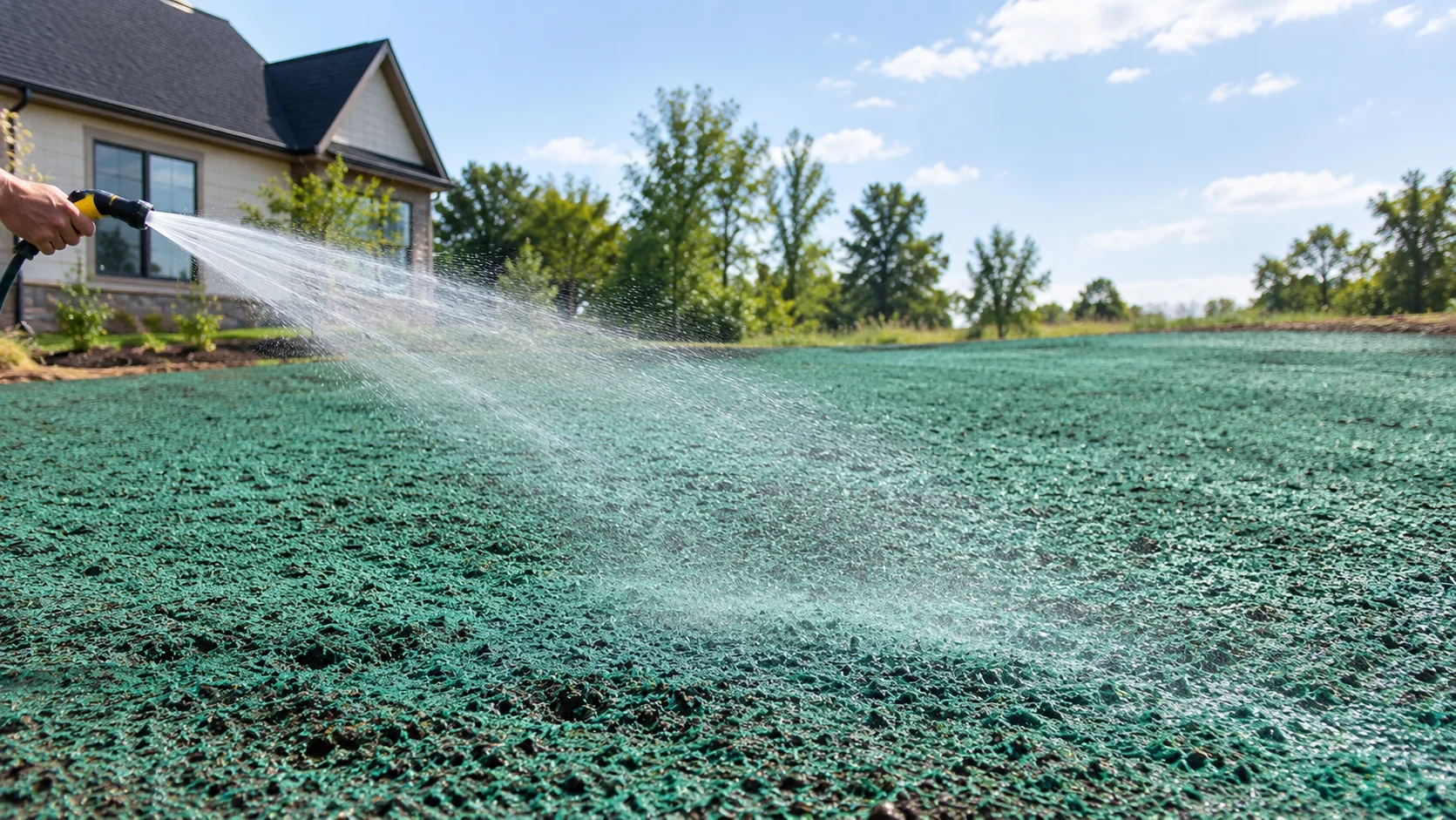
The grass seed watering calculator returns run times for your sprinklers, and this guide explains the schedule behind it. Sprayed hydroseed has almost no roots, so the seedlings depend on the top inch or two of soil staying damp.1 Iowa State calls grass seedlings very susceptible to drying out,2 and UC warns they are likely to die if the soil dries during germination.1
It covers the first 24 hours, each growth stage, the gallons and minutes behind the schedule, signs of too much or too little water, and the switch to normal lawn watering.
Key takeaways
- Wait about 24 hours after spraying so the mulch can dry and bond, unless the product label says otherwise.
- Until sprouts appear, water 2 to 4 light times a day, 1/8 to 1/4 inch (3 to 6 mm) a day in total. That is 78 to 156 gallons (295 to 590 liters) per 1,000 sq ft (93 m²).
- Keep the top 1 to 2 inches (25 to 50 mm) of soil damp but not soaked, because seedlings are likely to die if it dries out.
- At 1 to 2 inches (25 to 50 mm) of growth, ease to daily and then every 2 to 3 days with deeper runs. After the second or third mowing, water deeply 1 or 2 times a week.
- Minutes per run = daily depth ÷ DU ÷ runs per day ÷ precipitation rate × 60. For 5,000 sq ft at 1.5 in/hr, that is 3 runs of 4 minutes.
- Stop each run before water pools or moves mulch, and split runs on slopes.
Should you water hydroseed right after it is sprayed?
Not for about 24 hours. Michigan's hydroseeding guidance says a hydraulic matrix needs 24 hours to dry before rain to be effective,3 and an EPA Region 7 evaluation reports the same 24-hour wait before the first watering, citing a contractor.4 Wet mulch that has not bonded can slide off the soil and take seed with it.
Some bonded-fiber products cure faster, and the EPA report notes one that skips the 24-hour cure of most mulches,4 so follow the label or your installer if they differ.
Use that day to prepare. Confirm the heads cover the whole seedbed, replace clogged nozzles, and program 3 or 4 start times for the next morning. Once watering starts, the surface should not be allowed to dry.2
How to water hydroseed, stage by stage
Frequency falls and depth rises as the grass grows, so plant height is a better guide than the calendar. Table 1 shows the pattern.
Table 1. Hydroseed watering schedule by growth stage
| Stage | Trigger | Waterings | Water to apply |
|---|---|---|---|
| Cure | First 24 hours after spraying | None, unless the label says otherwise | 0 |
| Germination | Seed down, no sprouts yet | 2 to 4 light runs a day | 1/8 to 1/4 in (3 to 6 mm) a day in total; 78 to 156 gal per 1,000 sq ft; top 1 to 2 in (25 to 50 mm) of soil damp |
| Young seedlings | Sprouts under 1 in (25 mm), to about week 3 | 2 light runs a day; up to 4 if hot and windy | Same daily total |
| Taper | Sprouts 1 to 2 in (25 to 50 mm) tall | Daily, easing to every 2 to 3 days | Up to 1/2 in (13 mm) per watering; 312 gal per 1,000 sq ft |
| Established | After the second or third mowing | 1 or 2 deep waterings a week | Enough to wet the top 6 to 8 in (150 to 200 mm) |
Planning values built from Iowa State (light applications for three weeks after seeding), UC (up to 30 days, then every other day, then once or twice a week, wetting the top 6 to 8 inches) and UT Extension (1/8 to 1/4 inch a day, then about 1/2 inch every two to three days).1256 Gallons use 0.623 per sq ft per inch. Stage timing follows plant height and weather.
The sources agree on the pattern and differ on the count. Iowa State says two light applications a day usually suffice, up to four in hot, windy weather,2 while UC says several a day for up to 30 days.1 A workable starting point is 3 runs a day. Add a run if the mulch is dry before the next one, and drop one if water pools.
Put the first run in the early morning and the last by mid-afternoon, since UC advises against evening watering of new lawns because it encourages disease.1 Midday runs matter for a seedbed because its thin damp layer is the only moisture the seedlings have.
How long does hydroseed take to sprout?
It depends on the species, and so does the length of the light-watering stage. Table 2 lists approximate days to germinate from UT Extension.5
Table 2. Approximate days to germinate by grass species
| Grass | Season | Days to germinate |
|---|---|---|
| Perennial ryegrass | Cool | 3 to 7 |
| Tall fescue | Cool | 6 to 12 |
| Kentucky bluegrass | Cool | 14 to 21 |
| Zoysia (Zoysia japonica) | Warm | 10 to 14 |
| Bermudagrass (hulled seed) | Warm | 10 to 20 |
| Centipedegrass | Warm | 10 to 20 |
Days are from UT Extension. Cool-season seed germinates fastest at cyclic air temperatures of about 59 to 82°F (15 to 28°C), warm-season seed at 68 to 95°F (20 to 35°C). Unhulled bermudagrass often needs 14 to 21 days or longer.5
Slow species set the pace of a blend. UT notes that bluegrass, bermudagrass, centipedegrass and zoysia germinate more slowly than the fescues and ryegrasses,5 so in a ryegrass and bluegrass blend the ryegrass can be up at least a week early. Keep the light schedule going until the slow species emerge, not just until the first green shows.
Season moves the date too. A contractor quoted in the EPA evaluation advised against residential hydroseeding after about October 1 or in soil below 60°F (16°C), when seed may not germinate.4 Cooler soil slows germination, so the damp-seedbed stage runs longer. For mature water needs by species, see the lawn watering by grass type chart.
How much water does hydroseed need per day?
UT Extension puts new plantings at 1/8 to 1/4 inch a day for several weeks, rising to about 1/2 inch every two to three days as roots deepen.5 One inch over 1,000 square feet is 623 gallons, so those depths are about 78 to 156 gallons a day and 312 gallons per watering. The inches of water to gallons calculator converts any depth and area.
Table 3. Water and sprinkler minutes by depth, per 1,000 sq ft
| Depth to the soil | Gallons | Liters | Spray heads, 1.5 in/hr: minutes | Rotors, 0.5 in/hr: minutes |
|---|---|---|---|---|
| 0.05 in (1.3 mm) | 31 | 118 | 2.9 | 8.6 |
| 0.10 in (2.5 mm) | 62 | 236 | 5.7 | 17.1 |
| 0.125 in (3.2 mm) | 78 | 295 | 7.1 | 21.4 |
| 0.25 in (6.4 mm) | 156 | 590 | 14.3 | 42.9 |
| 0.50 in (12.7 mm) | 312 | 1,180 | 28.6 | 85.7 |
Gallons use 623 per inch per 1,000 sq ft (92.9 m²). Minutes = depth ÷ DU ÷ precipitation rate × 60 with DU 0.7, an untested planning value. Minutes are the total for the depth, to be split across runs. UT rounds 1/2 inch to about 300 gallons.5
The minutes run longer than depth divided by rate because sprinklers never wet evenly. Distribution uniformity (DU) is the average depth in the driest quarter of the zone divided by the overall average, and a low DU leaves dry streaks where seedlings die. The distribution uniformity calculator computes it from catch-can readings.
How to set your sprinkler controller for hydroseed
The controller needs three numbers: how fast each zone applies water, how much to apply per day, and how many runs to split it into.
Formula
Minutes per run = daily depth ÷ DU ÷ runs per day ÷ precipitation rate × 60
Daily depth is in inches (mm) and the precipitation rate in inches (mm) per hour. DU is a decimal; use 0.7 if untested. Gallons = area (sq ft) × depth (in) × 0.623. Liters = area (m²) × depth (mm).
- Measure the precipitation rate. Set straight-sided cans across the zone, run it for 15 minutes, average the depths and multiply by 4 for inches per hour. The catch-can test calculator does the arithmetic, the sprinkler precipitation rate calculator works from nozzle flow and spacing, and the sprinkler precipitation rate chart lists typical rates.
- Pick the daily depth. Choose a value between 1/8 and 1/4 inch, and the number of runs: three to start, four for hot, windy days.
- Convert to minutes. Divide the daily depth by DU, by the runs per day and by the precipitation rate, then multiply by 60. The sprinkler run time calculator returns minutes per run for any depth and rate.
- Space the start times. Spread the runs between about 7 a.m. and 3 p.m., so the mulch is watered through the drying hours and is dry by evening.
- Check and adjust. At mid-afternoon, press a finger into the soil under the mulch. It should be damp 1 to 2 inches (25 to 50 mm) down. Add a run if it is dry, and shorten runs if water pools.
Enter your grass type, area and sprinkler rate. The calculator returns runs per day and minutes per run for each stage.
Worked example: 5,000 sq ft of hydroseeded tall fescue
A 5,000 sq ft (465 m²) yard is hydroseeded with tall fescue. Spray heads apply 1.5 in/hr (38 mm/h) and DU is an untested 0.7. The target is 0.21 inch a day, inside the UT range, in 3 runs.
- Daily depth to the soil0.21 in (target)
- Applied depth after uniformity0.21 ÷ 0.7 = 0.30 in
- Depth per run (3 runs)0.30 ÷ 3 = 0.10 in
- Minutes per run0.10 ÷ 1.5 × 60 = 4 min
- Daily volume5,000 × 0.30 × 0.623 ≈ 935 gal
- Days 2 to 21 (20 days)935 × 20 ≈ 18,700 gal
- Taper: 1/2 in to the soil0.5 ÷ 0.7 = 0.714 in applied
- Minutes per taper watering0.714 ÷ 1.5 × 60 ≈ 29 min
- Volume per taper watering5,000 × 0.714 × 0.623 ≈ 2,225 gal
3 runs a day of 4 minutes, then about 29 minutes every 2 to 3 days
Metric: 0.21 in is 5.3 mm to the soil and 7.6 mm applied, about 3,540 liters a day over 465 m², or 70,800 liters over the 20 days. With rotors at 0.5 in/hr (13 mm/h), the same 4-minute run takes 12 minutes.
Check the result: a 4-minute run applies 0.10 inch, of which 0.07 inch reaches the seedbed (0.10 × 0.7), and three runs deliver 0.21 inch. If the 29-minute taper watering runs off, split it into two cycles of about 14 minutes an hour apart. The lawn water usage calculator totals the volume for your own lawn.
How heat, wind, rain and slopes change the schedule
Heat and wind
Add runs, not minutes. Iowa State allows up to four light waterings a day in hot, windy weather.2 In the worked example, 4 runs of 3 minutes deliver the same 0.21 inch as 3 runs of 4 minutes (0.30 ÷ 4 = 0.075 in; 0.075 ÷ 1.5 × 60 = 3 min). Mulch rate matters too: Michigan's guidance says 3,000 lb per acre of wood mulch (about 70 lb per 1,000 sq ft) retains more moisture in very hot conditions than the 2,000 lb starting rate.3 If you hire an installer, ask what rate they spray.
Rain
Within a month of spraying, a rain over 0.5 inch (13 mm) calls for an inspection for washouts and bare spots, according to a municipal erosion manual cited in the EPA report.4 When rain soaks the mulch, skip that day's runs and resume as the surface dries. The effective rainfall calculator estimates how much of a storm soaked in, and spraying ahead of a forecast storm is best avoided because the mulch needs 24 hours to dry.3
Slopes and clay
Runoff carries mulch and seed with it. Michigan's guidance says any site prone to erosion, including erosion from its own irrigation, is a candidate for a tackifier, and steep slopes benefit most.3 On slopes and clay, split each run into two shorter cycles an hour apart. The cycle and soak calculator sets the cycle length, and the soil infiltration rate chart shows how fast your soil takes water.
Keep the spray gentle
Michigan's guidance warns that water aimed at one spot for too long causes erosion during application.3 The same applies to a hose, so use a mist setting and keep it moving.
Signs your hydroseed is too dry or too wet
The schedule is a starting point. Check the seedbed at the hottest part of the afternoon for the first week.
Too dry
- The mulch is pale and dry to the touch before the next run.
- Soil 1 inch (25 mm) down is dusty or crumbles.
- Sprouts appear, then wilt or turn gray-green.
- Bare patches repeat in the same spots, which points to uneven coverage.
Too wet
- Puddles or runoff appear during a run.
- Mulch slides downhill and exposes bare soil.
- The soil stays saturated and soft between runs.
- Seedlings collapse at the base in warm weather, a sign of damping off.5
The soil under the mulch should be damp 1 to 2 inches down but not soaked.1 UT notes that Pythium can destroy young plants in wet soil at high temperatures.5 Change one thing at a time, either a run or the minutes, and check again the next day.
When to cut back to deep, infrequent watering
Cut back when sprouts reach 1 to 2 inches, not when the first green appears. Iowa State says to reduce frequency gradually at that height and water more deeply, and that one thorough watering a week is adequate once the grass has been mowed 2 or 3 times.2 UC adds a middle step: every other day as seedlings become established, then deep watering once or twice a week once roots have developed.1 Drop one daily run at a time and check the seedlings for two or three days before dropping another.
UT says to begin mowing tall fescue and ryegrass at a 2-inch (51 mm) cut when plants average 3 inches (76 mm), and hybrid bermudagrass and zoysia at 1½ inches (38 mm) when plants average 2¼ inches (57 mm), never removing more than one-third of the leaf.5 Each mowing counts toward the 2 or 3 that mark the change.
Deep means water that reaches the top 6 to 8 inches (150 to 200 mm), which UC says builds healthy roots and uses water efficiently.6 Check with a probe or long screwdriver after watering; it should slide in about 6 inches. The lawn watering schedule calculator sets days per week and minutes once the lawn is established.
Frequently asked questions
Can you overwater hydroseed?
Yes. Too much water saturates the seedbed, washes mulch and seed downhill and favors damping-off fungi in warm weather. Iowa State advises applying only enough water to keep the surface moist and avoiding runoff. If water pools or soil stays soggy between runs, remove a run or shorten each one.
What time of day should you water hydroseed?
Start in the early morning and spread the remaining runs through the day, finishing by mid-afternoon. Unlike an established lawn, a seedbed needs midday water because its damp layer is thin and dries quickly. UC advises against evening watering of new lawns because it can encourage disease. Check local restrictions first.
Should you water hydroseed when it rains?
Only if the rain did not soak the mulch. A storm that leaves the mulch and top inch of soil wet replaces that day's runs, while a brief shower often does not. Check the soil at midday and resume when the surface dries. After a rain over 0.5 inch within a month of spraying, inspect for washouts.
Can you water hydroseed with a hose?
Yes, with a sprinkler or a mist-setting nozzle that is kept moving. Time a bucket fill to learn your flow. At 5 gallons per minute, the 78 to 156 gallons that 1,000 sq ft needs each day takes about 16 to 31 minutes in total, before allowing for uneven coverage. Split that across 3 or 4 runs.
Why is my hydroseed patchy?
Common causes are dry spots from uneven sprinkler coverage, washouts after heavy rain and slow species that have not emerged yet. An EPA evaluation recorded patchy growth after a 1.68-inch rain two days after spraying. Inspect after storms, run catch cans to find dry zones, and re-spray bare patches only after fixing the cause.
Sources
- UC Statewide IPM Program. Irrigating new lawns. The UC Guide to Healthy Lawns. University of California Agriculture and Natural Resources.
- Iowa State University Extension and Outreach. How should I water a newly seeded lawn? Yard and Garden. Updated June 9, 2026.
- Michigan Department of Environment, Great Lakes, and Energy. Hydroseeding. Nonpoint Source Best Management Practices.
- Project Resources Inc. for U.S. EPA Region 7 (2005). Evaluation of Hydroseed for the Re-establishment of Residential Lawns, Omaha Lead Site, Omaha, Nebraska. Contractor and municipal-manual practices are cited as reported there.
- Samples, T. and Sorochan, J. Turfgrass Establishment Seeding (W160-B). University of Tennessee Extension.
- UC Statewide IPM Program. How to water. The UC Guide to Healthy Lawns. University of California Agriculture and Natural Resources.
Written by Daniel Reeves, PE, CID. Figures in this article were calculated from the cited sources and checked against our lawn watering calculator. Read how we calculate and our editorial policy. Spotted an error? Tell us.