Warm-Season vs Cool-Season Grass: Water Needs Compared
Warm-season grasses use about a quarter less water than cool-season grasses, but the gap changes with climate, month and watering schedule. This article gives the weekly totals, frequencies and run times for each, with a worked example.

By Daniel Reeves, PE, CID
Irrigation Design Engineer
Short answer
Warm-season grasses need about 25% less water than cool-season grasses: a crop coefficient of 0.6 versus 0.8, or 0.84 versus 1.12 inches (21 versus 28 mm) a week at 0.2 inch of daily ET.
Warm-season vs cool-season grass water needs also differ in rhythm. Warm-season lawns such as Bermuda, zoysia and St. Augustine usually need watering 1 or 2 times a week, while cool-season lawns such as tall fescue, Kentucky bluegrass and ryegrass need about 3 in summer.3
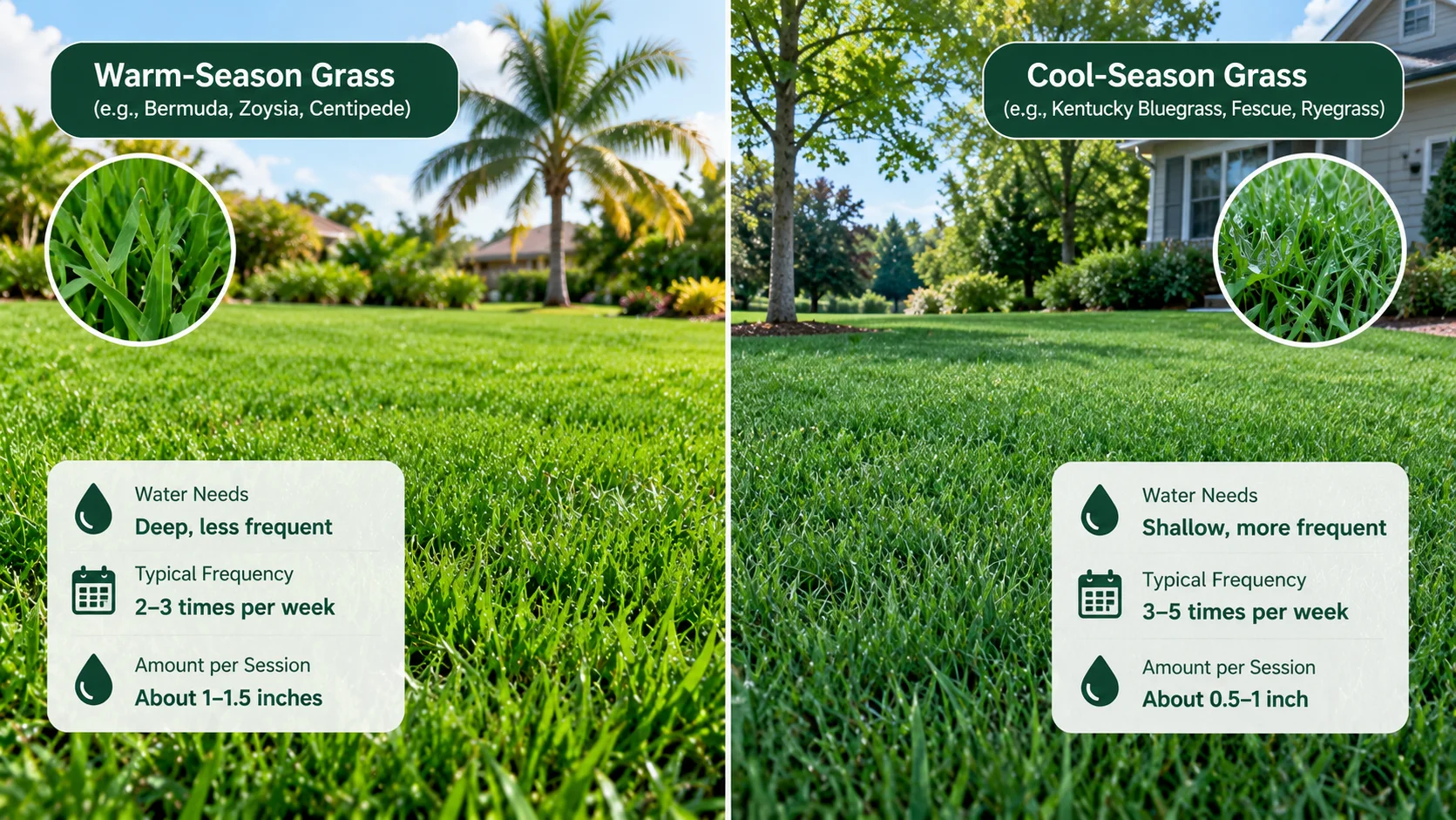
The grass type water needs calculator compares species for your yard, and this article shows the numbers behind it. The short version, that warm-season grass is the thrifty one, is true but incomplete, because the gap shifts with the month, the climate and how green you want the lawn to stay.
Below you will find the crop coefficients, weekly totals in inches and gallons, how often to water each type, a side-by-side worked example in minutes, and what each grass can survive on in a drought.
Key takeaways
- Weekly use = ETo × Kc. Kc is 0.8 for cool-season grasses and 0.6 for warm-season grasses, so warm-season lawns use about 25% less.
- At 0.2 inch of daily ET, a cool-season lawn needs 1.12 inches (28 mm) a week and a warm-season lawn 0.84 inch (21 mm), a difference of about 870 gallons per 5,000 sq ft.
- Warm-season lawns usually need watering 1 or 2 times a week. Cool-season lawns need about 3 waterings a week in summer.
- The gap is widest in spring and fall: in California data, warm-season grass uses 31% less in April and 28% less in October.
- To survive a drought, cool-season grass needs about 60% of reference ET and warm-season grass about 40%.
Why do cool-season grasses use more water?
Turfgrasses split into two groups by climate. Cool-season grasses grow in temperate climates, and warm-season grasses are adapted to tropical and subtropical ones.5 UC lists tall fescue, other fescues, ryegrasses and Kentucky bluegrass as cool-season, and Bermuda, zoysia and St. Augustine as warm-season.4
Most cool-season grasses are higher water users. Typical daily ET runs 3 to 8 mm (0.12 to 0.31 inch) for cool-season grasses and 2 to 5 mm (0.08 to 0.20 inch) for warm-season grasses.5 The ranges overlap, which is why a thirsty warm-season lawn in full sun can out-drink a cool-season lawn in a mild coastal summer. Climate, sun and mowing height move both numbers.
Roots explain the schedule difference. Warm-season grasses have extensive root systems that reach deep into the soil, while cool-season roots are not as extensive.3 In arid and semi-arid regions, warm-season grasses also give better turf for less water than cool-season grasses.5
How much less water do warm-season grasses need?
Turf water use is reference evapotranspiration (ETo), the water lost from a well-watered reference grass, multiplied by a crop coefficient (Kc).1 For practical purposes UC sets Kc at 0.8 for cool-season turfgrasses and 0.6 for warm-season turfgrasses on an annual average.2 Since 0.6 ÷ 0.8 = 0.75, the warm-season lawn needs 25% less.
UC also states that warm-season species need about 20% less water than cool-season species during the growing season.2 Use 20 to 25% as the planning range for how much warm-season grass saves. Get local ETo from the reference ET calculator, and adjust the coefficient for species and planting density with the landscape coefficient calculator.
Formula
Weekly plant use = ETo × Kc − effective rain
ETo in inches (mm) per week. Kc is 0.8 for cool-season grass and 0.6 for warm-season grass. One inch over 1,000 sq ft is 623 gallons; 1 mm over 1 m² is 1 liter.
Warm-season vs cool-season grass water needs by climate
The table applies both coefficients to three daily ET levels: 0.1 inch (2.5 mm) for a cool, coastal or northern summer, 0.2 inch (5 mm) for a typical warm US summer and 0.3 inch (8 mm) for a hot, dry inland or desert summer.
Weekly plant water use by grass type and climate
| Climate | Daily ETo | Cool-season, Kc 0.8 (per week; gal per 1,000 sq ft) | Warm-season, Kc 0.6 (per week; gal per 1,000 sq ft) | Warm-season saving per week |
|---|---|---|---|---|
| Cool, coastal or northern summer | 0.1 in (2.5 mm) | 0.56 in (14 mm); 349 gal | 0.42 in (11 mm); 262 gal | 0.14 in (4 mm), 25% |
| Typical warm summer | 0.2 in (5 mm) | 1.12 in (28 mm); 698 gal | 0.84 in (21 mm); 523 gal | 0.28 in (7 mm), 25% |
| Hot, dry inland or desert | 0.3 in (8 mm) | 1.68 in (43 mm); 1,047 gal | 1.26 in (32 mm); 785 gal | 0.42 in (11 mm), 25% |
Planning values from ETo × Kc × 7 days, before rain and before correcting for sprinkler uniformity. The saving is 25% in every row because the coefficient ratio is fixed; field comparisons put it nearer 20% in the growing season.2
Plant use is what the grass consumes, and your sprinklers must apply more than that. For your own numbers, the lawn water requirement calculator starts from local ET, and the inches of water to gallons calculator converts depth to volume for your lawn area.
How often to water warm-season and cool-season lawns
UC advises watering warm-season grasses as few times a week as needed to meet the weekly requirement without runoff, usually 1 or 2 times. For cool-season grasses it advises dividing the weekly minutes into about 3 equal irrigations spaced evenly through the week.3 UC’s landscape water calculators describe it another way: cool-season lawns need irrigation about 2 to 3 times a week in summer, while warm-season lawns do well about every 4 to 10 days, depending on soil water-holding capacity and root depth.4
Cool-season lawn
- About 3 waterings a week in summer, spaced evenly.
- Fewer waterings in cool months, each still wetting the root zone.
- Tall fescue, Kentucky bluegrass, ryegrass.
Warm-season lawn
- 1 or 2 waterings a week, or every 4 to 10 days on deep soil.
- Longer runs, because deep roots can use deeper water.
- Bermuda, zoysia, St. Augustine.
Desert areas, slopes and shallow soils need shorter, more frequent irrigations even for warm-season grass.3 The lawn watering schedule calculator turns a weekly total into days and minutes for your soil and sprinkler type.
Check local watering rules
Many cities limit watering days or hours, especially in drought. Keep the weekly depth from the table and split it across the days you are allowed to water. Local rules override any schedule here.
Worked example: 5,000 sq ft of Bermuda vs tall fescue
Take two identical 5,000 sq ft yards, one in tall fescue and one in Bermuda grass. ETo averages 0.2 inch a day, no rain falls, rotors apply 0.5 inch an hour, and distribution uniformity (DU) is an untested 0.7. Fescue is watered 3 times a week and Bermuda 2 times, following the UC frequencies above.
- Weekly ETo0.2 in/day × 7 = 1.4 in
- Plant use, tall fescue1.4 × 0.8 = 1.12 in
- Plant use, Bermuda1.4 × 0.6 = 0.84 in
- Water to apply, fescue1.12 ÷ 0.7 = 1.6 in
- Water to apply, Bermuda0.84 ÷ 0.7 = 1.2 in
- Per wateringfescue 1.6 ÷ 3 = 0.53 in; Bermuda 1.2 ÷ 2 = 0.6 in
- Minutes per wateringfescue 0.53 ÷ 0.5 × 60 = 64 min; Bermuda 0.6 ÷ 0.5 × 60 = 72 min
- Weekly volumefescue 5,000 × 1.6 × 0.623 ≈ 4,984 gal; Bermuda 5,000 × 1.2 × 0.623 ≈ 3,738 gal
Fescue: 3 × 64 min. Bermuda: 2 × 72 min.
Bermuda uses about 1,246 gallons less a week, 25%. Metric: 1.6 in is 41 mm and 1.2 in is 30 mm a week over 465 m², about 18,900 liters versus 14,150 liters.
Bermuda runs fewer, longer waterings for less total water, which suits its deeper roots. If 72 minutes at 0.5 inch an hour causes runoff, split it into two 36-minute cycles an hour apart with the cycle and soak calculator.
Two inputs in the example are assumptions. Measure the real application rate with the sprinkler precipitation rate calculator, and test uniformity with the distribution uniformity calculator. The how long to water lawn calculator then returns minutes for each zone.
Pick a warm-season or cool-season species and the calculator returns its weekly water need for your climate.
How does the gap change through the year?
The 25% gap is an annual average. UC publishes monthly coefficients for California, and the two grass types diverge sharply in spring and fall and converge in midwinter.2
Monthly crop coefficients for California turfgrass
| Month | Cool-season Kc | Warm-season Kc | Warm-season uses less by |
|---|---|---|---|
| January | 0.61 | 0.61 | 0% |
| April | 1.04 | 0.72 | 31% |
| July | 0.94 | 0.71 | 24% |
| October | 0.75 | 0.54 | 28% |
| Annual average | 0.80 | 0.60 | 25% |
Kc values from UC for California; percentages are 1 − (warm ÷ cool), rounded.2 Use your own local ET and climate rather than these months outside California.
The table shows why a program set in July over-applies later. In October it applies about 25% too much to a cool-season lawn (0.94 against 0.75) and about 31% too much to a warm-season lawn (0.71 against 0.54). Reset the controller monthly, or use the seasonal adjustment calculator to find the percentage for each month.
Which grass survives a drought on less water?
UC reports that tall fescue and other cool-season grasses survive and keep soil covered on about 60% of ETo, with many brown areas, considerable thinning and little growth. Bermuda and other warm-season grasses give a similar minimal result at about 40% of ETo.2
At 1.4 inches of weekly ETo, survival is 0.84 inch (21 mm) for the cool-season lawn and 0.56 inch (14 mm) for the warm-season lawn, against 1.12 and 0.84 inch to keep each one looking good. Survival watering suits a rationing period, not a lawn you want to enjoy, so decide early in the season which standard you are holding.
How to choose between the two for your yard
Climate comes first. Cool-season grasses suit temperate climates and warm-season grasses suit tropical and subtropical ones,5 so the best-adapted species for your region usually wins before water use enters the discussion. Where both grow, the water difference becomes a real deciding factor.
Quantify it for your lawn. The worked example saves about 1,246 gallons (4,720 liters) a week over 5,000 sq ft, so a 20-week summer season saves about 24,900 gallons (94,300 liters). The lawn watering cost calculator turns that volume into a water bill for your rates. For species-level values, check the lawn watering by grass type chart.
Large lawns, athletic fields and commercial turf warrant a design review by a qualified irrigation designer, because uniformity and soil variation can outweigh the coefficient difference.
Frequently asked questions
Do warm-season grasses use less water than cool-season grasses?
Yes. UC puts the practical crop coefficient at 0.8 for cool-season turfgrasses and 0.6 for warm-season ones, so warm-season lawns use about 25% less water on an annual average. Published ET rates tell the same story, at 2 to 5 mm a day for warm-season grasses against 3 to 8 mm for cool-season grasses.
How much water does Bermuda grass need compared with tall fescue?
Bermuda grass needs about 60% of reference ET and tall fescue about 80%. In a week with 1.4 inches of reference ET, Bermuda needs about 0.84 inch (21 mm) and tall fescue about 1.12 inches (28 mm). A sprinkler system with 70% uniformity must apply 1.2 and 1.6 inches to deliver those amounts.
Can you water warm-season grass only once a week?
Often, yes. UC says 1 or 2 times a week is usually enough for warm-season grasses because their deep roots reach deeper water, and its landscape guidance gives about every 4 to 10 days in summer depending on soil and root depth. Sandy or shallow soil, slopes and desert heat call for shorter, more frequent runs.
Can cool-season grass survive on warm-season amounts of water?
Barely. UC reports that tall fescue held at about 60% of reference ET survives with brown patches, thinning and little growth. That equals the warm-season coefficient of 0.6, so a cool-season lawn watered like Bermuda sits at survival level instead of looking good. Bermuda reaches a similar minimal result at about 40%.
Which type of grass is better for a dry climate?
Warm-season grasses, in most cases. In arid and semi-arid regions they produce better turf with less water than cool-season grasses, and they survive on about 40% of reference ET versus 60%. Local watering rules, shade and winter conditions still matter, so confirm which species suit your area before you replace a lawn.
How do I tell which type of grass I have?
Identify the species. UC lists tall fescue, other fescues, ryegrasses and Kentucky bluegrass as cool-season grasses, and Bermuda, zoysia and St. Augustine as warm-season grasses. If you cannot name yours, a local extension office or garden center can match a leaf and growth sample to a species before you pick a coefficient.
Sources
- Allen, R.G., Pereira, L.S., Raes, D. and Smith, M. (1998). Crop Evapotranspiration: Guidelines for Computing Crop Water Requirements. FAO Irrigation and Drainage Paper 56. Food and Agriculture Organization of the United Nations.
- UC Center for Landscape & Urban Horticulture. Turfgrass Crop Coefficients (Kc). University of California Agriculture and Natural Resources.
- UC Statewide IPM Program. How Many Times a Week to Water. The UC Guide to Healthy Lawns. University of California Agriculture and Natural Resources.
- UC Center for Landscape & Urban Horticulture. Landscape Water Requirement Calculators. University of California Agriculture and Natural Resources.
- Huang, B. Turfgrass Water Requirements and Factors Affecting Water Usage. USGA Water Resource Center. United States Golf Association.
Written by Daniel Reeves, PE, CID. Figures in this article were calculated from the cited sources and checked against our lawn watering calculator. Read how we calculate and our editorial policy. Spotted an error? Tell us.