Overwatered Lawn: Signs, Damage, and How to Fix It
An overwatered lawn looks thirsty, so it often gets even more water. This guide shows the signs, the damage and a measured fix, with run-time numbers you can check against your own sprinklers.

By Daniel Reeves, PE, CID
Irrigation Design Engineer
Short answer
An overwatered lawn stays spongy a day after watering, yellows in patches and pulls up easily; if a probe finds wet soil at 6 inches (15 cm), skip the next watering.
A tall fescue lawn in a warm week uses about 1.1 inches (28 mm) and needs about 1.6 inches (41 mm) applied at typical sprinkler uniformity. Water well above that, especially in daily short runs, is the usual cause. Fix it by splitting the right weekly total into about 3 deeper waterings.
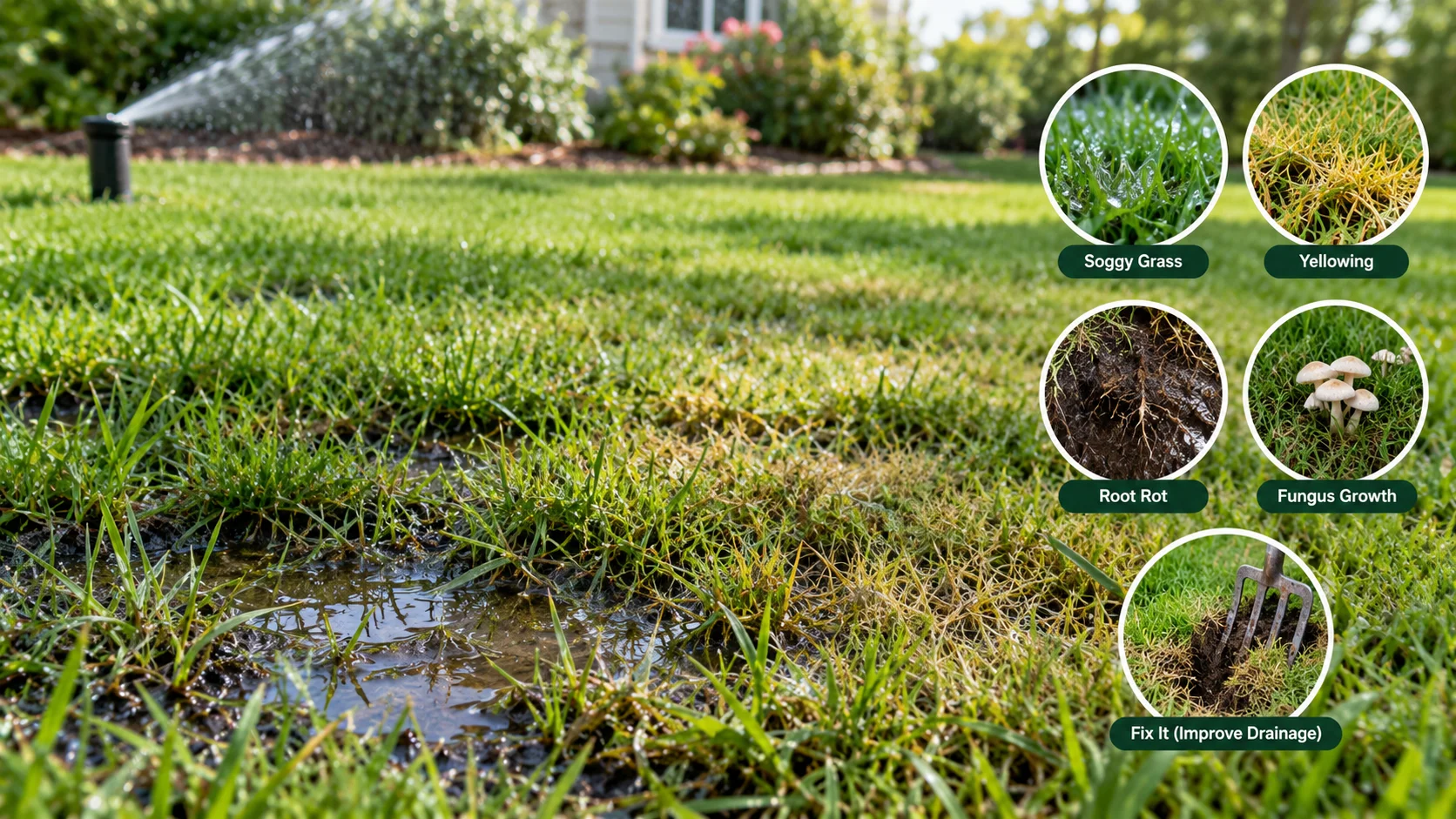
Yellow, thin turf looks like thirst, so people react by turning the water up. That turns a mild problem into dead patches and fungus. The lawn watering schedule calculator shows what your yard needs each week, and this guide shows how to tell you are past it.
Below you will find the signs, how to separate overwatering from drought stress, the causes, the damage, a soil test, the arithmetic behind “too much,” a worked example in inches and minutes, and a step-by-step recovery plan.
Key takeaways
- Soil that is still wet at 6 inches (15 cm) a day after watering means the lawn does not need water yet.
- Yellowing and browning appear in both overwatered and drought-stressed turf, so the soil probe decides, not the color.
- Overwatering causes shallow roots, root rot, fungus and weeds such as crabgrass and dollarweed.
- A tall fescue lawn in a warm week needs about 1.6 inches (41 mm) applied. A daily 15-minute spray cycle applies 2.63 inches (67 mm), which is 64% too much.
- Stop watering until the root zone dries, then water about 3 times a week for cool-season grass or 1 to 2 times for warm-season grass.
- Split any run that causes runoff into two or three cycles, and water in the early morning.
What are the signs of an overwatered lawn?
Extension agents see the same pattern again and again. A Georgia county agent reports that 80 to 90 percent of the plant problems he has handled came down to too much water or poor drainage.3 In turf it shows up as the following.
- Spongy, soggy ground. The soil is still wet when you push a probe 6 inches down, a day or more after the last run.
- Thinning and bare spots. Georgia extension lists general unthriftiness and bare patches among the lawn symptoms of excess moisture.3
- Algae, nostoc and crayfish chimneys. Green slime, jelly-like nostoc and mud towers on the surface all signal soil that stays saturated.3
- Weeds that like wet feet. Dollarweed thrives in soggy turf, and Purdue lists increased crabgrass among the consequences of overwatering.32
- Turf that peels up. When root rot advances, plants pull up easily and the roots look dark and stunted.3
- Runoff. Water running onto the sidewalk or street means the soil cannot take in the rate the sprinkler delivers.4
Is it an overwatered or underwatered lawn?
Both stresses turn grass yellow, tan or brown, which is why guessing wrong is so common. The lawn itself gives different clues, and a probe settles it in a minute.
Too much water
- Soil is wet at 6 inches a day after watering.
- Ground feels spongy and turf lifts like a rug.
- Algae, nostoc or fungal spots appear.
- Browning spreads in rings or patches even though you water often.
Too little water
- Footprints stay visible for several minutes.
- Blades fold or roll and turn blue-gray.
- A screwdriver will not push in more than about 2 inches.
- Dry spots return in the same places and recover fast after a watering.
If the symptoms point both ways, the lawn is probably watered unevenly. Low spots stay soggy while high spots and areas near pavement dry out. Checking distribution uniformity tells you how large the gap is.
What causes an overwatered lawn?
Almost every case traces to the schedule rather than the weather. Purdue notes that a fixed schedule ignores what the grass needs, and recommends changing the program with the turf's condition.2 The usual culprits:
- A summer program left running in fall. Water use falls as ET falls, and a July program in October applies far more than the grass uses. A seasonal adjustment calculator gives the monthly percentage.
- Daily short runs. They keep the surface wet and the roots shallow while the total still adds up to too much.
- Watering on rain days. Rain that soaked in counts toward the week; see the effective rainfall calculator.
- High application rate on slow soil. Clay can absorb only a fraction of an inch per hour. The soil infiltration rate calculator shows what your soil can accept before water runs off.
- Overlapping programs or stuck valves. Two programs, extra start times or a leaking zone valve quietly add water.
- Poor drainage. Low spots and compacted soil stay wet even on a correct schedule.
What damage does overwatering do to grass?
UF/IFAS lists three main problems from improper irrigation: shallow root growth, disease, and leaching or depletion of nutrients.1 Each one feeds the others.
Shallow roots
Frequent light watering wets only the surface, so roots stay near it. Shallow roots reach less water in a dry spell, and the lawn turns brown faster even though it is watered more often.1
Root rot and fungus
Large patch, Pythium root rot and take-all root rot are tied to wet soil from rain or irrigation, and symptoms can appear at any time of year.1 Purdue adds that evening watering can raise disease incidence.2
Weeds and nutrient loss
Wet turf favors crabgrass and dollarweed, and stressed grass struggles to use the nutrients in the soil after overwatering.12 Higher water bills come with all of it.
Caution: brown patches may be disease
Brown or yellow rings in a wet lawn can be one of the fungal diseases above. A county extension office or lab can name the pathogen, but the moisture fix is the same either way, and Georgia extension recommends preventing these problems rather than treating them.3
How do you check whether the soil is too wet?
Test 24 hours after a normal watering, in the wettest spot and an average spot. Push a long screwdriver or soil probe in as far as it goes, or cut a small plug with a spade. Purdue says the soil should be wet to the depth of the deepest roots, about 6 inches for most lawns, and no deeper than the roots need.2
If the tool slides in easily and the soil at the bottom is soggy, the lawn is holding more water than it can use. Repeat daily until the probe meets resistance around 4 to 6 inches (10 to 15 cm). Then you know how long your soil really takes to dry, which beats any calendar rule.
To see what the sprinklers deliver, run a catch-can test and convert the result with the sprinkler precipitation rate calculator.
How much water is too much for a lawn?
Too much means more than the grass uses plus what the sprinklers waste. Grass use is reference evapotranspiration (ETo) times a crop coefficient,5 and UC lists 0.8 for cool-season lawns and 0.6 for warm-season lawns.6 Your lawn water requirement calculator result is the benchmark.
Formula
Applied per week = precipitation rate × (minutes per run ÷ 60) × runs per week
Compare it with grass use ÷ DU, where grass use = weekly ETo × Kc and DU is distribution uniformity as a decimal. Weekly gallons = square feet × inches × 0.623.
Weekly water applied by common schedules versus a 1.6 in (41 mm) need
| Schedule | Rate (in/hr) | Weekly total | Share of need |
|---|---|---|---|
| Spray heads, 15 min, daily | 1.5 (38 mm/hr) | 2.63 in (67 mm) | 164% |
| Spray heads, 21 min, 3 days | 1.5 (38 mm/hr) | 1.58 in (40 mm) | 98% |
| Rotors, 30 min, daily | 0.5 (13 mm/hr) | 1.75 in (44 mm) | 109% |
| Rotors, 64 min, 3 days | 0.5 (13 mm/hr) | 1.60 in (41 mm) | 100% |
Example rates, not your sprinklers; measure yours. The 1.6 in need is a cool-season lawn in a warm week at 0.7 DU, worked out below. Rotors on a daily 30-minute program look close on total, but seven wettings keep the surface damp and the roots shallow.
Worked example: a daily 15-minute spray program
Take a 5,000 sq ft (465 m²) tall fescue lawn. Spray heads apply 1.5 in/hr and run 15 minutes every day. ETo averages 0.2 inch a day, no rain falls, and DU is an untested 0.7.
- Weekly ETo0.2 in/day × 7 = 1.4 in
- Grass use1.4 × 0.8 = 1.12 in
- Need applied at DU 0.71.12 ÷ 0.7 = 1.6 in
- Actually applied1.5 × (15 ÷ 60) × 7 = 2.625 in
- Over the need2.625 ÷ 1.6 = 1.64, so 64% over
- Excess depth2.625 − 1.6 = 1.025 in
- Excess volume per week5,000 × 1.025 × 0.623 ≈ 3,190 gal
- Corrected run time(1.6 ÷ 3) ÷ 1.5 × 60 = 21 min, 3 days a week
Replace 7 × 15 min with 3 × 21 min: 40% less run time
Metric: 67 mm applied against 41 mm needed, about 31,000 liters against 18,900 liters a week, so roughly 12,100 liters wasted. Runs of 21 minutes apply 0.53 inch (13 mm); if that causes runoff, split each into two cycles.
Your own inputs change the result. The lawn water usage calculator turns inches into gallons for your lawn size, and the how long to water lawn calculator converts a target depth to minutes per zone.
Enter grass, soil, sprinkler type and weather. The calculator returns waterings per week and minutes per zone.
How do you fix an overwatered lawn?
Recovery is mostly subtraction. Work through these in order.
- Stop watering. Turn the controller off and probe the soil each day. Restart only when the lawn shows stress, such as lingering footprints, and the soil at 6 inches is no longer soggy.
- Find the cause. Look for duplicate programs, extra start times, a leaking valve or a summer program still running in cool weather. Fix drainage in low spots.
- Reset to fewer, deeper waterings. UC advises about 3 equal waterings a week for cool-season grass and 1 or 2 for warm-season grass, with fewer in cool months.4 Compute the depth with the irrigation interval calculator.
- Cap each run at the runoff point. UC recommends finding the longest run before runoff begins and not exceeding it.4 The cycle and soak calculator splits long runs into short cycles.
- Water in the early morning. Purdue puts the ideal window in the early hours and links evening watering to disease.2
- Replace dead turf last. Reseed or sod patches whose roots have rotted only after the soil has dried and the schedule is corrected.
How do you keep a lawn from being overwatered again?
Make the schedule follow the grass. Adjust the program monthly, skip a watering after rain that delivers about as much as one run, and recheck the probe whenever the weather changes. Warm-season and cool-season turf use different amounts, so confirm yours in the lawn watering by grass type chart.
If your city restricts watering days, keep the weekly depth and split it across the days allowed; local rules override this guide. Large or commercial turf with several zones and slopes is worth a professional audit, because uneven coverage hides in the averages.
Frequently asked questions
Can an overwatered lawn recover?
Often yes, if the roots are still alive. Stop watering until the soil at 6 inches (15 cm) is no longer soggy, then resume a deep, infrequent schedule for your grass. Rotted roots and dead patches pull up easily and need reseeding or sod once the soil dries. Extension agents stress prevention over cure.
Does yellow grass mean too much water or too little?
It can mean either, because both stresses discolor turf. Check the soil, not the color. Soggy soil at 6 inches (15 cm), spongy footing and runoff point to too much water. Footprints that linger for minutes, blades that roll up and a screwdriver that will not push in point to too little.
Can you overwater a new lawn?
Yes. Purdue extension calls overwatering sod a common mistake and advises moistening a seed bed to 1 to 2 inches without saturating it. New lawns do need frequent light watering, but pooled water, mushy ground or runoff means each run is too long. Shorten the runs and let the surface drain between them.
Does heavy rain count as overwatering?
It can. A storm that soaks the root zone does the same work as a watering, so irrigating on top of it adds water the soil cannot hold. Turn the controller off or skip the next scheduled day after a soaking rain, then probe the soil before restarting the program.
How do I know if my sprinklers are causing it?
Run a catch-can test: set several straight-sided cans across a zone, run it for 15 minutes and measure the depth. 0.375 inch in 15 minutes is 1.5 inches per hour. Multiply that rate by the weekly minutes your controller runs, then compare the total with what the grass actually uses.
Sources
- Trenholm, L. and Unruh, J.B. Improving Turfgrass Health: Proper Irrigation Techniques. UF/IFAS Extension, University of Florida.
- Throssell, C. and Reicher, Z. Irrigation Practices for Homelawns. AY-7-W. Purdue University Extension.
- UGA Cooperative Extension, Camden County. Overwatering: The Signs and Symptoms. University of Georgia.
- UC Statewide IPM Program. How Many Times a Week to Water. The UC Guide to Healthy Lawns. University of California Agriculture and Natural Resources.
- Allen, R.G., Pereira, L.S., Raes, D. and Smith, M. (1998). Crop Evapotranspiration: Guidelines for Computing Crop Water Requirements. FAO Irrigation and Drainage Paper 56. Food and Agriculture Organization of the United Nations.
- UC Center for Landscape & Urban Horticulture. Plant Factor or Crop Coefficient: What's the Difference? University of California Agriculture and Natural Resources. Values adapted from ANSI/ASABE S623.
Written by Daniel Reeves, PE, CID. Figures in this article were calculated from the cited sources and checked against our lawn watering calculator. Read how we calculate and our editorial policy. Spotted an error? Tell us.