How Much Water Does Watering the Lawn Actually Use?
A lawn's water use comes down to area, depth and efficiency. This guide gives the gallons for each inch, week and sprinkler run, then shows how to check your own meter against what the grass needs.

By Daniel Reeves, PE, CID
Irrigation Design Engineer
Short answer
Each inch of water on a lawn takes 0.623 gallon per square foot, so a typical 1 to 1.5 inches a week uses 623 to 935 gallons per 1,000 square feet (2,360 to 3,540 liters).23
How much water watering the lawn uses at your meter is higher, because sprinklers lose water to wind, runoff and uneven coverage. A well-run system needs about a third more than the grass uses, and a poorly run one can use two to two and a half times as much.62
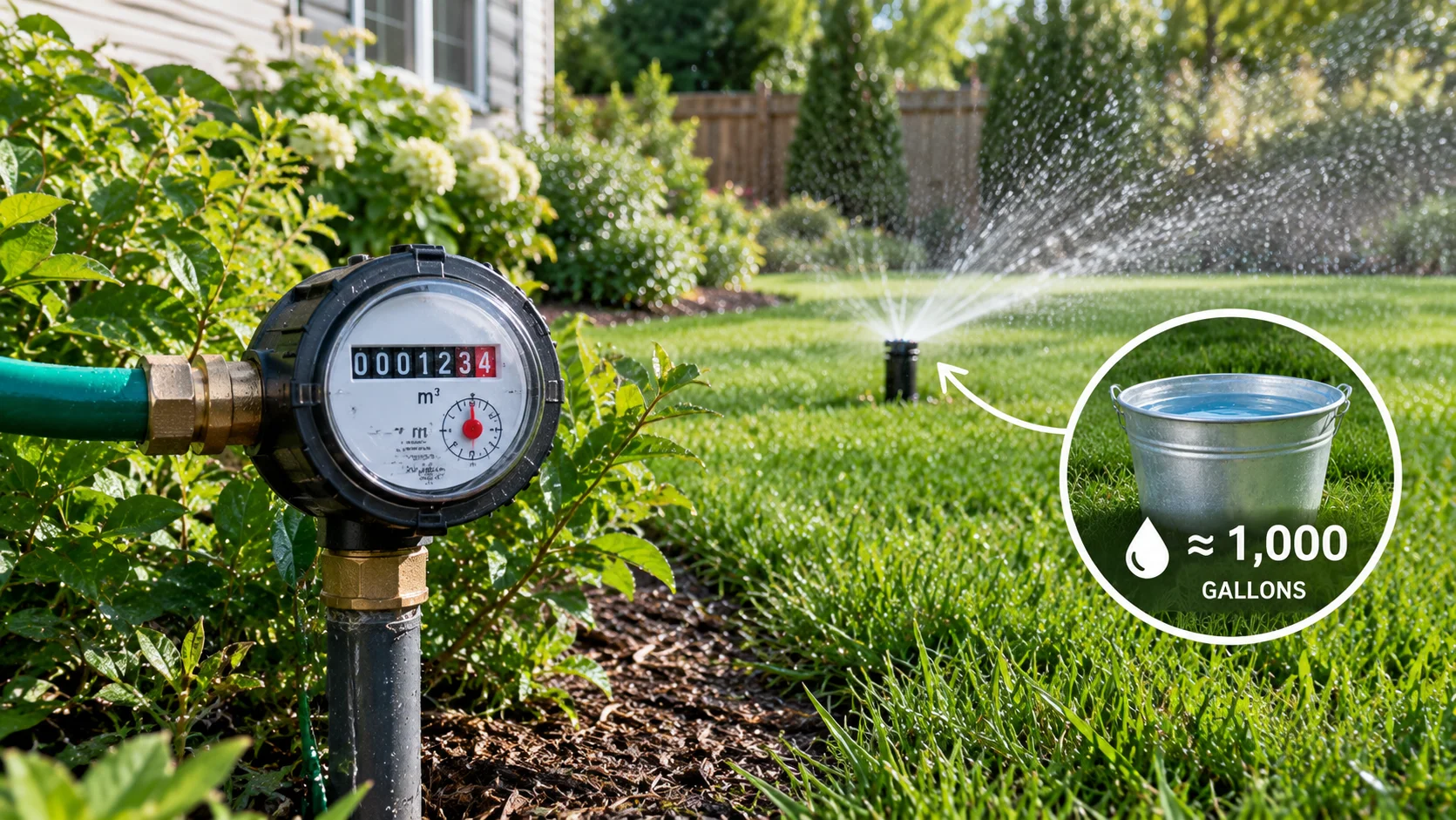
"An inch a week" is a depth, and your water bill is in gallons. Turning one into the other takes your lawn's area and the share of water that actually reaches the roots. The lawn water usage calculator makes that conversion for any lawn size, depth and system efficiency.
Below you will find the gallons for every inch, week and sprinkler run, the reason the meter reads more than the grass uses, and a worked example you can repeat with your own numbers.
Key takeaways
- One inch of water on one square foot is 0.623 gallon, so 1,000 sq ft takes 623 gallons (2,360 liters) per inch.
- Most lawns need about 1 to 1.5 inches a week, or 623 to 935 gallons per 1,000 sq ft (2,360 to 3,540 liters), before rain.
- Grass use is weekly ETo × 0.8 for cool-season lawns or × 0.6 for warm-season lawns, so warm-season grass uses a quarter less.
- Divide grass use by system efficiency to estimate the meter reading: 0.75 adds a third, and 0.4 to 0.5 doubles it or more.
- A run uses flow (gpm) × minutes. A 5-gallon bucket that fills in 30 seconds means 10 gpm, or 300 gallons in 30 minutes.
- Outdoor use is more than 30 percent of household water on average and up to 60 percent in arid regions.
How many gallons is one inch of water on a lawn?
The conversion is fixed by geometry. One inch of water over one square foot is one-twelfth of a cubic foot, and a cubic foot holds 7.48 gallons, which gives 0.623 gallon.2 In metric it is simpler still: 1 millimeter of depth over 1 square meter is exactly 1 liter, so 1 inch (25.4 mm) is 25.4 liters per square meter.
Formula
Gallons = lawn area (sq ft) × depth (in) × 0.623
Metric: liters = area (m²) × depth (mm). Useful conversions: 1 sq ft = 0.0929 m², 1 in = 25.4 mm, 1 gallon = 3.785 liters.
The inches of water to gallons calculator applies the formula for any area and depth. The table shows the results for four common lawn sizes.
Gallons used per watering by lawn area and depth applied
| Lawn area | 0.5 in (13 mm) | 1 in (25 mm) | 1.5 in (38 mm) |
|---|---|---|---|
| 1,000 sq ft (93 m²) | 312 gal (1,180 L) | 623 gal (2,360 L) | 935 gal (3,540 L) |
| 2,500 sq ft (232 m²) | 779 gal (2,950 L) | 1,558 gal (5,900 L) | 2,336 gal (8,840 L) |
| 5,000 sq ft (465 m²) | 1,558 gal (5,900 L) | 3,115 gal (11,790 L) | 4,673 gal (17,690 L) |
| 10,000 sq ft (929 m²) | 3,115 gal (11,790 L) | 6,230 gal (23,580 L) | 9,345 gal (35,370 L) |
Net water reaching the lawn, assuming no losses. Liters use 1 gallon = 3.785 liters, rounded to the nearest 10.
UF/IFAS used the same arithmetic for an average Florida home. A half-inch run over 3,179 sq ft of irrigated lawn comes to 991 gallons (about 3,750 liters), even if every drop lands where it should.2
How much water does watering the lawn use per week?
UC's turf guide says most lawns need about 1 to 1.5 inches of water a week to keep the root system moist, and that roots of established lawns reach 6 to 8 inches.3 On 1,000 sq ft, that is 623 to 935 gallons (2,360 to 3,540 liters).
Your own figure comes from evapotranspiration (ET), the water a lawn loses through its leaves and the soil surface. Engineers measure it against a reference grass as ETo, then scale it with a plant factor: 0.8 for cool-season lawns such as tall fescue and Kentucky bluegrass, and 0.6 for warm-season lawns such as Bermuda, zoysia and St. Augustine.5 At the same ETo, a warm-season lawn therefore uses 25 percent less water (0.6 ÷ 0.8 = 0.75).
Weekly net water use per 1,000 sq ft by weekly ETo and grass type
| Weekly ETo | Cool-season lawn (× 0.8) | Warm-season lawn (× 0.6) |
|---|---|---|
| 1.0 in (25 mm) | 0.8 in (20 mm) = 498 gal (1,890 L) | 0.6 in (15 mm) = 374 gal (1,410 L) |
| 1.5 in (38 mm) | 1.2 in (30 mm) = 748 gal (2,830 L) | 0.9 in (23 mm) = 561 gal (2,120 L) |
| 2.0 in (51 mm) | 1.6 in (41 mm) = 997 gal (3,770 L) | 1.2 in (30 mm) = 748 gal (2,830 L) |
Weekly ETo of 1.0, 1.5 and 2.0 in equals about 0.14, 0.21 and 0.29 in a day (3.6, 5.4 and 7.3 mm). Get your local figure from a weather station or your state's ET network. Values are net of rain and system losses.
Rain that soaks in counts toward these totals, so subtract it before you irrigate. The lawn water requirement calculator returns the weekly need from local ET and grass type, and the lawn watering by grass type chart compares species side by side.
How many gallons does one sprinkler or hose run use?
A run's volume does not depend on the lawn. It depends only on how fast water leaves the sprinkler and how long it runs.
Formula
Gallons per run = flow (gal/min) × run time (min)
Depth applied (in) = gallons ÷ (area in sq ft × 0.623). Metric: liters = L/min × minutes.
Flow is set by the nozzle and your water pressure, not by the hose. For a hose-end sprinkler, time how long a 5-gallon bucket takes to fill with the same faucet setting you use for watering, then divide 300 by the seconds. The bucket test calculator does the arithmetic, and the sprinkler GPM calculator estimates flow from nozzle sizes.
Water used by one sprinkler at common flow rates
| 5-gallon bucket fill time | Flow | 30-minute run | 60-minute run | Depth in 30 min on 1,000 sq ft |
|---|---|---|---|---|
| 30 seconds | 10 gpm (38 L/min) | 300 gal (1,140 L) | 600 gal (2,270 L) | 0.48 in (12 mm) |
| 40 seconds | 7.5 gpm (28 L/min) | 225 gal (850 L) | 450 gal (1,700 L) | 0.36 in (9 mm) |
| 60 seconds | 5 gpm (19 L/min) | 150 gal (570 L) | 300 gal (1,140 L) | 0.24 in (6 mm) |
| 75 seconds | 4 gpm (15 L/min) | 120 gal (450 L) | 240 gal (910 L) | 0.19 in (5 mm) |
One sprinkler running the whole time. Depth assumes every gallon lands on 1,000 sq ft of lawn. Flow through a sprinkler is usually lower than from an open hose, so measure at the sprinkler if you can.
For an in-ground system, add the flow of every head on a zone to get the zone's gpm, then multiply by the zone's minutes. Hose users can turn a target depth into minutes with the lawn hose watering time calculator.
Why does the meter read more than the lawn uses?
Grass use is the net need. The meter records the gross volume you pump, and the gap between them is irrigation efficiency, the share of applied water the lawn actually uses.
Formula
Water pumped = lawn water need ÷ irrigation efficiency
Efficiency as a decimal: 1.0 means no losses, 0.75 is a well-run sprinkler system, 0.5 means half the water is lost.
California's water-efficient landscape ordinance assumes 0.75 for overhead spray systems.6 Measured results are often worse. UF/IFAS reports typical irrigation system efficiency of 40 to 50 percent,2 and EPA estimates that as much as 50 percent of outdoor water is lost to wind, evaporation and runoff from inefficient methods and systems.1
Water pumped to give 1,000 sq ft a net 1.2 inches a week, by efficiency
| Efficiency | Depth pumped per week | Gallons per week | Multiple of grass need |
|---|---|---|---|
| 1.0 (no losses) | 1.2 in (30 mm) | 748 gal (2,830 L) | 1.0× |
| 0.75 (well-run sprays) | 1.6 in (41 mm) | 997 gal (3,770 L) | 1.33× |
| 0.5 | 2.4 in (61 mm) | 1,495 gal (5,660 L) | 2.0× |
| 0.4 | 3.0 in (76 mm) | 1,869 gal (7,070 L) | 2.5× |
The 1.2-inch need is a cool-season lawn at 1.5 in weekly ETo, from the second table. Efficiency below 0.75 is not a design target; it shows what poorly run systems can reach.
Uneven coverage drives much of the loss. When one corner gets half as much water as the rest, you run the whole zone longer so that corner gets enough, and every extra minute over the rest of the lawn is wasted. The distribution uniformity calculator scores your system from catch-can readings.
How much of a home's water goes to the lawn?
EPA says outdoor use accounts for more than 30 percent of household water on average, and as much as 60 percent in arid regions.1 UF/IFAS found that the highest-using homes in some Florida counties spend 60 to 70 percent of their water on irrigation.2
One run makes the scale clear. UF/IFAS compared the 991-gallon run for an average Florida lawn with indoor uses: it equals 6.6 hours in the shower with a standard 2.5 gpm showerhead, or 18 loads in a traditional clothes washer.2
Worked example: a 4,000 sq ft Bermuda lawn in July
Take a 4,000 sq ft (372 m²) Bermuda lawn in a hot July week. ETo averages 0.25 inch a day, 0.25 inch of rain soaks in, and the overhead sprinklers run at the 0.75 planning efficiency. The effective rainfall calculator shows how much of a real storm counts as that 0.25 inch.
- Weekly ETo0.25 in/day × 7 = 1.75 in
- Grass water use1.75 × 0.6 = 1.05 in
- Effective rain−0.25 in
- Net irrigation need1.05 − 0.25 = 0.80 in
- Depth to pump0.80 ÷ 0.75 = 1.067 in
- Weekly volume4,000 × 1.067 × 0.623 ≈ 2,660 gal
- Per watering (2 a week)2,660 ÷ 2 = 1,330 gal
- 30-day month2,660 × 30 ÷ 7 = 11,400 gal
- Cost at an example $5 per 1,000 gal11.4 × $5 = $57
About 2,660 gallons a week, 11,400 gallons in a 30-day month
Metric: 1.75 in is 44 mm of ETo, the net need is 20 mm, and 27 mm is pumped each week. That is about 10,060 liters a week and 43,100 liters in 30 days over 372 m². The $5 rate is an example; use the rate on your bill.
Efficiency decides the result. At 0.4, the same lawn pumps 0.80 ÷ 0.4 = 2 inches a week, or 4,000 × 2 × 0.623 = 4,984 gallons, about 1.9 times the 2,660 gallons at 0.75. The lawn watering cost calculator turns your own gallons into dollars.
How to measure your own lawn's water use
Two quick checks tell you what you apply and what you pay for. Do them on a calm morning with the other water in the house off.
- Read the meter. Note the reading before and after one full run. The difference in gallons is the run volume. If the low-flow dial keeps moving with every fixture off, you have a leak to fix first.
- Run a can test. Set out at least 6 straight-sided cans across the zone, run it for 15 minutes, and average the depths. Multiply the average by 4 to get inches per hour; a quarter inch in 15 minutes is 1.0 in/hr. The catch-can test calculator also returns uniformity.
- Convert the depth. Multiply the depth applied by the zone's area and by 0.623, then compare with the meter. A meter that reads far above the can result points to leaks, overspray, runoff or heads watering pavement.
Enter lawn area, depth and system efficiency. The calculator returns gallons per watering, per week and per month.
Where does lawn water get wasted, and how do you cut it?
Losses and scheduling mistakes add up faster than a lawn's real need does.
Where the extra goes
What cuts it fastest
Weather changes the need every month, so a program set in July overwaters in October. The seasonal adjustment calculator gives the percentage to use each month, and the smart controller savings calculator estimates what a weather-based controller would save you.
Check local rules first
Many utilities limit watering days or hours, and those limits override any schedule here. Large turf areas, commercial sites and agricultural systems should be designed or audited by a certified professional.
Frequently asked questions
How many gallons does a sprinkler use per hour?
Multiply its flow in gallons per minute by 60. A sprinkler running at 5 gallons per minute uses 300 gallons an hour (1,140 liters), and one at 10 gallons per minute uses 600 (2,270 liters). Time how long a 5-gallon bucket takes to fill and divide 300 by the seconds to find your flow.
How many gallons does it take to put an inch of water on an acre?
An acre is 43,560 square feet. At the exact factor of 0.62337 gallon per square foot per inch, an acre-inch is about 27,150 gallons (102,800 liters). A lawn getting 1.5 inches in a week therefore takes about 40,700 gallons per acre, before any loss to wind, runoff or uneven coverage.
How does watering the lawn compare with indoor water use?
UF/IFAS worked out that one half-inch run on an average Florida home irrigating 3,179 square feet uses 991 gallons. That equals about 6.6 hours in the shower with a standard showerhead or 18 loads in a traditional washing machine. EPA says outdoor use averages more than 30 percent of household water, and up to 60 percent in arid regions.
Does watering every day use more water than watering twice a week?
Not if the weekly depth is the same, because gallons depend on total inches applied. The bigger cost is to the lawn. UC advises deep, infrequent watering that wets the top 6 to 8 inches of soil, where the roots of established lawns grow, and puts most lawns at about 1 to 1.5 inches a week.
How much water can a smart irrigation controller save?
EPA says replacing a clock-based controller with a WaterSense labeled irrigation controller can cut an average home's irrigation water use by up to 30 percent and save up to 15,000 gallons (56,800 liters) a year. Savings depend on how far the old schedule overshot the lawn's real need, so a well-tuned timer gains less.
How much water does a lawn use in a month?
A 1,000-square-foot lawn getting 1 to 1.5 inches a week uses about 2,670 to 4,000 gallons over a 30-day month (10,100 to 15,100 liters), before rain and before system losses. Multiply by your lawn area divided by 1,000, then divide by your system's efficiency to estimate the meter reading.
Sources
- U.S. Environmental Protection Agency. WaterSense Statistics and Facts. EPA WaterSense program.
- Taylor, N., Robb Price, K. and Spatz, B. (2023). How much water am I using to irrigate my yard? Publication AE585. UF/IFAS Extension, University of Florida.
- UC Statewide IPM Program. Irrigation scheduling. The UC Guide to Healthy Lawns. University of California Agriculture and Natural Resources.
- UC Statewide IPM Program. When to water. The UC Guide to Healthy Lawns. University of California Agriculture and Natural Resources.
- UC Center for Landscape & Urban Horticulture. Plant Factor or Crop Coefficient: What's the Difference? University of California Agriculture and Natural Resources.
- California Department of Water Resources. Model Water Efficient Landscape Ordinance (MWELO): text and appendices. Irrigation efficiency values for estimated total water use.
Written by Daniel Reeves, PE, CID. Figures in this article were calculated from the cited sources and checked against our lawn watering calculator. Read how we calculate and our editorial policy. Spotted an error? Tell us.