Hand Watering vs Hose-End Sprinklers vs In-Ground Systems
Each method applies water at a different rate and with different evenness, and those two numbers set your run time and your gallons. This guide puts published figures side by side and shows how to convert them to minutes.

By Daniel Reeves, PE, CID
Irrigation Design Engineer
Short answer
Well-designed in-ground rotors deliver the most even water, hose-end sprinklers need the least equipment, and hand watering takes about 52 minutes per 1,000 sq ft (93 m²) for 0.5 inch at 6 gpm.
Hand watering vs hose-end sprinklers is a question of labor and uniformity: moved sprinklers tested near a low-quarter DU of 0.30, while the average residential in-ground system tested at 0.45.2 Measure your own flow and application rate before you set any run time.
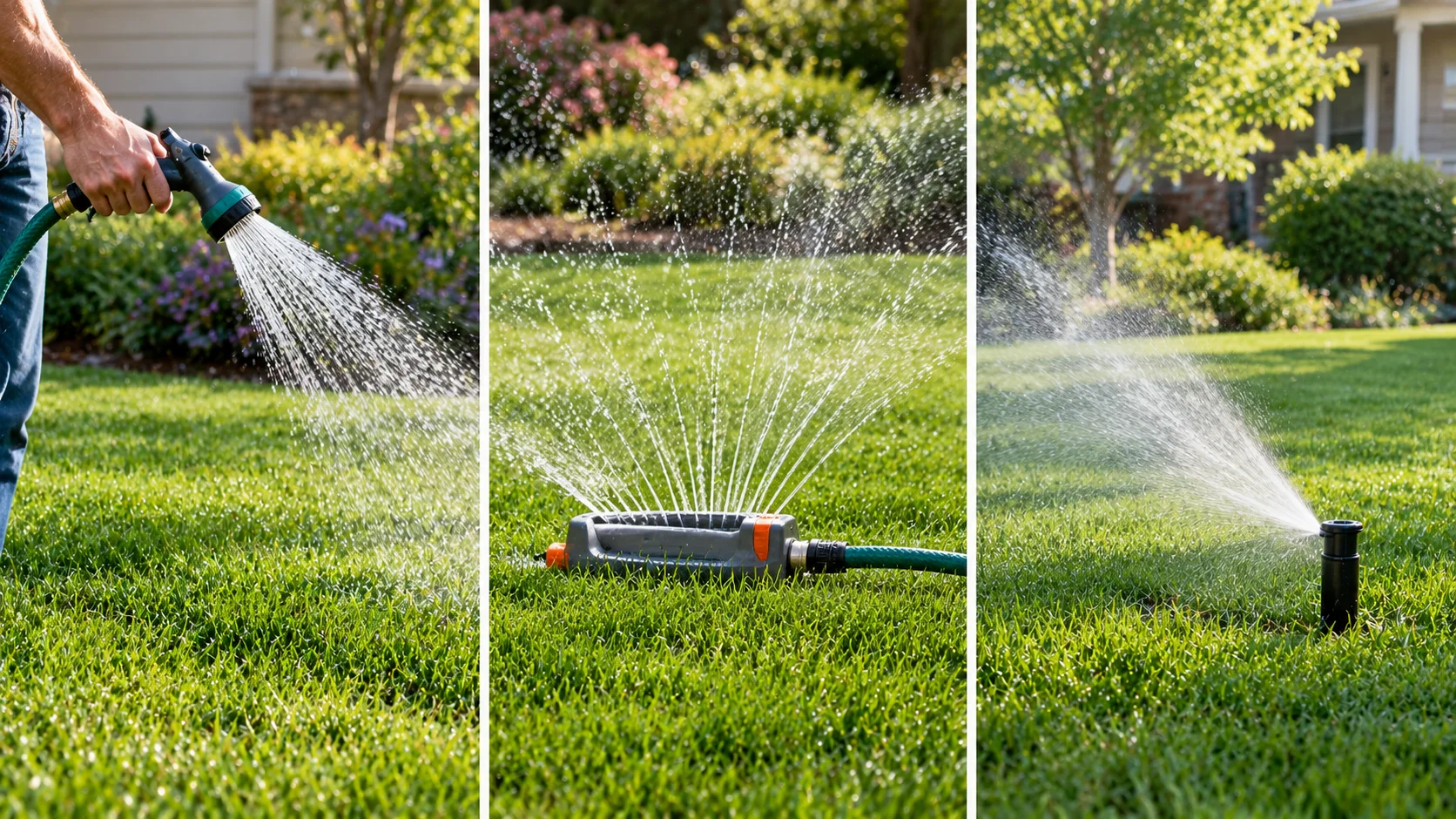
Convenience is the usual way to compare watering methods, but it leaves out the two numbers an irrigation engineer checks first: how fast the method applies water and how evenly. Those set your run time and your gallons, and the lawn hose watering time calculator turns a measured hose flow into minutes for any lawn size.
This article puts hose watering, hose-end sprinklers and in-ground systems side by side with published application rates and uniformity tests, shows the minutes and gallons each needs on the same lawn, and ends with the field tests that tell you which numbers apply to your yard.
Key takeaways
- In-ground rotors apply 0.3 to 0.7 in/hr (8 to 18 mm/hr) and fixed sprays 1.4 to 2.0 in/hr (36 to 51 mm/hr), so the same minutes deliver very different depths.
- Hand watering takes about 52 minutes per 1,000 sq ft to apply 0.5 inch at 6 gpm, and about 4 hours 20 minutes for 5,000 sq ft.
- Published low-quarter DU is about 0.30 for moved sprinklers, 0.41 for in-ground sprays and 0.49 for in-ground rotors. NMSU rates a rotor zone “good” at 0.65.
- Low uniformity costs water: watering the driest quarter of a 2,500 sq ft lawn to 0.5 inch takes about 2,600 gallons at DU 0.30 and about 1,200 gallons at DU 0.65.
- Measure flow with a bucket and application rate with catch cans; box ratings and hose-size guesses are not measurements.
- Split any run that causes puddles into cycles an hour apart.
How do hand watering, hose-end sprinklers and in-ground systems differ?
The three methods differ in who controls the flow and how the water is spread. With a hose and nozzle you steer the stream. A hose-end sprinkler spreads the hose flow over a fixed pattern that you move by hand. An in-ground system spreads zone flow through spray heads or rotors on a controller.
Application rate and published uniformity by watering method
| Method | Application rate | Low-quarter DU (published) | Your part |
|---|---|---|---|
| Hand watering | Hose flow ÷ area you wet; set by how fast you sweep | No standard figure; depends on technique | Hold the hose the whole time |
| Hose-end sprinkler | Hose flow ÷ pattern area; measure with catch cans | About 0.30 (Utah residential lawns)2 | Start, move and shut off |
| In-ground spray heads | 1.4–2.0 in/hr (36–51 mm/hr)3 | 0.41 (Florida residential average)2 | Program a controller |
| In-ground rotors | 0.3–0.7 in/hr (8–18 mm/hr)3 | 0.49 (Florida residential average)2 | Program a controller |
DU figures come from different studies, regions and test methods, so compare them by rank, not by the second decimal.2
Application rate sets how long you run. Distribution uniformity (DU) sets how much extra water you need to keep the driest spots green. DU is the average of the driest quarter of catch cans divided by the average of all cans, so 1.00 is perfect and lower numbers are worse.1
How long does hand watering take?
Hand watering has no spray pattern to correct, only a flow to measure. Time how long your hose takes to fill a 5-gallon bucket and divide: Alabama Extension’s example fills 5 gallons in 0.37 minute, which is 13.5 gpm.5 Test with the hose and nozzle you actually use, because a hose 25 feet or longer restricts flow and other demands on the same supply lower it further.5 The bucket test calculator does the division.
Formula
Minutes = area (sq ft) × depth (in) × 0.623 ÷ flow (gpm)
0.623 is gallons per square foot per inch of depth. Metric: minutes = area (m²) × depth (mm) ÷ flow (L/min), because 1 mm over 1 m² is 1 liter.
Hand-watering time to apply 0.5 inch (12.7 mm) of water
| Lawn area | Water needed | Minutes at 6 gpm (23 L/min) | Minutes at 10 gpm (38 L/min) |
|---|---|---|---|
| 1,000 sq ft (93 m²) | 312 gal (1,180 L) | 52 min | 31 min |
| 2,500 sq ft (232 m²) | 779 gal (2,950 L) | 130 min | 78 min |
| 5,000 sq ft (465 m²) | 1,558 gal (5,900 L) | 260 min | 156 min |
Water needed = area × 0.5 × 0.623. No uniformity loss is applied, so the table assumes every gallon lands where you aim it. Minutes are rounded.
Five thousand square feet is more than four hours with a hose in your hand at 6 gpm. That is the practical limit of hand watering: beds, containers, new plantings and small lawns. To convert any depth into gallons first, use the inches of water to gallons calculator.
Hand watering vs hose-end sprinklers: which is better for a lawn?
A hose-end sprinkler takes over the standing but gives up control of the stream. Its application rate is the hose flow spread over the pattern: rate (in/hr) = gpm × 96.3 ÷ pattern area (sq ft). An oscillating sprinkler passing 6 gpm over a 40 × 30 ft (12 × 9 m) pattern averages 6 × 96.3 ÷ 1,200 = 0.48 in/hr (12 mm/hr) if the pattern were even, which it rarely is. The hose-end sprinkler output calculator runs this for your flow and pattern size.
Uniformity is the weak point. The closest published comparison is a Utah study of residential lawns, summarized by Baum and colleagues, which found a low-quarter DU of about 0.30 for hand-moved sprinklers against 0.37 for solid-set systems.2 UC Cooperative Extension advises using several sprinkler positions with overlapping patterns and checking for leaks between the faucet, hose and sprinkler.6 NMSU tells auditors to test only in winds of 5 mph or less, a reminder that wind reshapes any pattern.1
Against hand watering, a sprinkler wins on time and loses on aim. A hose lets you put water on a dry patch exactly, but only while you stand there. A practical split is a sprinkler for the bulk of the lawn and the hose for beds and spots.
How uniform are in-ground sprinkler systems in practice?
On paper an in-ground system is the most uniform of the three. In the field it often falls short. Baum, Dukes and Miller tested 25 residential systems in central Florida with 100 to 500 catch cans per lawn and measured an average low-quarter DU of 0.45, with rotor zones at 0.49 and spray zones at 0.41.2 Even new heads on a test plot under ideal conditions averaged only 0.55.2
A California field assessment cited in the same paper found residential turf systems averaging 0.49, and more than 40% of the systems tested fell below 0.40. The causes, in order of frequency, were faulty or poorly maintained heads, mixed spray and rotor heads in one zone, large pressure swings and poor head-to-head coverage.2
The advantage of an in-ground system over a moved sprinkler comes from design and upkeep, not from the pipe in the ground. Check that every head in a zone puts out the same rate with the matched precipitation calculator, and look up typical rates by head type in the sprinkler precipitation rate chart. Rate matters as much as uniformity: sprays at 1.4 to 2.0 in/hr can outrun the soil within minutes, while rotors at 0.3 to 0.7 in/hr usually can run longer before water pools.3
What distribution uniformity counts as good?
NMSU rates sprinkler uniformity on a five-step scale and says a lawn system should rate at least “good.”1 The thresholds differ by head type, because rotors can reach higher DU than fixed sprays.
Lowest-quarter DU ratings for turf sprinklers (NMSU)
| Rating | Fixed spray (DU) | Rotor (DU) |
|---|---|---|
| Excellent | 0.75 | 0.80 |
| Very good | 0.65 | 0.70 |
| Good | 0.55 | 0.65 |
| Fair | 0.50 | 0.60 |
| Poor | 0.40 | 0.50 |
Values are the rating thresholds as NMSU publishes them. DU is the average of the driest quarter of catch cans divided by the average of all cans.1
Compare the table with the field averages. Florida spray zones averaged 0.41, near NMSU’s poor value of 0.40, and rotor zones averaged 0.49, just under its poor value of 0.50.2 The moved-sprinkler figure of 0.30 sits below both. To get your own number, enter catch-can volumes into the distribution uniformity calculator.
How much extra water does low uniformity cost?
If you want the driest quarter of the lawn to reach your target depth, you must apply the target divided by DU everywhere. A lower DU means a deeper application on the wetter areas. Table 4 applies that rule to a 2,500 sq ft (232 m²) lawn with a 0.5-inch (12.7 mm) target. The scheduling coefficient calculator turns a measured DU into a run-time multiplier.
Water to bring the driest quarter of a 2,500 sq ft lawn to 0.5 inch
| Scenario | DU | Depth applied | Water per watering | Times the reference |
|---|---|---|---|---|
| Moved hose-end sprinkler, Utah residential average2 | 0.30 | 1.67 in (42 mm) | 2,596 gal (9,830 L) | 3.3× |
| In-ground spray heads, Florida residential average | 0.41 | 1.22 in (31 mm) | 1,899 gal (7,190 L) | 2.4× |
| In-ground rotors, Florida residential average | 0.49 | 1.02 in (26 mm) | 1,589 gal (6,020 L) | 2.0× |
| Rotor zone rated “good” by NMSU | 0.65 | 0.77 in (20 mm) | 1,198 gal (4,540 L) | 1.5× |
| Spray zone rated “excellent” by NMSU | 0.75 | 0.67 in (17 mm) | 1,038 gal (3,930 L) | 1.3× |
| Reference: no pattern loss | 1.00 | 0.50 in (13 mm) | 779 gal (2,950 L) | 1.0× |
Depth applied = 0.5 ÷ DU. Gallons = 2,500 × depth × 0.623. This is the scheduling convention that waters the driest quarter to the target, so most of the lawn gets more. Accepting a lower target for the driest spots uses less water and leaves those spots short.
The spread is large. The same lawn needs about 2,596 gallons per watering at DU 0.30 and about 1,198 gallons at DU 0.65, and the ideal case is 779 gallons. Fixing uniformity can save more water than switching methods.
How do you set the run time for each method?
The same formula works for all three methods once you know your flow, your application rate and your DU.
Formula
Minutes per watering = target depth (in) ÷ application rate (in/hr) × 60 ÷ DU
Metric: use depth in mm and application rate in mm/hr. For hand watering, use the flow formula above instead.
- Measure flow. For hand watering and hose-end sprinklers, run the bucket test through the same hose and nozzle you use, and divide gallons by minutes.
- Measure the application rate. NMSU calls for at least 24 straight-sided cans on an in-ground zone,1 and UC’s quick method uses six or more cans run for 20 minutes, then multiplies the average depth by 3 to get inches per hour.4 The catch-can test calculator and the sprinkler precipitation rate calculator do the conversion.
- Calculate DU. Sort the cans from lowest to highest, average the lowest quarter, and divide by the overall average.
- Compute the minutes. Apply the formula, or let the how long to water lawn calculator convert inches to minutes per zone.
- Cap each run at what the soil absorbs. If water pools or runs off, split the run into cycles with about an hour between them.3 UC suggests dividing weekly minutes by 2, 3 or 4 when runoff appears.4 The cycle and soak calculator sets the cycle length.
- Catch-can average, 20-minute test0.17 in
- Application rate0.17 × 3 = 0.51 in/hr
- Lowest-quarter average0.11 in
- DU0.11 ÷ 0.17 = 0.65
- Depth to apply0.5 ÷ 0.65 = 0.77 in
- Minutes per watering0.5 ÷ 0.51 × 60 ÷ 0.65 = 91 min
- Water per watering2,500 × 0.77 × 0.623 ≈ 1,198 gal
91 minutes, as two cycles of about 45 minutes an hour apart
Metric: 12.7 mm target, 13 mm/hr rate, 19.5 mm applied, about 4,540 liters over 232 m². Hand watering the same lawn at 6 gpm takes 130 minutes of your time for 779 gallons, with no pattern loss assumed.
Enter your measured gpm and lawn area. The calculator returns minutes and gallons per watering.
Which method fits which yard?
Match the method to the area, the soil and how much testing you will do. The thresholds below come from the hand-watering times in Table 2, not from a fixed rule.
Hose or hose-end sprinkler fits when
- The area is about 1,000 sq ft or less, roughly an hour of hand watering for 0.5 inch at 6 gpm.
- You water beds, containers or new plantings that each need a different amount.
- You rent, or the lawn is temporary.
- You will measure the rate with cans and move the sprinkler on a timer or alarm.
An in-ground system fits when
- The lawn is 2,500 sq ft or more, where hand watering takes over two hours per 0.5 inch at 6 gpm.
- Slopes or clay soil need programmed cycles an hour apart.
- Zones can be built with matched heads, correct spacing and regulated pressure.
- You will test it, because an untested system can land near the 0.45 field average.
Check local rules and size
Municipal watering restrictions can limit hose-end sprinklers and in-ground systems differently, and large, commercial or sloped sites need a professional design. To price the gallons from Table 4, run them through the lawn watering cost calculator.
Frequently asked questions
Is a hose-end sprinkler as good as an in-ground system?
It can match one only if you place and time it carefully. A Utah residential study reported a low-quarter DU of about 0.30 for hand-moved sprinklers and 0.37 for solid-set systems, and Florida in-ground systems averaged 0.45. Run catch cans under either one and compare the measured DU, not the hardware.
Does hand watering use less water than a sprinkler?
It can, because you stop when each spot is wet, but nothing measures the depth for you. At 6 gpm, putting 0.5 inch on 1,000 square feet takes about 312 gallons, or 52 minutes. Time yourself or count buckets, or you will under- or over-water without noticing.
How many gallons per hour does a garden hose use?
It depends on pressure, hose length and diameter, so measure it. In an Alabama Extension example, a 5-gallon bucket filled in 0.37 minute, which is 13.5 gpm or 810 gallons per hour. The same hose at 6 gpm would use 360 gallons per hour. Longer hoses and shared supply lines reduce flow.
Can I mix spray heads and rotors in one zone?
Avoid it. Spray heads apply 1.4 to 2.0 inches per hour and rotors 0.3 to 0.7, so a shared run time overwaters one type and underwaters the other. Baum and colleagues list mixed equipment among the common causes of low uniformity in residential systems. Put each head type on its own zone.
How many catch cans do I need for a sprinkler test?
NMSU calls for at least 24 cans for reliable results on an in-ground zone, tested in winds of 5 mph or less. UC’s quick tuna-can method uses six or more cans run for 20 minutes, then multiplies the average depth by 3 to get inches per hour. More cans give a more trustworthy DU.
Why does my in-ground system leave dry spots?
Common causes are faulty or clogged heads, mixed spray and rotor heads in one zone, pressure swings and poor head-to-head coverage, in that order of frequency in a California field assessment cited by Baum and colleagues. Walk the zone while it runs, fix broken heads, then repeat a catch-can test.
Sources
- Kent, C. and Leinauer, B. (2013). How to Perform a Catch Can Irrigation Audit on a Home Lawn Sprinkler System. Guide H-510. New Mexico State University Cooperative Extension Service.
- Baum, M.C., Dukes, M.D. and Miller, G.L. (2005). Analysis of Residential Irrigation Distribution Uniformity. Journal of Irrigation and Drainage Engineering 131(4): 336–341. American Society of Civil Engineers.
- Texas A&M AgriLife Extension Service (2022). Landscape Irrigation Cycling Quick Guide. Texas A&M University.
- Hartin, J., Geisel, P.M. and Unruh, C.L. (2001). Lawn Watering Guide for California. ANR Publication 8044. University of California Agriculture and Natural Resources.
- Alabama Cooperative Extension System (2021). NPTC Tools of the Trade: Measuring Water Flow Rate. ANR-2827. Auburn University.
- University of California Cooperative Extension. Lawn Watering Guide. Includes instructions for watering a lawn with a hose-end sprinkler. University of California Agriculture and Natural Resources.
Written by Daniel Reeves, PE, CID. Figures in this article were calculated from the cited sources and checked against our lawn watering calculator. Read how we calculate and our editorial policy. Spotted an error? Tell us.