How Much Water Does a Lawn Need per Week?
The 1-inch rule is a fair start, but a lawn's real weekly need swings from under half an inch to nearly 2 inches with the weather, the grass and your sprinklers. Here's how to find your number.

By Daniel Reeves, PE, CID
Irrigation Design Engineer
Short answer
An established lawn needs about 1 to 1.5 inches (25 to 38 mm) of water per week in summer, counting rain, and roughly half that in spring and fall.
Cool-season grasses such as tall fescue and Kentucky bluegrass sit at the top of that range; warm-season grasses such as Bermuda and zoysia use about 25% less. In hot, dry climates a cool-season lawn can need close to 2 inches. One inch over 1,000 sq ft is 623 gallons.
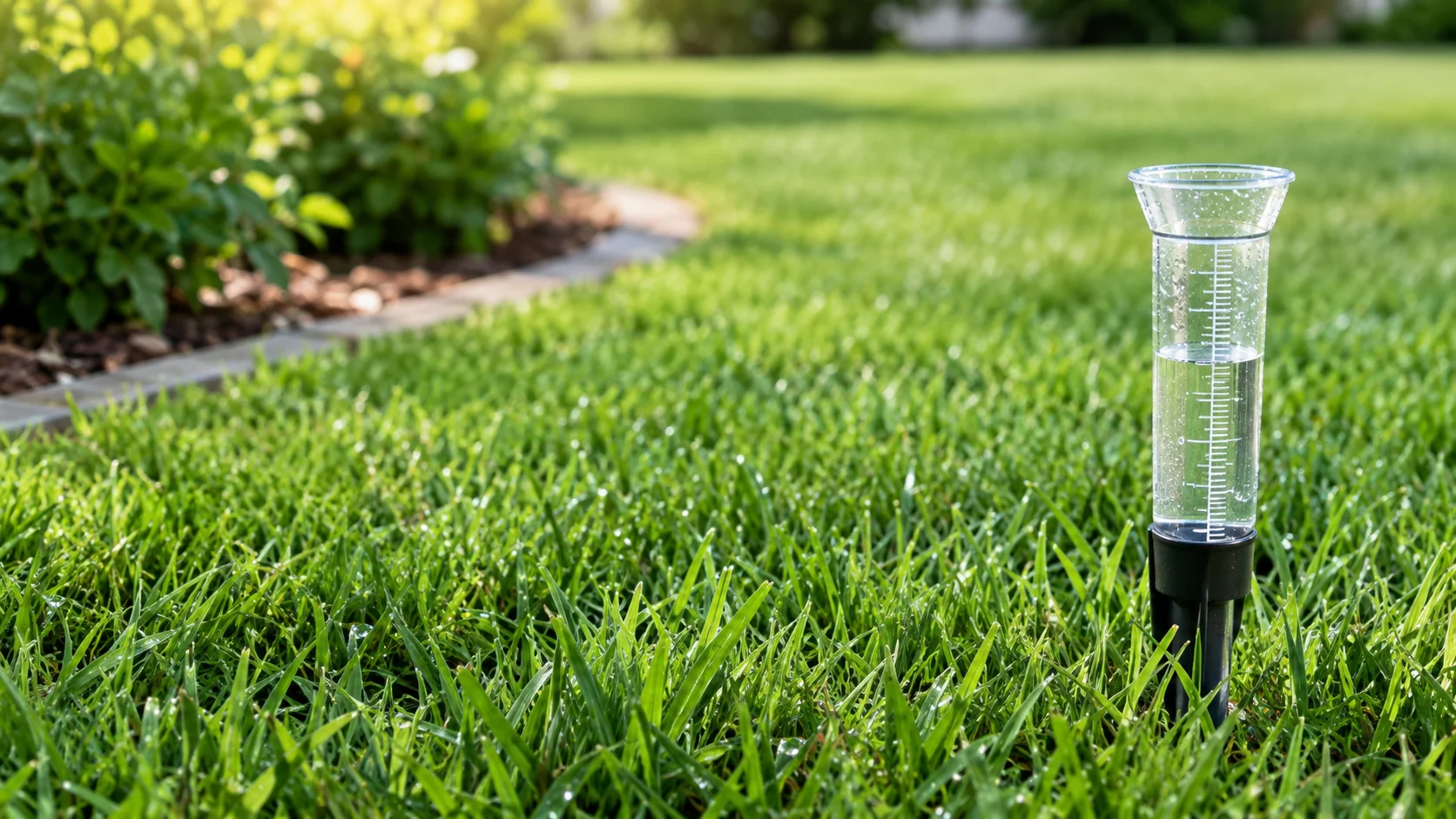
"One inch a week" is the most repeated line in lawn care, and it isn't wrong. It's an average. It fits an established cool-season lawn in a mild summer, and it misses in both directions everywhere else. A fescue lawn in Phoenix in July can lose more than an inch and a half a week to evaporation and plant use. The same lawn in a cool April might need a third of that.
This guide shows where the number comes from, gives typical weekly needs by climate and grass type, and walks through the calculation step by step, so you can set a schedule that fits your lawn. If you'd rather skip the math, the lawn watering calculator runs the same method with your own inputs.
Key takeaways
- Weekly lawn water need = reference evapotranspiration (ETo) × crop coefficient, minus effective rain.
- Cool-season grass uses about 80% of ETo; warm-season grass about 60%.
- Uneven sprinklers force you to apply more than the grass uses. Divide by your system's distribution uniformity.
- Soil decides how you split the weekly total: sand needs small, frequent waterings; clay needs slow, split cycles.
- Convert inches to minutes with your sprinklers' precipitation rate, measured with a catch-can test.
Where the 1-inch rule comes from
Grass loses water two ways: evaporation from the soil and transpiration through the leaves. Together they're called evapotranspiration, or ET. Irrigation engineers measure it against a reference crop, a healthy, well-watered stand of cool-season grass about 4 to 6 inches tall. The water that reference grass would use under the day's sun, heat, humidity and wind is the reference evapotranspiration, ETo.1
Across much of the US in early summer, ETo runs about 0.15 inches a day, a little over 1 inch a week. Multiply by the 0.8 crop coefficient for cool-season turf and you land just under an inch. That's the 1-inch rule. It holds as long as your weather looks like that average, and most weeks it doesn't.
Weekly water needs by climate and grass type
Research by the University of California, adapted into the ANSI/ASABE landscape water standard, sets the average crop coefficient at 0.8 for cool-season lawns (tall fescue, Kentucky bluegrass, ryegrass, bentgrass) and 0.6 for warm-season lawns (Bermuda, zoysia, St. Augustine, buffalograss).2 Applying those to typical weekly ETo gives the ranges below.
Typical weekly water use of established lawns, before rain
| Weather | Reference ET per week | Cool-season lawn | Warm-season lawn |
|---|---|---|---|
| Spring or fall, most regions | 0.55–0.85 in (14–21 mm) | 0.45–0.65 in (11–17 mm) | 0.35–0.5 in (9–13 mm) |
| Mild summer (coastal, northern states) | 1.05–1.25 in (27–32 mm) | 0.85–1.0 in (21–25 mm) | 0.65–0.75 in (16–19 mm) |
| Hot, humid summer (Southeast, Midwest) | 1.25–1.55 in (32–39 mm) | 1.0–1.25 in (25–32 mm) | 0.75–0.9 in (19–23 mm) |
| Hot, dry summer (inland West, desert) | 1.75–2.45 in (44–62 mm) | 1.4–1.95 in (36–50 mm) | 1.05–1.45 in (27–37 mm) |
Planning ranges calculated as ETo × 0.8 (cool-season) and ETo × 0.6 (warm-season). Your local weather service or state extension ET network gives current ETo for your area.
Two things stand out. First, the season matters as much as the region: a Midwest lawn in October needs about half what it needed in July. Second, choosing a warm-season grass in a hot climate cuts water use by roughly a quarter before you change anything else. The grass type water needs calculator compares specific species, and our lawn watering by grass type chart lists 13 common lawn grasses.
How to calculate your lawn's weekly water need
The method below is the one used in irrigation design and water audits.3 It takes four numbers, and you can find all of them in about ten minutes.
Formula
Water to apply (in) = (ETo × Kc − effective rain) ÷ DU
ETo = weekly reference evapotranspiration. Kc = crop coefficient (0.8 cool-season, 0.6 warm-season). DU = distribution uniformity of your sprinklers, as a decimal.
- Find this week's ETo. Many state extension services and water agencies publish daily ETo from local weather stations. Add seven days together, or multiply a typical daily value by 7. The evapotranspiration calculator estimates it from temperature if you don't have a station nearby.
- Multiply by your grass's crop coefficient. Use 0.8 for cool-season lawns and 0.6 for warm-season lawns. The result is what the grass actually uses.
- Subtract effective rain. Count the rain that soaked in, not every drop that fell. More on this below.
- Divide by your system's distribution uniformity. No sprinkler system waters evenly. To get enough water to the driest spots, you apply extra everywhere. A well-designed rotor system might reach a DU of 0.75; many residential spray systems measure lower. If you haven't tested yours, 0.7 is a reasonable planning figure.
Enter your lawn area, grass type and rainfall, and the calculator returns inches, gallons and a weekly schedule.
Worked example: a 5,000 sq ft fescue lawn in July
Take a 5,000 sq ft tall fescue lawn in a hot, humid summer week. ETo averaged 0.2 inches a day, one storm dropped 0.4 inches of rain, and the spray-head system has an untested DU, so we use 0.7.
- Weekly ETo0.2 in/day × 7 = 1.4 in
- Grass water use1.4 × 0.8 = 1.12 in
- Minus effective rain1.12 − 0.4 = 0.72 in
- Adjust for uniformity0.72 ÷ 0.7 = 1.03 in
- Convert to gallons5,000 × 1.03 × 0.623 ≈ 3,200 gal
- Run time at 1.5 in/hr1.03 ÷ 1.5 × 60 ≈ 41 min
About 1 inch, or 3,200 gallons, this week
Split into three waterings of about 14 minutes each. Metric: about 26 mm, or 12,100 liters over 465 m².
After rain, the lawn is short 0.72 inches, yet the sprinklers have to apply 1.03 inches so the driest spots still get enough. That extra 0.31 inch is the uniformity penalty, and on this lawn it's about 960 gallons a week. Improving DU through better head spacing and matched nozzles is often the cheapest water savings in a yard; the distribution uniformity calculator shows how much yours costs you.
How many gallons is 1 inch of water on a lawn?
One inch of water over one square foot is 144 cubic inches. A US gallon is 231 cubic inches, so each inch of depth works out to 0.623 gallons per square foot, or 623 gallons per 1,000 sq ft. In metric it's simpler: 1 mm of water over 1 m² is exactly 1 liter.
Gallons needed to apply a given depth of water
| Lawn area | ½ inch | 1 inch | 1½ inches |
|---|---|---|---|
| 1,000 sq ft (93 m²) | 312 gal | 623 gal | 935 gal |
| 2,500 sq ft (232 m²) | 779 gal | 1,558 gal | 2,338 gal |
| 5,000 sq ft (465 m²) | 1,558 gal | 3,117 gal | 4,675 gal |
| 10,000 sq ft (929 m²) | 3,117 gal | 6,234 gal | 9,351 gal |
| 1 acre (43,560 sq ft) | 13,577 gal | 27,154 gal | 40,731 gal |
These are volumes delivered to the lawn surface. Your water bill also includes whatever is lost to overspray and runoff. For other depths, use the inches of water to gallons calculator, or estimate the bill with the lawn watering cost calculator.
How rain changes the number
Rain counts toward the weekly total, but not inch for inch. Very light showers, under about a tenth of an inch, mostly wet the leaves and evaporate. Heavy downpours on firm or sloped ground partly run off before they soak in. The rain that reaches the root zone is called effective rainfall.
For a home lawn, a practical approach works well: put a rain gauge in an open spot, count moderate rains at their full depth, ignore drizzles, and count only the first inch or so of a heavy storm. If a storm fills the root zone, you can often skip watering for several days. The effective rainfall calculator estimates it more precisely for monthly planning.
Tip: a rain sensor pays for itself
Many areas require rain sensors on automatic controllers. Even where they aren't required, a sensor that pauses the system after rain prevents the most common waste in residential irrigation: watering a lawn that's already wet.
How soil type decides how often you water
The weekly total tells you how much. Your soil tells you how to split it. Soil acts like a tank: it can hold only so much water within reach of the roots, and it can absorb water only so fast. Most lawn roots sit in the top 6 inches or so.
How soil type changes a lawn watering schedule
| Soil | Water held per foot | Per watering (6 in roots) | Typical summer pattern |
|---|---|---|---|
| Sandy | 0.5–0.75 in | About 0.15–0.2 in | Short waterings, every 1–2 days in peak heat |
| Loam | 1.5–2.0 in | About 0.4–0.5 in | 2–3 waterings a week |
| Clay | 1.8–2.4 in | About 0.45–0.6 in | 2 waterings a week, each split into cycles |
Per-watering depth assumes refilling half the root zone's available water, a common management target. Typical values; your soil may differ.
Sandy soil drains fast and holds little, so an inch applied at once mostly drains past the roots. Clay holds plenty but takes it in slowly, often only 0.1 to 0.2 inches an hour, so a long run puddles and runs off. The fix for clay is cycle and soak: run each zone in two or three short cycles with an hour's gap between them. The cycle and soak calculator sets the cycle length, and the available water capacity calculator works out how much your soil holds.
University of California guidance puts the typical rhythm at about three waterings a week for cool-season grass in summer and one or two for warm-season grass, which roots deeper.4
Turning inches into minutes on your timer
Controllers run on minutes, not inches. To convert, you need your sprinklers' precipitation rate: how many inches per hour they put down. Different head types vary by a factor of four or more.
Typical precipitation rates and time to apply 1 inch
| Sprinkler type | Typical rate | Minutes for 1 inch |
|---|---|---|
| Fixed spray heads | 1.5–2.0 in/hr | 30–40 |
| Multi-stream rotary nozzles | 0.4–0.6 in/hr | 100–150 |
| Gear-driven rotors | 0.4–0.8 in/hr | 75–150 |
| Hose-end sprinklers | 0.2–1.0 in/hr, varies widely | Measure it |
Published rates are a guide; your pressure and spacing change the real figure. Measure it directly with a catch-can test: set out six or more straight-sided cans across a zone, run it for 15 minutes, and measure the water in each. The catch-can test calculator turns those readings into a precipitation rate and DU, then the how long to water lawn calculator converts your weekly inches into minutes per zone. For a hose, use the hose watering time calculator.
Signs your lawn is getting too little or too much
Numbers set the starting point. The lawn tells you whether it's right. Check it a few times a week during the first month of a new schedule.
Too little water
- Footprints stay visible for several minutes after you walk across it.
- Blades turn blue-gray and fold or curl lengthwise.
- Dry patches appear in the same spots each week, usually far from heads.
- A screwdriver won't push more than 2 inches into the soil.
Too much water
- The ground feels spongy or squelches a day after watering.
- Water runs onto sidewalks or pools in low spots.
- Mushrooms, algae or fungal patches show up.
- Roots are shallow: turf peels up easily when tugged.
The screwdriver test is the most useful single check. An hour after watering, a screwdriver should slide easily into moist soil about 6 inches deep. If it stops short, water longer; if the soil is soggy well below that, cut back.
Special cases: new lawns, dormancy and shade
New seed and new sod
Everything above applies to established lawns. Seed needs the top half-inch of soil kept moist, which usually means light watering once to several times a day until germination, then tapering off as roots develop. New sod needs soaking through to the soil beneath and daily watering for the first week or two. The grass seed watering calculator and sod watering calculator build those schedules.
Letting a lawn go dormant
Cool-season grasses can go dormant in summer drought: they turn brown but the crowns stay alive. If you choose this route, many extension services suggest a light soaking of around half an inch every two to three weeks to keep crowns from dying. Don't flip between dormant and green repeatedly; breaking dormancy draws on the plant's reserves.
Shade and slopes
Shaded turf uses noticeably less water than turf in full sun, so shaded zones on a shared schedule tend to be overwatered. Slopes shed water faster, so they need shorter cycles with soak time between. Where possible, give each of these its own zone.
Check local watering rules
Many cities limit lawn watering to certain days or hours, especially in summer. Set your schedule inside those limits; the weekly depth stays the same, it's just split differently.
Frequently asked questions
Is 1 inch of water a week enough for a lawn?
For an established cool-season lawn in a mild summer, yes, about 1 inch including rain is close. In hot, dry weather a cool-season lawn can use 1.5 to 2 inches a week, while in spring and fall half an inch is often enough. Warm-season grasses use roughly a quarter less than cool-season grasses in the same weather.
How long should I water my lawn to apply 1 inch?
It depends on your sprinkler's precipitation rate. Fixed spray heads apply about 1.5 to 2 inches per hour, so 1 inch takes 30 to 40 minutes a week. Rotors apply about 0.4 to 0.8 inches per hour, so 1 inch takes 75 to 150 minutes. Measure your own rate with a catch-can test.
Is it better to water a lawn every day or a few times a week?
On loam and clay soils, water two or three times a week, deeply enough to wet the root zone. Daily light watering keeps roots shallow. Sandy soils hold little water, so they need smaller, more frequent waterings in hot weather.
What time of day should I water my lawn?
Early morning, finishing before about 10 a.m. Wind is usually lower, less water evaporates, and the grass dries during the day, which lowers the risk of fungal disease compared with evening watering.
Does rain count toward a lawn's weekly water?
Yes, but only the rain that soaks into the root zone. Measure it with a rain gauge and subtract it from the week's need. Very light showers mostly evaporate, and heavy downpours partly run off, so count them at less than their full depth.
How do I know if my lawn got enough water?
Push a screwdriver or soil probe into the lawn an hour after watering. It should slide in easily to about 6 inches, the depth of most lawn roots. If it stops short, water longer next time; if the ground stays soggy or puddles, water less.
Sources
- Allen, R.G., Pereira, L.S., Raes, D. and Smith, M. (1998). Crop Evapotranspiration: Guidelines for Computing Crop Water Requirements. FAO Irrigation and Drainage Paper 56. Food and Agriculture Organization of the United Nations.
- UC Center for Landscape & Urban Horticulture. Plant Factor or Crop Coefficient: What's the Difference? University of California Agriculture and Natural Resources. Values adapted from ANSI/ASABE S623.
- Richie, W.E., Green, R.L. and Gibeault, V.A. (1997). Using ETo (Reference Evapotranspiration) for Turfgrass Irrigation Efficiency. California Turfgrass Culture, 47(3–4). University of California Cooperative Extension.
- UC Statewide IPM Program. The UC Guide to Healthy Lawns: Irrigation Recommendations. University of California Agriculture and Natural Resources.
Written by Daniel Reeves, PE, CID. Figures in this article were calculated from the cited sources and checked against our lawn watering calculator. Read how we calculate and our editorial policy. Spotted an error? Tell us.