How Long to Water Your Lawn (by Sprinkler Type)
Run time depends on how fast your sprinklers apply water, not on a fixed number of minutes. Here are the times for spray heads, rotors and hose-end sprinklers, and how to work out your own.

By Daniel Reeves, PE, CID
Irrigation Design Engineer
Short answer
How long to water your lawn depends on your sprinklers: fixed spray heads need about 15 to 20 minutes per watering, rotors about 38 to 75 minutes, to apply roughly half an inch (13 mm).
Two waterings like that deliver about 1 inch (25 mm) a week, or 30 to 40 minutes of spray heads and 75 to 150 minutes of rotors in total. Divide the depth you need by your precipitation rate in inches per hour, then multiply by 60. If water runs off before the time is up, split the run into cycles.
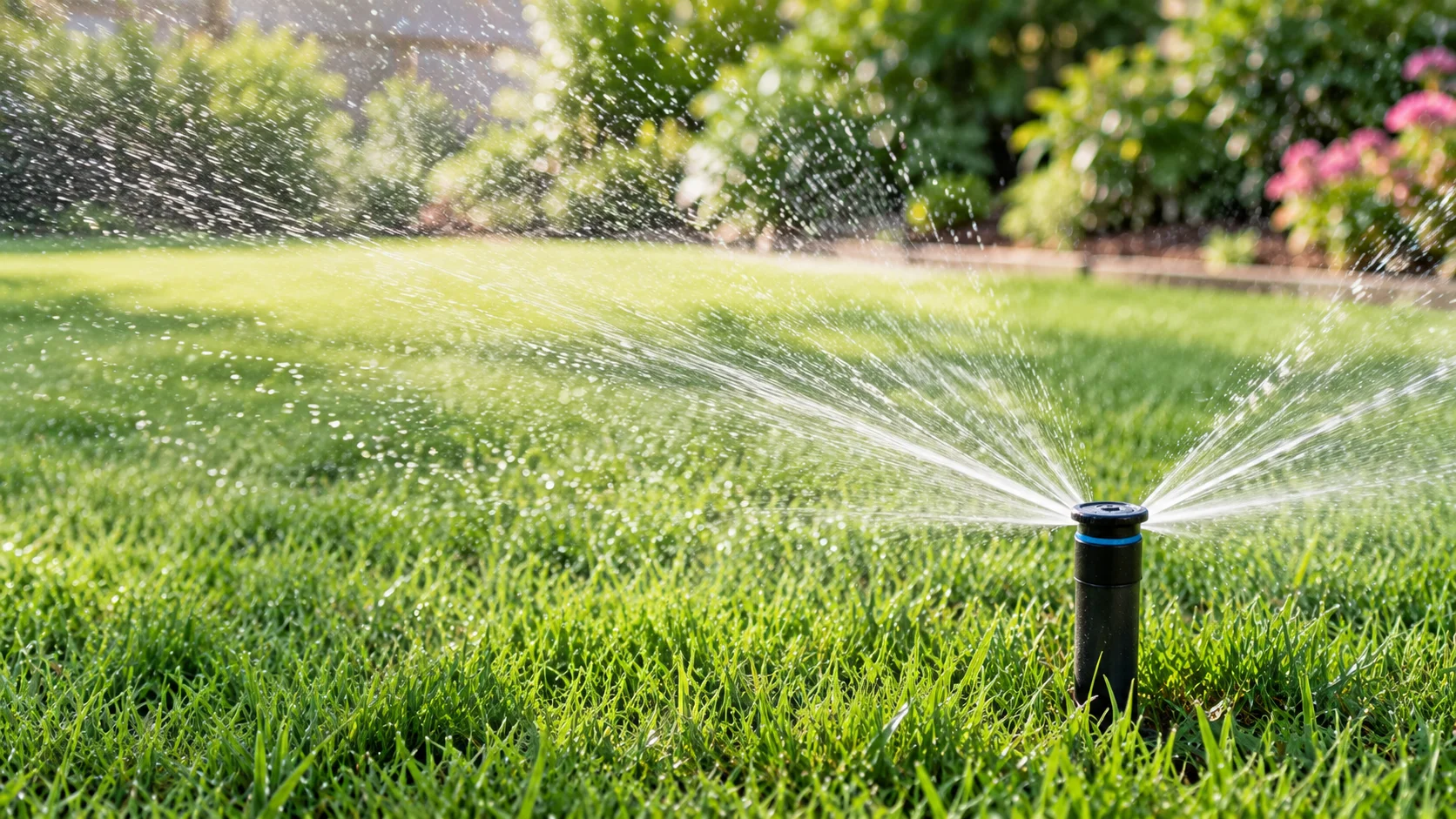
Most run-time advice gives one number, usually 15 to 30 minutes, and it fits almost no one. Spray heads apply water two to five times faster than rotors, so 20 minutes delivers 0.5 to 0.67 inches (13 to 17 mm) from one and only 0.13 to 0.27 inches (3 to 7 mm) from the other.4 Minutes only mean something once you know the rate.
This guide gives the minutes for each sprinkler type, shows how to measure your own rate, and explains when to split a run into cycles. To skip the math, the how long to water lawn calculator converts your weekly inches into minutes for each zone.
Key takeaways
- Run time (minutes) = depth to apply ÷ precipitation rate (in/hr) × 60. The rate is what differs between yards.
- Fixed sprays need about 15 to 20 minutes for 0.5 inch; gear-driven rotors need about 38 to 75 minutes.
- Measure your rate with a 15-minute catch-can test: average depth in inches × 4 = inches per hour.
- If water runs off before the zone finishes, split the run into two or three cycles with an hour between them.
- Run times change with the season: the same rotor zone needs about 75 minutes a week in spring and over 230 in a hot, dry week.
How long to water your lawn: the formula
Run time is the depth of water you want to apply divided by how fast your sprinklers apply it.3 Controllers count minutes, so multiply by 60.
Formula
Run time (min) = depth per watering (in) ÷ precipitation rate (in/hr) × 60
Depth per watering = weekly depth ÷ waterings per week. If you know your distribution uniformity (DU) as a decimal, divide the weekly depth by DU first.
For example, 0.5 inch from a spray head that applies 1.5 inches per hour takes 0.5 ÷ 1.5 × 60 = 20 minutes. The weekly depth itself comes from your grass, weather and rain; the lawn watering calculator finds it. Cool-season lawns average about 1 inch a week in summer, and warm-season lawns about a quarter less.6 The sprinkler run time calculator applies the formula zone by zone.
How many minutes should each sprinkler type run?
Published precipitation rates run from about 0.3 to more than 2.5 inches per hour, depending on the head.4 The table turns typical rates into minutes.
Run time by sprinkler type for 0.5 inch per watering and 1 inch per week
| Sprinkler type | Typical rate | Minutes for 0.5 in (13 mm) | Minutes for 1 in (25 mm) |
|---|---|---|---|
| Fixed spray heads | 1.5–2.0 in/hr (38–51 mm/hr) | 15–20 | 30–40 |
| Multi-stream rotary nozzles | 0.4–0.6 in/hr (10–15 mm/hr) | 50–75 | 100–150 |
| Gear-driven rotors | 0.4–0.8 in/hr (10–20 mm/hr) | 38–75 | 75–150 |
| Hose-end sprinklers | Varies widely | Measure it | Measure it |
Minutes = depth ÷ rate × 60, rounded. Typical published ranges; your pressure, nozzle and spacing change the real rate. See the sprinkler precipitation rate chart for more head types.
Never share one run time between head types. A zone of sprays and a zone of rotors need separate valves and separate times. A mixed zone leaves one part soaked or the other part dry.
How do you find your sprinkler's precipitation rate?
Two methods work. The catch-can test measures what your system really does, including poor spacing and low pressure. The flow method calculates it from the specifications.
- Set out cans. Place six or more straight-sided containers, such as tuna cans, in a grid across one zone, spaced evenly and away from the edge.
- Run the zone for 15 minutes. Note the exact time, and make sure no other zone or wind is interfering.
- Measure and average. Measure the water depth in each can in inches, then average them.
- Multiply by 4. Fifteen minutes is a quarter of an hour, so average depth × 4 is the rate in inches per hour. An average of 0.11 inch gives 0.44 in/hr.
The catch-can test calculator does the averaging and also reports distribution uniformity, the average of the driest quarter of cans divided by the overall average. A low figure means you must run longer to cover the dry spots, which the distribution uniformity calculator quantifies.
The flow method needs the zone's total flow and area. Converting gallons over square feet to inches gives a constant of 96.25.5
Formula
Precipitation rate (in/hr) = 96.25 × flow (gpm) ÷ area (sq ft)
Flow is the total gallons per minute of all heads on the zone. In metric, rate (mm/hr) = 60 × flow (L/min) ÷ area (m²).
Get zone flow from your nozzle charts with the sprinkler GPM calculator, or work out the whole rate with the sprinkler precipitation rate calculator.
Tip: test the worst zone first
Start with the zone that browns first. If its cans show the lowest depth, most of your dry-spot problem is a run-time or spacing problem, not a lawn problem.
Worked example: a 2,400 sq ft rotor zone in July
A tall fescue zone covers 2,400 sq ft (223 m²) with rotors totaling 11 gpm (41.6 L/min). After rain, the lawn needs 1.0 inch (25 mm) this week. The system's DU is 0.75, and you water twice a week.
- Precipitation rate96.25 × 11 ÷ 2,400 = 0.44 in/hr
- Weekly depth for uniformity1.0 ÷ 0.75 = 1.33 in
- Depth per watering1.33 ÷ 2 = 0.67 in
- Minutes per watering0.67 ÷ 0.44 × 60 ≈ 91 min
- Weekly total91 × 2 = 182 min
- Gallons applied11 gpm × 182 min ≈ 2,000 gal
About 91 minutes, twice a week
Split each watering into three 30-minute cycles. Metric: rate 11.2 mm/hr, weekly depth 34 mm, about 7,570 liters over 223 m².
The 91 minutes surprises many people, but it is normal for rotors at 0.44 inches per hour. It is also why a 15-minute rotor zone browns the lawn: it applies about 0.11 inch, about a sixth of what this zone needs per watering.
Enter your weekly depth and precipitation rate, and the calculator returns the run time for each zone.
How long can a zone run before water runs off?
Soil absorbs water only so fast. When sprinklers apply water faster than the soil takes it in, water pools and flows onto pavement. The City of Bend publishes the minutes at which irrigation begins to run off on Central Oregon soils.4
Minutes before runoff on Central Oregon soils, by sprinkler rate
| Sprinkler rate | Coarse sand (min) | Sand (min) | Sandy loam (min) |
|---|---|---|---|
| Fixed spray, 1.5 in/hr (38 mm/hr) | 10 | 8 | 7 |
| High efficiency, 1 in/hr (25 mm/hr) | 22 | 15 | 10 |
| Rotor, 0.4 in/hr (10 mm/hr) | 70 | 60 | 50 |
Source values for Central Oregon soils. Clay soils, not listed, often absorb only 0.1 to 0.2 inch per hour, so they reach the limit sooner.
Read the first row carefully. A spray head at 1.5 inches per hour on sandy loam runs off after 7 minutes, having applied only 1.5 × 7 ÷ 60 = 0.175 inch. To apply 0.5 inch you need about three cycles of 7 minutes, with time between them for the soil to drain. That is cycle and soak, and the cycle and soak calculator sets the cycle length for your rate and soil. To check how fast your own soil absorbs, use the soil infiltration rate calculator.
University of California guidance for home lawns suggests about three waterings a week for cool-season grass in summer, and one or two for warm-season grass.2 Each watering should be as deep as the soil can take without runoff, so a rotor zone can run long while a spray zone needs cycles.
How does run time change with the season?
Grass water use follows reference evapotranspiration (ETo), the water lost from a well-watered reference grass in the day's weather.1 Multiply by 0.8 for cool-season turf and you have the planning depths below.6 The table converts them to weekly minutes for two rates.
Weekly run time for a cool-season lawn by season, before rain and uniformity
| Season | Weekly depth | Rotor zone at 0.44 in/hr (min) | Spray zone at 1.5 in/hr (min) |
|---|---|---|---|
| Spring or fall | 0.55 in (14 mm) | 75 | 22 |
| Mild summer | 0.9 in (23 mm) | 123 | 36 |
| Hot, humid summer | 1.1 in (28 mm) | 150 | 44 |
| Hot, dry summer | 1.7 in (43 mm) | 232 | 68 |
Depths are midpoints of cool-season planning ranges (ETo × 0.8). Divide by your DU for the real setting. Warm-season lawns need about 25% less.
Weekly minutes swing by a factor of three, so a timer set once in June is wrong by September. The seasonal adjustment calculator scales your run times by month, and the lawn watering schedule calculator spreads the total across days. Subtract rain that soaked in: 0.5 inch of effective rain covers half of a 1-inch week.
How long should you water with a hose-end sprinkler?
Hose-end sprinklers have no standard rate. Output depends on the model, the tap pressure and the hose length, so you must measure. Put a straight-sided can in the pattern and run the sprinkler for 30 minutes. If the can holds 0.5 inch (13 mm), the rate is 1 inch per hour (25 mm/hr) and 1 inch of water takes 60 minutes.
Move the sprinkler after each run so overlapping passes cover the whole lawn. The hose watering time calculator handles the conversion once you have your can reading.
Signs your run time is too short or too long
The numbers set the starting point, and the lawn confirms it. Check after the first two or three waterings on a new schedule.
Run too short
- A screwdriver stops within 2 inches (5 cm) of the surface an hour after watering.
- Dry patches sit in the same places each week, usually far from heads.
- Blades turn blue-gray and fold, and footprints linger.
- Catch cans average less than your target depth.
Run too long
- Water flows onto sidewalks or pools before the zone finishes.
- The soil is soggy the next day.
- Mushrooms, algae or fungal patches appear.
- Roots are shallow and the turf peels up when tugged.
The best single check is a screwdriver or soil probe. An hour after watering it should slide easily to about 6 inches (15 cm), the depth of most lawn roots. If it stops short, add depth by adding a cycle; if the soil is soggy well below that, cut the run.
Check local watering rules
Many cities limit lawn watering to set days and hours, and some cap minutes per zone. Keep the weekly depth the same and split it to fit the limits. Large or commercial systems usually need a professional design review.
Frequently asked questions
How many minutes should I run rotors on my lawn?
Gear-driven rotors apply about 0.4 to 0.8 inches per hour, so 0.5 inch takes 38 to 75 minutes and a full inch takes 75 to 150 minutes. Pressure, nozzle size and spacing move the rate, so a catch-can test gives your exact figure and is worth doing once per zone.
Is 15 minutes enough to water a lawn?
Only with fixed spray heads, and only for a light watering. At 1.5 to 2 inches per hour, 15 minutes applies about 0.4 to 0.5 inch. The same 15 minutes from rotors applies only 0.1 to 0.2 inch, which is too little for a normal watering. Check your own precipitation rate before trusting any fixed time.
How long should I water with a hose and sprinkler?
Measure it, because hose-end sprinklers vary widely in output. Set a straight-sided can in the pattern, run the sprinkler for 30 minutes and measure the depth. If you collect 0.5 inch, the rate is 1 inch per hour, so applying 1 inch takes 60 minutes. Repeat the test if your tap pressure changes.
Should I water my lawn every day?
Not an established lawn. Daily light watering encourages shallow roots. Most cool-season lawns do well with two or three deeper waterings a week in summer, and warm-season grasses often need only one or two. Sandy soils are the exception and may need shorter, more frequent runs in peak heat.
What is the best time of day to water a lawn?
Early morning, finishing before about 10 a.m. Wind is usually lower, less water evaporates, and the grass dries during the day, which lowers the risk of fungal disease compared with evening watering. Set the start time so the last zone, including all its cycles, finishes by mid-morning.
How much should I shorten run times after rain?
Subtract the rain that soaked in from the week's need, then recalculate. If 0.5 inch of effective rain fell and your lawn needs 1 inch that week, cut the total run time in half. Measure rain with a gauge, and ignore showers under about 0.1 inch, which mostly evaporate.
Sources
- Allen, R.G., Pereira, L.S., Raes, D. and Smith, M. (1998). Crop Evapotranspiration: Guidelines for Computing Crop Water Requirements. FAO Irrigation and Drainage Paper 56. Food and Agriculture Organization of the United Nations.
- UC Statewide IPM Program. The UC Guide to Healthy Lawns: Irrigation Recommendations. University of California Agriculture and Natural Resources.
- Richie, W.E., Green, R.L. and Gibeault, V.A. (1997). Using ETo (Reference Evapotranspiration) for Turfgrass Irrigation Efficiency. California Turfgrass Culture, 47(3–4). University of California Cooperative Extension.
- City of Bend Water Services. Smart Irrigation Scheduling. Precipitation rates by sprinkler type and minutes to runoff on Central Oregon soils.
- Desert Research Institute. Gross Estimated Runtimes for Small to Medium Turf Areas. Washoe County Evapotranspiration project. Gallons-to-depth run-time method.
- UC Center for Landscape & Urban Horticulture. Plant Factor or Crop Coefficient: What's the Difference? University of California Agriculture and Natural Resources. Values adapted from ANSI/ASABE S623.
Written by Daniel Reeves, PE, CID. Figures in this article were calculated from the cited sources and checked against our how long to water lawn calculator. Read how we calculate and our editorial policy. Spotted an error? Tell us.