Brown Lawn Despite Watering? 9 Causes and Fixes
Brown grass after weeks of sprinkler runs usually has a cause other than too little water. This guide covers nine causes, from uneven coverage to grubs, with the test and the fix for each.

By Daniel Reeves, PE, CID
Irrigation Design Engineer
Short answer
A lawn stays brown despite watering when water is not reaching the roots evenly: most often uneven sprinkler coverage, runoff on compacted or clay soil, or grubs and disease, not too little water.
Test before you add minutes. A catch-can test shows how much each part of the lawn receives, a screwdriver shows whether the soil takes water in, and a dig shows whether roots are still there. The nine causes below each have one check and one fix.
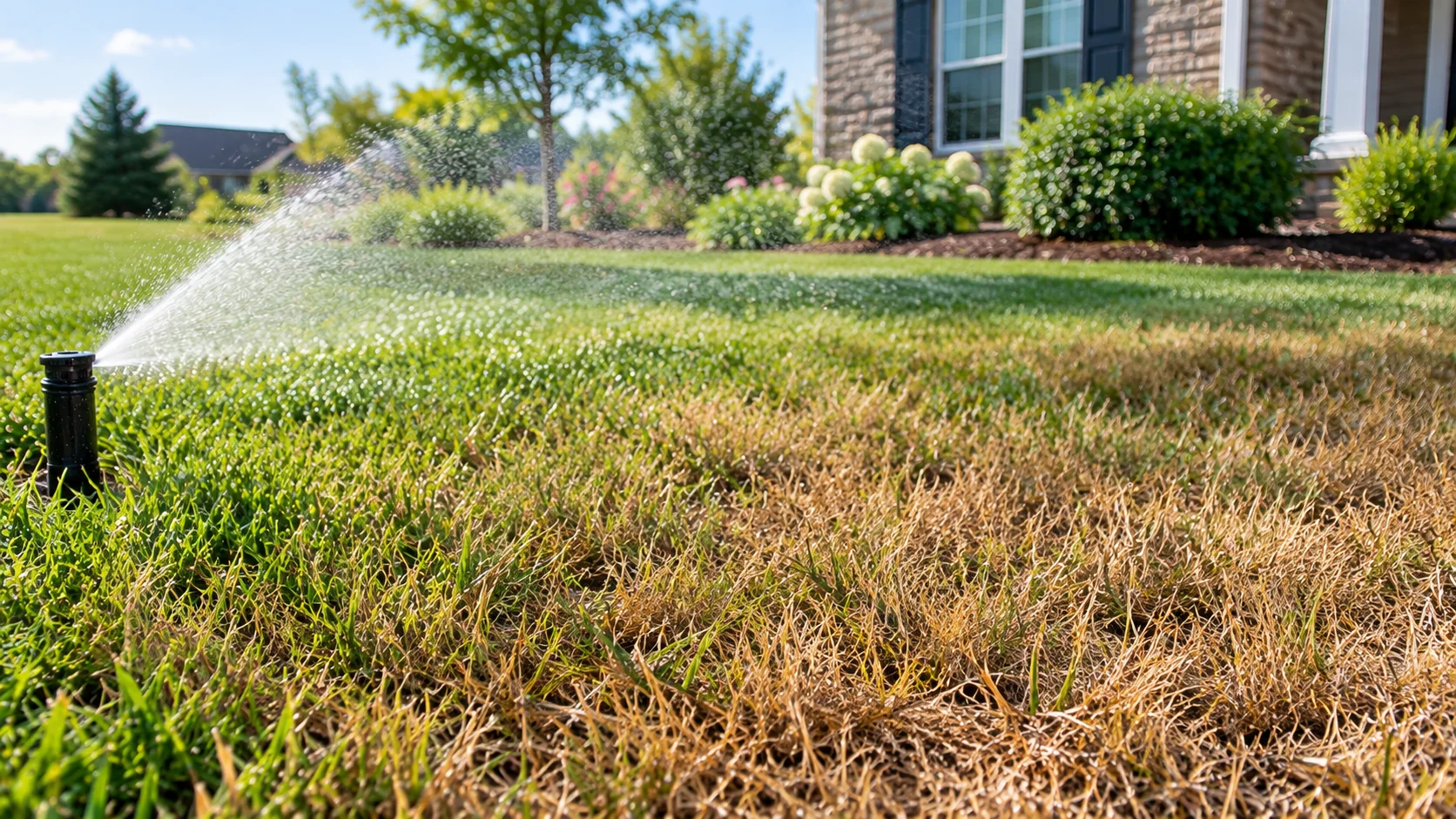
A brown lawn despite watering is rarely a sign that you need to water more. UC extension, writing for California, puts incorrect watering and unsuited grass ahead of insects as the most likely causes of unhealthy lawns.2 The fastest first measurement is how evenly your sprinklers cover the turf, and the distribution uniformity calculator scores a catch-can test in a few minutes.
Below are nine causes, the check that confirms each and the fix. The article starts with a pattern check, covers the water-side causes, works one example through the numbers, then covers pests, disease and soil, and ends with a 30-minute test order.
Key takeaways
- Uneven watering is the first suspect. UC recommends a can test and a check for broken heads before changing anything else.1
- If brown spots persist after more frequent watering, the problem is coverage or the soil, not the schedule.5
- Run time depends on measured output in inches per hour. A guessed rate is the most common reason a zone runs too short.
- Grub-killed turf feels spongy and rolls up like carpet. Dig before you treat; 5 or fewer grubs per square foot needs no treatment.23
- Fewer, longer waterings with cycles beat daily sips on clay and slopes.4
Brown lawn despite watering: what the pattern tells you
Where the brown sits narrows the cause before you test anything. UC's diagnostic guide says uniform spots that appear suddenly in one area most often point to a non-living cause such as watering, while damage that gradually expands is more typical of disease or insects.6 Damage around sprinkler heads, where dogs are active, or in stripes where fertilizer went down each has its own signature.6
Brown lawn patterns, likely causes and first checks
| What you see | Likely cause | First check |
|---|---|---|
| Dry wedge or ring near a head | Broken, clogged or misaimed head; gaps in coverage | Run the zone and watch every head |
| Brown on slopes or beside pavement | Runoff before water soaks in | Run 5 minutes and look for flow |
| Hard, dry patches that stay brown | Compaction, thatch or short run times | Screwdriver test and catch cans |
| Patches that spread; spongy ground | Grubs or other root feeders | Peel back sod and count grubs |
| Stripes or spots after feeding or pets | Fertilizer or urine burn | Match the pattern to your application |
| Whole lawn tan in heat or cold | Dormancy or unsuited grass | Check grass type against your climate |
Patterns follow UC's diagnostic guidance.6 Several causes can overlap in one lawn, so confirm with the check before you treat.
Causes 1 to 4: the water is not reaching the roots
1. Run times too short for your sprinklers
Run time is depth divided by precipitation rate, so a wrong rate gives a wrong run time. Spray heads, rotors and drip-style rotary nozzles put out very different amounts per hour, and mixed heads on one zone make it worse. UC's lawn watering guide has you measure hourly output with cans instead of assuming it.5
Check: set cans, run 15 minutes, and convert the average depth to inches per hour. The sprinkler precipitation rate calculator gives a rate from head and spacing data to compare against your cans. Fix: use the measured rate in the how long to water lawn calculator to get minutes per zone.
2. Uneven coverage and dry spots
Even a correct average leaves spots short when coverage is uneven. UC lists broken heads and missing head-to-head coverage as causes of dry areas, and recommends a can test to confirm uniform coverage.1 If brown spots continue despite more frequent irrigation, UC says to check sprinkler coverage for uniformity.5
Check: compare the driest can with the average using a catch-can test. Fix: replace broken heads, clear nozzles, re-aim arcs and fix tilted bodies. Then score the result and use the scheduling coefficient calculator to set run times that cover the driest area.
3. Frequent shallow watering
Ten minutes a day at 0.8 inch per hour applies 0.13 inch a day, about 0.93 inch a week, which sounds adequate. The trouble is that each sip is small, the dry spots never catch up, and roots stay near the surface where heat reaches them first. UC advises splitting a cool-season lawn's weekly water into about 3 equal irrigations rather than many small ones.4
Check: push a probe in a day after watering and see how deep the moisture goes. Fix: cut the number of watering days and lengthen each run. The lawn watering schedule calculator returns days per week and minutes for your grass and soil.
4. Runoff before the water soaks in
If the sprinkler applies water faster than the soil absorbs it, the surplus runs to the street. A zone that applies 1.5 inches per hour on soil that takes in 0.3 inch per hour sends 1.2 inches of every hour to the gutter, and the lawn at the top of a slope stays dry. UC recommends finding the longest run before runoff begins and never exceeding it.4
Check: run a zone for 5 minutes and watch for flow. Compare your soil with the soil infiltration rate chart or estimate it with the soil infiltration rate calculator. Fix: use short cycles an hour apart, sized by the cycle and soak calculator.
Do not add minutes first
Longer runs on a zone with runoff or uneven coverage overwater the green parts and still miss the brown ones. Measure, then change the schedule.
Worked example: a zone that looks fine and is not
Take a spray zone on a cool-season lawn that needs 1 inch (25 mm) a week net, run 3 times a week. Cans run for 15 minutes show an average of 0.20 inch, and the driest quarter averages 0.14 inch.
- Precipitation rate0.20 ÷ 15 × 60 = 0.80 in/hr
- Distribution uniformity (low quarter)0.14 ÷ 0.20 = 0.70
- Current output, 15 min × 3 days0.20 × 3 = 0.60 in/week average
- Driest areas now receive0.14 × 3 = 0.42 in/week
- Need per watering1.0 ÷ 3 = 0.33 in
- Apply per watering, corrected for DU0.33 ÷ 0.70 = 0.48 in
- Minutes per watering0.48 ÷ 0.80 × 60 = 36 min
36 minutes, 3 times a week, instead of 15
Metric: 0.80 in/hr is 20 mm/hr; the driest areas received 10.7 mm of the 25 mm needed, and 36 minutes applies about 12 mm per watering. If the soil runs off at 36 minutes, split it into two cycles an hour apart.
The owner was watering every week and the driest quarter still got 42 percent of what the lawn needed. No schedule fixes that without a measured rate and a uniformity figure. The lawn water deficit calculator shows the gap between water applied and water needed.
Enter catch-can depths from one zone. The calculator returns distribution uniformity and the run-time correction.
Causes 5 to 9: the problem is not the schedule
5. Thatch and compacted soil
Thick thatch and hard soil shed water. UC advises aerating the lawn annually and removing thatch that exceeds 1/2 inch.2 Brown patches that sit on firm, dry ground, especially in traffic areas, often belong here.
Check: push a long screwdriver into a brown area and a green one; a dead stop in the brown area means compaction. Fix: core aerate, then water in short cycles so the water has time to enter the new holes.
6. Grubs and chinch bugs
Masked chafer grubs eat roots. UC says the damage shows as irregular brown patches in late summer or fall, the ground feels spongy, and heavily infested lawn can be rolled up.3 UC also warns that insects are not a common cause of lawn damage in California, so rule out watering first.2
Check: dig around the roots at the edge of a brown patch and count grubs per square foot; 5 or fewer needs no treatment.2 On St. Augustinegrass, add chinch bugs to the same inspection. Fix: aerate, keep irrigation and fertilizer appropriate, and treat only above the threshold.23
7. Overwatering and fungal disease
Too much water browns grass too. UC notes that overwatered turf can scald or scorch where drainage is poor and temperatures are high, and that waterlogged areas lead to root pathogen problems.1 Turfgrass diseases produce damage that resembles drought.2
Check: spongy ground a day after watering, mushrooms, and patches that expand gradually.6 Fix: drop a watering day, water early in the morning so blades dry quickly, and aerate where drainage is poor.1
8. Fertilizer and pet urine burn
UC lists stripes where fertilizer was applied and spots where dogs are active as distinct patterns.6 Both are chemical burn, and extra water does not undo them while the dead grass is still in place.
Check: match the pattern to your spreader passes or to where the dog goes. Fix: water the area deeply to dilute what remains, rake out dead grass, reseed, and keep the spreader overlap tight.
9. Dormancy or the wrong grass for your climate
UC names planting grass varieties not suited to your area, along with poor care, as a likely cause of unhealthy lawns.2 A cool-season fescue in a hot, dry summer, or Bermudagrass in winter, will turn tan whatever you apply.
Check: compare your species with local conditions using the grass type water needs calculator. Fix: match the program to the season with the seasonal adjustment calculator, and size your weekly total with the lawn water requirement calculator. If the species is wrong for the site, plan to replace it.
A 30-minute test order
Work through these in order, and change only one thing at a time.
- Watch the zone run. Look at every head for breakage, clogging and tilt, and note any flow off the lawn.
- Set cans. Place cans on green and brown areas, run 15 minutes and record each depth.
- Probe the soil. Push a screwdriver into brown and green areas and compare the resistance.
- Dig at the edge. Check the roots and count grubs at the line between healthy and damaged grass.
- Change the schedule last. Use the measured rate and uniformity, then give the new program two weeks.
Local watering rules and soil conditions vary. For a large or commercial site, an irrigation audit by a certified professional is worth the cost.
Frequently asked questions
Why is my lawn brown even though I water it every day?
Daily watering often means short runs that never reach the roots evenly. Ten minutes at 0.8 inch per hour applies only 0.13 inch, so the lawn gets 0.93 inch a week but in sips, and dry spots stay dry. Measure output with cans, then water less often for longer, with cycles if water runs off.
Should I water more if my grass is turning brown?
Not until you have tested. UC advises checking sprinkler coverage when brown spots continue despite more frequent irrigation. Extra minutes overwater the spots that already get enough and still miss the dry ones. Run a catch-can test first, then change the schedule only if the average depth is too low.
How do I tell grub damage from drought?
Grub-damaged turf has no roots holding it down. UC describes irregular brown patches, spongy ground and grass that can be rolled up like carpet. Cut a square foot of sod, peel it back and count the white C-shaped grubs. UC says a lawn needs no treatment at 5 or fewer grubs per square foot.
Why are brown spots only around my sprinkler heads?
Spots at the heads point to the heads. UC lists broken heads and gaps in head-to-head coverage as common causes of dry areas. Run the zone, watch each head, and check for clogged nozzles, tilted bodies and arcs knocked out of line. A catch-can test shows how much water those spots receive.
Can overwatering turn grass brown?
Yes. UC notes that overwatered turf can scald or scorch where drainage is poor and temperatures are high, and that waterlogged areas invite root diseases. Spongy soil a day after watering, mushrooms and runoff are the clues. Cut the number of waterings, not just the minutes, and let the top of the soil dry between runs.
Sources
- UC Statewide IPM Program. Poor watering practices. The UC Guide to Healthy Lawns. University of California Agriculture and Natural Resources.
- UC Statewide IPM Program. Lawn Insects: Quick Tips. Pests in Gardens and Landscapes. University of California Agriculture and Natural Resources.
- UC Statewide IPM Program. Masked chafers (white grubs). The UC Guide to Healthy Lawns. University of California Agriculture and Natural Resources.
- UC Statewide IPM Program. How Many Times a Week to Water. The UC Guide to Healthy Lawns. University of California Agriculture and Natural Resources.
- Hartin, J. Lawn Watering Guide for California. ANR Publication 8044. University of California Agriculture and Natural Resources.
- UC Statewide IPM Program. Patterns and locations of the problem. The UC Guide to Healthy Lawns. University of California Agriculture and Natural Resources.
Written by Daniel Reeves, PE, CID. Figures in this article were calculated from the cited sources and checked against our lawn watering calculator. Read how we calculate and our editorial policy. Spotted an error? Tell us.