How Much Water Does Bermuda Grass Need?
Bermuda grass tolerates drought, but it still needs about 1 inch of water a week while it grows. This guide shows how soil, weather and season raise or lower that number, and how to turn it into minutes on your controller.

By Daniel Reeves, PE, CID
Irrigation Design Engineer
Short answer
Bermuda grass needs about 1 inch (25 mm) of water a week while it is actively growing, counting rain, and up to about 1.6 inches (40 mm) in hot, dry summer weather.
Apply it in 1 or 2 deep waterings that wet the top 6 inches (15 cm) of soil. Sandy soil takes about 0.5 inch (13 mm) at a time, so it needs water about every third day, while fine-textured soil can take 1 inch (25 mm) once a week. A dormant lawn needs about 1 inch (25 mm) only if 3 weeks pass without rain.
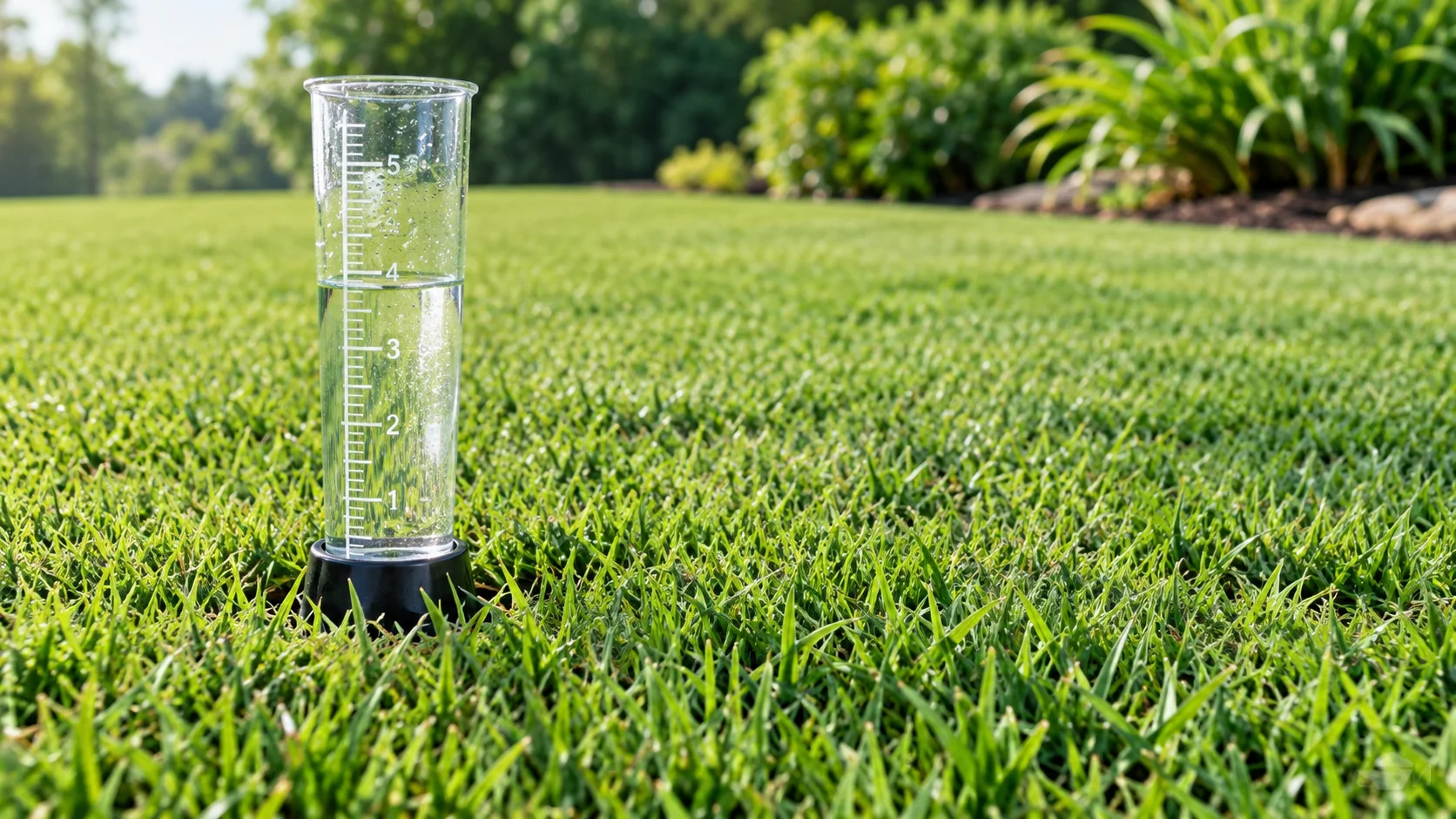
Bermuda grass has a reputation for thriving on neglect, so how much water Bermuda grass needs often gets answered with a shrug. The real answer shifts with the week's weather, the soil and the sprinkler. The grass type water needs calculator gives a weekly figure for your grass, and the sections below explain how that figure is built.
You will find the weekly amount by season, how to split it across waterings on sand and clay, the ET formula that produces it, a worked example that finishes with run times, and what dormant and newly planted lawns need.
Key takeaways
- Bermuda grass needs about 1 inch (25 mm) a week while growing, counting rain: roughly 0.5 inch in fall and up to 1.6 inches (40 mm) in hot, dry summers.
- It uses about 60% of reference ET on an annual average, 0.60 in UC's table, which is about 20% less water than cool-season grasses.
- Apply the weekly amount in 1 or 2 deep waterings that wet the top 6 inches. Sand holds about 0.5 inch per watering; heavy soil holds about 1 inch.
- Minutes per watering equal the depth divided by your measured sprinkler rate, times 60.
- Water between 2 a.m. and 8 a.m., and skip daily sprinkling on established turf.
- A dormant lawn needs about 1 inch only when 3 weeks pass without rain.
How much water Bermuda grass needs each week
NC State Extension sets the target for a growing Bermuda lawn at about 1 inch (25 mm) a week, with rainfall counted toward it.2 That single figure hides a range, because grass water use follows the weather. Engineers estimate it as reference evapotranspiration (ETo) multiplied by a crop coefficient (Kc).
UC's turfgrass table covers warm-season grasses, a group that includes Bermuda, and gives an annual average Kc of 0.60, with monthly values from 0.54 in February and October to 0.79 in May.1 UC's own example: on a day when ETo is 0.20 inch, Bermuda grass uses 0.12 inch.1 The reference ET calculator supplies ETo, and the crop evapotranspiration calculator applies the Kc.
Weekly water need for Bermuda grass by season and weather
| Season and weather | Assumed ETo | Kc (UC, warm-season) | Weekly need before rain |
|---|---|---|---|
| Spring (March to May) | 0.15 in/day (3.8 mm) | 0.76 | 0.8 in (20 mm) |
| Mild summer | 0.20 in/day (5.1 mm) | 0.70 | 1.0 in (25 mm) |
| Hot, humid summer | 0.24 in/day (6.1 mm) | 0.70 | 1.2 in (30 mm) |
| Hot, dry summer | 0.32 in/day (8.1 mm) | 0.70 | 1.6 in (40 mm) |
| Fall (September to November) | 0.12 in/day (3.0 mm) | 0.58 | 0.5 in (12 mm) |
Weekly need = 7 × ETo × Kc. ETo values are round planning figures, not station data, so replace them with your local ETo. Kc values are the averages of UC's monthly warm-season figures for each season (spring 0.76, June to August 0.70, fall 0.58).1 Water applied by sprinklers must be higher, as the formula section shows.
The extension figure of 1 inch sits between the mild-summer and hot-humid rows, which is why it works as a rule of thumb for much of the South. In fall Bermuda grass needs about 40% of what it uses in a hot, humid July week, which means a controller still running its summer program overwaters. Trim run times each month or use a seasonal percentage; the seasonal adjustment calculator gives the monthly figure.
UC notes that the amount applied through irrigation usually equals or exceeds ETo, because sprinkler systems apply water unevenly.1 For a quick estimate from local ET, use the lawn water requirement calculator, and see other species side by side in the lawn watering by grass type reference.
How often to water Bermuda grass
Bermuda is a warm-season grass with an extensive, deep root system, so UC recommends deep, infrequent watering: as few times a week as your soil allows without runoff, usually 1 or 2, spaced evenly through the week.6
Texas A&M tells homeowners to wet the soil to 6 inches (15 cm) and then wait for stress symptoms before watering again. Those are a dull bluish color, rolled or folded leaves and footprints that stay put, and they usually appear 5 to 10 days later, depending on the weather.3
Daily sprinkling works against the grass. Clemson Extension warns that frequent small amounts encourage a shallow root system and leave the lawn less drought tolerant, and it names newly seeded, sodded or sprigged lawns as the only exception.4 The lawn watering schedule calculator builds a schedule from your soil and sprinkler type.
How soil type changes the amount per watering
Soil sets how much one watering can usefully hold. Clemson Extension puts it at about 0.5 inch (13 mm) on coarse, sandy soil and 1 inch (25 mm) on heavy or fine-textured soil, either of which moistens the soil to a depth of 4 to 6 inches (10 to 15 cm).4 NC State adds that sandy soils need more frequent watering, about 0.5 inch every third day.2
Bermuda grass watering by soil type at a 1 inch a week target
| Soil | Most per watering | Waterings per week | How to handle it |
|---|---|---|---|
| Sandy, coarse | 0.5 in (13 mm) | 2, about every 3 to 4 days | Probe a day later; the wet zone should reach 4 to 6 in (10 to 15 cm) |
| Heavy, fine-textured | 1 in (25 mm) | 1, every 7 days | Apply in 2 or 3 cycles if runoff starts |
| Any soil where runoff starts early | 0.5 in (13 mm) at a time | Same weekly total | Run to the first runoff, pause 30 to 60 minutes, repeat |
Per-watering amounts are Clemson's;4 the pause is Texas A&M's.3 Waterings per week are the 1 inch weekly target divided by the amount per watering. NC State's every-third-day schedule for sand works out to 2.3 waterings and about 1.2 inches (30 mm) a week.2
Clay takes water in slowly, so when sprinklers outpace the soil, water leaves the lawn before the root zone is wet. Texas A&M's fix is to run the zone until water first leaves the lawn, note the time, stop for 30 minutes to 1 hour, then continue in repeat cycles until the full amount is down.3 NC State gives the same advice for clay soils.2 The cycle and soak calculator splits a run into cycles, and the soil infiltration rate calculator shows how fast your soil takes water.
How to calculate Bermuda grass watering from ET
The method has six steps, and every input is either measured on your lawn or looked up.
Formula
Weekly water to apply = (7 × ETo × Kc − effective rain) ÷ DU
ETo is daily reference ET in inches. Kc is the warm-season crop coefficient: 0.60 as an annual average, or the monthly value from UC. DU stands for distribution uniformity, written as a decimal; use 0.7 as a planning value until you have measured it. Number of waterings = weekly water to apply ÷ the most your soil takes per watering, rounded up. Minutes per watering = water per watering ÷ precipitation rate × 60.
- Get weekly ETo. Add up daily ETo from a local weather station or state ET network, or multiply a typical daily value by 7.
- Apply the crop coefficient. Multiply by 0.6 for an annual average, or use UC's monthly Kc, such as 0.71 in July.1
- Subtract rain. Deduct the rain your gauge caught that soaked in. The effective rainfall calculator works out how much of a storm reaches the roots.
- Correct for uneven coverage. Divide by DU. The distribution uniformity calculator turns catch-can readings into a DU figure.
- Choose the number of waterings. Divide by the per-watering limit for your soil from Table 2 and round up.
- Convert to minutes. Set 5 or 6 straight-sided cans in the zone, run the sprinklers 30 minutes, average the depths and double the result to get inches per hour.3 Then minutes equal depth divided by that rate, times 60.4 The catch can test calculator does the averaging.
Pick Bermuda grass to see its weekly water need next to other grass types.
Worked example: a 5,000 sq ft Bermuda lawn in July
Consider a Bermuda lawn of 5,000 sq ft (465 m²) on clay loam. The week is hot and humid, with ETo of 0.24 inch (6.1 mm) a day and no rain. The rotors put down 0.5 inch an hour, and because uniformity has not been tested, DU is taken as 0.7. UC's July Kc for warm-season grass is 0.71.1
- Weekly ETo0.24 in/day × 7 = 1.68 in
- Bermuda grass use (July Kc)1.68 × 0.71 = 1.19 in
- Water to apply (DU 0.7)1.19 ÷ 0.7 = 1.70 in
- Waterings per week (1 in limit)1.70 ÷ 1.0 = 1.7, round up to 2
- Water per watering1.70 ÷ 2 = 0.85 in
- Minutes per watering0.85 ÷ 0.5 × 60 = 102 min
- Weekly volume5,000 × 1.70 × 0.623 ≈ 5,300 gal
2 waterings a week, about 102 minutes each
Space them 3 or 4 days apart. Metric: 1.70 in is 43 mm a week, about 22 mm per watering, or roughly 20,000 liters over 465 m².
Now test the plan against the soil. The 0.85 inch applied per watering is under the 1 inch a heavy soil takes, and about 0.60 inch reaches the roots after the DU correction (0.85 × 0.7). At 0.5 inch an hour, 102 minutes may exceed what clay loam absorbs in one pass, so split each watering into three 34-minute cycles with 30 to 60 minutes between them. A day later, probe the soil to confirm it is wet to 6 inches.
When to water Bermuda grass: time of day and rain
Start between 2 a.m. and 8 a.m. NC State finds that this window lowers the incidence of certain diseases.2 Clemson also names early morning as the most efficient time, because evaporation is lowest and the blades dry quickly.4
Rain counts toward the weekly total. Keep a gauge in the yard, subtract what it collects, and hold off when rain is forecast, as Clemson advises.4 Where local rules restrict watering days, spread the same weekly depth over the permitted days. Those rules override any schedule here.
Sports fields and other heavily used turf are a special case. UC notes that its Kc values may fall short of what intensively used and high-performance turf needs to recover and perform.1 Those areas need a schedule designed for the site.
Signs Bermuda grass needs water now
Treat the schedule as a first draft that the lawn edits. Clemson suggests walking across the lawn late in the day, when footprints show best, and using the first spots to show stress as your indicator. Those are usually sandy ground, high spots and edges beside pavement.4
Water now
- Footprints stay visible long after you cross the lawn.
- The grass takes on a dull bluish or bluish-gray cast.
- Leaves wilt, roll or fold.
- A screwdriver is hard to push into the soil.
Hold off
- Blades spring back after you walk across them.
- A screwdriver or probe slides in easily.
- Fewer than 5 days have passed since a deep watering and no stress shows.
- Water ponds or flows toward the street; use shorter runs or add cycles.
The probe test comes from NC State and Texas A&M, which both use it to judge how deep the last watering reached.23 If stress shows before the next planned day, water early. If a probe finds moist soil at 6 inches, delay the next watering by a day.
How much water dormant Bermuda grass needs
Clemson lists Bermuda among the warm-season grasses prone to winter dormancy, and it stresses that dormancy is not death: new blades emerge in spring.5 NC State says irrigation is usually unnecessary from September through February, but the soil should not be allowed to go powder-dry.2
When winter stays dry, Clemson's rule for warm-season lawns is to apply 1 inch (25 mm) if no rain has fallen in 3 weeks.5 Texas A&M adds that dormant Bermuda may need periodic water when the weather is warm, dry and windy.3
The same grass can also go dormant in a summer drought and recover when conditions improve.4 What hurts is stopping halfway: Clemson warns that coaxing a lawn out of dormancy and then not watering again exhausts the plants.4 Decide in early summer whether to keep the lawn green all season or let it rest, and hold to that choice.
How much water new Bermuda seed needs
A new planting is the one case where frequent watering is right. NC State says to keep a Bermuda seedbed continually moist with light, frequent irrigation several times a day until the seed has germinated, then to irrigate less often.2 That is the reverse of the deep, infrequent plan for an established lawn, so switch back as roots take hold. The grass seed watering calculator sets the plan by growth phase.
Frequently asked questions
Can you overwater Bermuda grass?
Yes. Clemson Extension notes that extra watering encourages weeds, can stimulate disease and raises water bills, and that small daily amounts keep roots shallow. Texas A&M also advises against excessive watering and fertilizing to prevent thatch. Water that pools or runs onto pavement is a sign to shorten the run.
How long should I run sprinklers to apply 1 inch?
Minutes equal the depth divided by your sprinkler rate, times 60. Clemson's table gives 1 inch in 40 minutes at 1.5 inches an hour, 60 minutes at 1 inch an hour and 120 minutes at 0.5 inch an hour. Measure your own rate with cans first, because sprays and rotors differ widely.
How many gallons does a Bermuda lawn need per week?
One inch of water over 1,000 sq ft is about 623 gallons (2,360 liters), or 0.62 gallon per square foot. A 5,000 sq ft lawn needs about 3,100 gallons (11,800 liters) at 1 inch a week, before correcting for uneven coverage. Multiply by 1.2 or 1.6 for hot weeks.
Does Bermuda grass use less water than tall fescue?
Yes. UC reports that warm-season grasses, including Bermuda, need about 20% less water than cool-season grasses such as tall fescue during the growing season. The annual average crop coefficient is 0.60 for warm-season turf against 0.80 for cool-season turf, so the same weather calls for less irrigation on Bermuda.
How little water can Bermuda grass survive on?
UC says Bermuda grass irrigated at about 40% of ETo survives with minimal performance: browner patches, thinning and little growth. With ETo at 0.24 inch a day, that is about 0.67 inch (17 mm) a week. Treat it as a drought floor, not a target for a lawn you want dense and green.
Does rain count toward the weekly inch?
Yes. NC State frames the target as about 1 inch a week from rainfall plus irrigation while the grass is growing. Keep a rain gauge in the yard, subtract what it collects from the weekly target, and skip or shorten the next watering. Clemson also advises holding off when rain is forecast.
Sources
- UC Center for Landscape & Urban Horticulture. Turfgrass Crop Coefficients (Kc). University of California Agriculture and Natural Resources. Kc values from Meyer et al. (1985).
- Miller, G., Kerns, J., Billeisen, T., Yelverton, F., Peacock, C. and Brandenburg, R. (2021). Bermudagrass Lawn Maintenance Calendar. AG-431. NC State Extension.
- Chalmers, D.R., McAfee, J.A. and Havlak, R. (2006). Maintaining Bermudagrass Lawns. E-242. Texas A&M AgriLife Extension.
- Polomski, R.F. and Shaughnessy, D. (2019). Watering Lawns. HGIC 1207. Clemson Cooperative Extension Home & Garden Information Center.
- Clemson Cooperative Extension Home & Garden Information Center. Winter Irrigation for Turfgrass Lawns.
- UC Statewide IPM Program. How Many Times a Week to Water. The UC Guide to Healthy Lawns. University of California Agriculture and Natural Resources.
Written by Daniel Reeves, PE, CID. Figures in this article were calculated from the cited sources and checked against our lawn watering calculator. Read how we calculate and our editorial policy. Spotted an error? Tell us.