Smart Sprinkler Controllers: Are They Worth It?
Field studies report savings from 6% to over 90%, and both ends are real. This guide shows how to tell which group your lawn belongs to, what a smart controller returns in dollars, and when it pays back.

By Daniel Reeves, PE, CID
Irrigation Design Engineer
Short answer
Yes, if you overwater today. Field studies put typical savings from smart sprinkler controllers at about 6% to 15% of outdoor water, and 40% or more for heavy irrigators.
Whether smart sprinkler controllers are worth it depends on one ratio: the water your lawn gets now divided by the water it needs. Above 1.0 a controller saves water; below 1.0 it raises use. Across 2,294 California sites, 41.8% used more water after installation.1
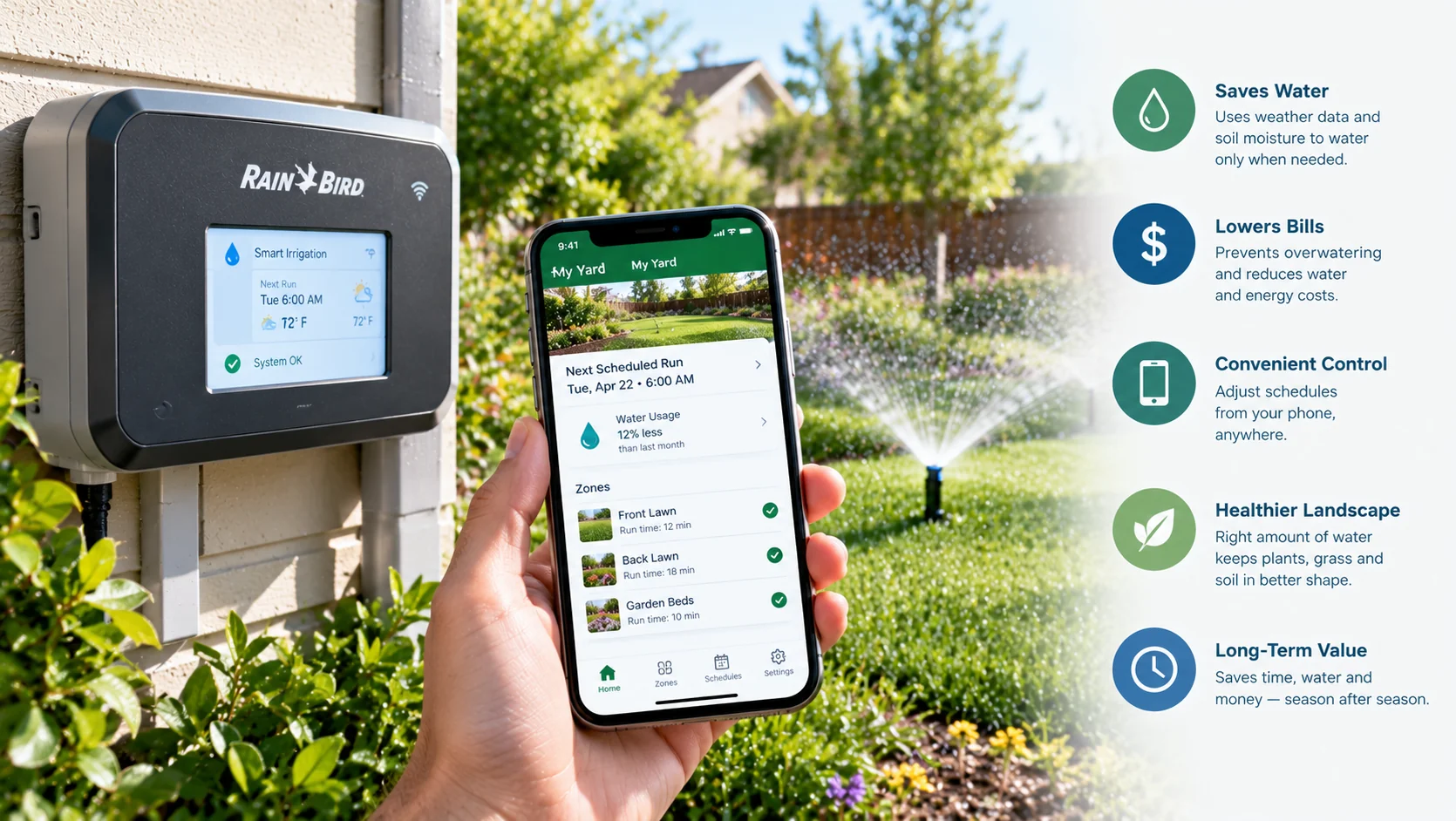
Published savings run from 6% to 92%, and both ends are real measurements from different yards.2 The smart controller savings calculator estimates your own number, and this article shows why the range is so wide and where your lawn falls.
Below: how the two controller types work, what field studies measured, who saves and who ends up using more, a payback formula with a worked example, and how to set one up so it earns its keep.
Key takeaways
- Typical savings are about 6% to 15% of outdoor water. Heavy irrigators save 40% or more, and underwatered lawns use more.
- EPA puts the average saving at nearly 7,600 gallons (28,800 liters) a year for a WaterSense labeled weather-based controller, and more than 15,000 gallons (56,800 liters) for a soil moisture sensor.
- Application ratio, water applied divided by plant need, predicts your result. A ratio of 1.5 caps savings at 33%; a ratio of 0.8 raises use by 25%.
- Payback is installed cost divided by net annual savings: about 2.4 years for the example lawn at 15% savings.
- Default settings usually need fine-tuning for weeks or months, and no controller fixes poor sprinkler coverage.
What is a smart sprinkler controller and how does it work?
A standard timer waters on fixed days at fixed run times, whatever the weather. A smart controller uses weather data or soil moisture readings to shorten, lengthen or skip scheduled watering.3 EPA's WaterSense program labels both kinds, and either can be a stand-alone controller or an add-on to your existing timer.4,5
Weather-based (ET) controllers
Weather-based controllers estimate how much water the lawn lost to evapotranspiration (ET), the combined evaporation and plant water use, and replace some or all of it.3 Signal-based units receive weather or ET data over a network, often Wi-Fi with a phone app. Historical-ET units run a stored regional water-use curve. On-site units measure weather at the controller.3
All three are only as accurate as the zone data you enter: slope, shade, soil, plant type and sprinkler application rate.3 The evapotranspiration calculator runs the same ET arithmetic.
Soil moisture sensor controllers
Soil moisture sensor (SMS) controllers bury a probe in the root zone. In the common bypass design, the probe connects to an existing timer and blocks a scheduled run when the soil is wetter than a set threshold. On-demand units start and stop watering themselves.3 A single sensor belongs in the driest zone, with the run times of the other zones trimmed by hand.3
Irrigation controller types compared
| Type | What it reads | What it does | Field savings reported |
|---|---|---|---|
| Clock timer | Nothing | Runs a fixed schedule | Baseline; applies about 47% more water than manual watering on average2 |
| Rain sensor | Rainfall | Skips a run during or after rain | 21% in a 2014 meta-analysis2 |
| Weather-based (ET) controller | Weather, site and plant data | Adjusts run times or watering days | 15% in the same meta-analysis; 6.1% across 2,294 California sites2,1 |
| Soil moisture sensor | Root-zone moisture | Bypasses runs, or starts and stops them | 38% in the same meta-analysis2 |
The meta-analysis pooled 42 data points and excluded studies of high-water users. Baselines and climates differ, so compare within a row, not across rows.
How much water do smart controllers actually save?
EPA estimates that a WaterSense labeled weather-based controller saves an average home nearly 7,600 gallons (28,800 liters) a year compared with a clock-based controller. For a soil moisture sensor the figure is more than 15,000 gallons (56,800 liters).4,5 Nationally, outdoor use is about 30% of household water, and much more in the arid West.6
Independent field studies give a lower range. A 2009 evaluation of 2,294 California sites, then the largest field study of smart controllers, found average outdoor use fell 6.1% after installation.1 A 2024 review of 80 residential studies found reductions from 6% to 92%, with about 15% for typical users and more than 40% for heavy ones.2
Measured savings from smart controllers
| Source | What was measured | Result |
|---|---|---|
| California utility programs, 2009 | 2,294 sites, weather-normalized, first year | 6.1% less outdoor use; 47,300 gal (179,000 L) per site1 |
| Same California study, 3 years | 384 sites, change versus the year before installation | Year 1 up 6%; year 2 down 7.8%; year 3 down 16.4%1 |
| Review of 80 residential studies, 2024 | Typical users versus heavy irrigators | About 15% versus more than 40%2 |
| University of Florida | Properly installed and programmed ET controllers on homes | 21% to 31% reduction3 |
Not directly comparable: baselines, climates and sample sizes differ. More than 90% of the three-year California controllers were one technology.
The spread comes from who was tested: results of 40% and above come from studies of heavy irrigators.2 The California researchers found the same pattern, with pre-installation application the most important factor in whether a site saved.1
Are smart sprinkler controllers worth it for your yard?
It depends on one ratio. The California researchers called it the application ratio: the water a site applied divided by the theoretical irrigation requirement for its landscape, which is set by local ET, the plant factor and effective rain. A ratio above 1.0 means you overwater, and a smart controller aims to bring it to 1.0.1
The data show why that matters. Sites that cut their application after installation had a median starting ratio of 137%. Sites that increased it had a median of 95%, so more than half of them were already watering below the theoretical requirement.1
Formula
Change in use = (1 ÷ application ratio) − 1
Application ratio = water applied ÷ plant water need, both in inches per year. A negative result is a saving. The formula assumes the controller delivers exactly the plant need, so treat it as a ceiling.
Where your application ratio puts the savings ceiling
| Application ratio | What it means | Change in use if the controller delivers exactly plant need |
|---|---|---|
| 0.80 | Watering 20% below plant need | Up 25% |
| 1.00 | Matches plant need | No change |
| 1.25 | Watering 25% above plant need | Down 20% |
| 1.50 | Watering 50% above plant need | Down 33% |
| 2.00 | Watering 100% above plant need | Down 50% |
A ceiling, not a forecast: it ignores uneven coverage, and the California average was 6.1%.
To find your ratio, convert last year's irrigation gallons to inches with the inches of water to gallons calculator, then divide by plant need from the lawn water requirement calculator, adjusting for rain with the effective rainfall calculator. A 5,000 sq ft (465 m²) lawn that received 36 inches (914 mm) where need is 27 inches (686 mm) has a ratio of 1.33 and a savings ceiling of 25%.
Likely to save
- You run one schedule all season and rarely adjust it.
- Your application ratio is 1.25 or higher.
- Runoff reaches the street or the lawn stays soggy after watering.
- You have a large landscape or a high price per 1,000 gallons.
Unlikely to save
- You already water below plant need and accept some brown patches.
- Your application ratio is near or below 1.0.
- Your lawn is small and your water is cheap.
- Heads are misaligned or leaking, which a controller cannot fix.
Florida field studies reached the same conclusion for the second group: users already irrigating below well-watered levels, and accepting some decline in landscape quality, will not benefit.2
How long does a smart controller take to pay back?
Payback depends on how much water your lawn gets, what you pay for it, and what the controller costs installed. The California cost analysis assumed a 10-year useful life, so a payback well under 10 years is a reasonable bar.1
Formula
Payback (years) = installed cost ÷ (annual dollar savings − annual fees)
Annual dollar savings = annual irrigation gallons × savings rate × price per 1,000 gallons ÷ 1,000. Annual irrigation gallons = area (sq ft) × inches applied × 0.623.
- Find annual irrigation water. Multiply area by inches applied per year, then by 0.623. Get inches from run time times precipitation rate; the sprinkler precipitation rate calculator converts your catch-can or nozzle data.
- Pick a savings rate. Use 6% (California average), 15% (typical, 2024 review) and 40% (heavy irrigators) as low, middle and high cases.
- Use your price per 1,000 gallons. Take the rate of the tier your irrigation water falls in. If you are billed per hcf (748 gallons), divide the hcf price by 0.748. The irrigation water cost calculator handles the gallons-to-dollars step.
- Subtract annual fees. Some signal-based controllers charge a yearly data fee, and about 48% of 46 California survey respondents said they would stop paying it, which turns the unit back into a plain timer.1
- Divide. Installed cost divided by net annual savings gives years to break even.
For reference, at average savings the California analysis justified spending up to $229 over 10 years for a 4,000 sq ft landscape on water at $3 per hcf (about $4.01 per 1,000 gallons), and $458 for 12,000 sq ft at $2 per hcf (about $2.67).1
Enter lawn area, how much you water now and your water price to see estimated annual savings.
Worked example: payback on a 5,000 sq ft lawn
Take a 5,000 sq ft (465 m²) lawn on a timer that applies 36 inches (914 mm) a year. Water costs $5.00 per 1,000 gallons ($1.32 per cubic meter) and a smart controller costs $200 installed, with no annual fee. Price and cost are example inputs, not sourced figures; replace them with yours.
- Annual water applied5,000 × 36 × 0.623 = 112,140 gal
- Savings rate15%
- Water saved per year112,140 × 0.15 = 16,821 gal
- Value of that water16,821 ÷ 1,000 × $5.00 = $84
- Annual fees$0
- Payback$200 ÷ $84 = 2.4 years
About 2.4 years at 15% savings
Metric: 112,140 gal is about 424,000 liters applied, and 16,821 gal is about 63,700 liters saved a year, worth about $84 at $1.32 per cubic meter.
The same lawn at three savings rates
| Savings rate | Water saved per year | Dollars saved per year | Payback on $200 |
|---|---|---|---|
| 6% (California average) | 6,728 gal (25,500 L) | $34 | 5.9 years |
| 15% (typical, 2024 review) | 16,821 gal (63,700 L) | $84 | 2.4 years |
| 40% (heavy irrigator) | 44,856 gal (169,800 L) | $224 | 0.9 year |
Assumes 36 inches a year, $5.00 per 1,000 gallons, a $200 unit and no fees. The 40% row implies a plant need of about 22 inches.
Why do some smart controllers save little water?
Most shortfalls trace to setup, not hardware. The California researchers warned that default settings usually need fine-tuning over the first weeks or even months, and that this is not a device to install and forget.1 Savings also build slowly: at 384 sites tracked for three years, use rose 6% in year 1, then fell 7.8% in year 2 and 16.4% in year 3 against the year before installation.1
A controller also cannot correct poor sprinkler coverage; the same report says even the best one cannot run well on a system with poor head spacing and low distribution uniformity.1 Measure yours with a catch-can test and score it with the distribution uniformity calculator first.
Owners who installed their own units cut use 9.0%, against 3.6% for professional installs, which was not statistically significant. The researchers called the cause unclear.1
- Measure each zone. Run a catch-can test and enter the measured precipitation rate. The sprinkler precipitation rate chart lists typical rates to sanity-check your result.
- Enter real zone data. Set plant type, soil, slope, shade and sprinkler type for every zone, the inputs ET controllers rely on.3
- Prevent runoff. On clay or slopes, split long runs into short cycles. The cycle and soak calculator sets the cycle length.
- Compare and adjust. Compare the first month's run times with your old timer's, watch the lawn, and change one zone at a time. Judge the result on bills after a full season.
Tip: write down your old schedule first
Record every zone's days and run times before you replace the timer. You need the old numbers to see what the new controller changed.
What should you look for when choosing a smart controller?
Start with the WaterSense label. Labeled weather-based controllers are independently certified for irrigation adequacy, irrigation excess and supplemental features such as handling local watering restrictions, and the test method is now a consensus standard, ANSI/ASABE S627.4
- Weather-based or soil moisture. Sensor studies tend to show larger savings, but sensors must be buried, usually one per zone, with wiring back to the controller. The 2024 review recommends weather-based units for targeted outreach programs because they only replace the timer.2
- Stand-alone or add-on. Add-on devices work with an existing clock-based controller.4 Confirm compatibility with your timer's make and model before you buy.
- Rebates. Some utilities offer rebates on labeled controllers, so check before you buy.4
Large, commercial and agricultural systems need a design review by a certified irrigation professional, and city watering restrictions override any controller schedule.
When is a smart controller not worth buying?
Skip it if your application ratio is near or below 1.0, because the controller will hold use level or raise it. Skip it, or wait, if the arithmetic does not close. A 1,000 sq ft (93 m²) lawn receiving 36 inches uses 22,428 gallons (84,900 liters) a year. At 15% that saves 3,364 gallons (12,700 liters). At $5.00 per 1,000 gallons that is about $17 a year, a payback of about 12 years on a $200 unit and longer than the 10-year life in the California analysis.1
Cheaper steps often capture part of the gain first. Fix leaks and misaligned heads, and cut run times with the season; the seasonal adjustment calculator gives the percentage for each month. For planting beds, the drip conversion savings calculator compares drip with spray.
Money is not the only return. The California researchers also listed less runoff, better landscape health and diagnostics that expose coverage problems, and many participants valued the convenience.1
Frequently asked questions
Can a smart controller raise my water use?
Yes. A smart controller schedules to plant need, so a lawn that is underwatered now gets more water. In the California study of 2,294 sites, 41.8% showed a statistically significant increase in application after installation. Those sites had a median starting application ratio of 95%, meaning most were already watering below plant need.
Do smart sprinkler controllers need Wi-Fi?
Not always. Signal-based weather controllers get ET data over a network, and many newer units use Wi-Fi with a phone app. Historical-ET controllers run a stored regional curve, on-site units read their own weather sensors, and soil moisture sensors need no weather feed. Ask whether a recurring data fee applies before you buy.
What does the WaterSense label mean on an irrigation controller?
WaterSense is the EPA efficiency label, earned through independent certification. Weather-based models are tested for irrigation adequacy, meaning plant needs are met, and irrigation excess, meaning overwatering is avoided. They must also include supplemental features, such as the ability to accommodate watering restrictions. The label does not guarantee your settings are right.
Is a soil moisture sensor better than a weather-based controller?
Studies tend to show higher savings for soil moisture sensors, but conditions differ, so the comparison is loose. Sensors must be buried in the root zone, usually one per zone, with wiring back to the controller. A weather-based controller replaces the timer without underground work, which is why a 2024 review favors it for outreach programs.
How long until a smart controller starts saving water?
Not necessarily in year one. In the California study of 384 sites tracked for three years, water use rose 6% in year 1, then fell 7.8% in year 2 and 16.4% in year 3 compared with the year before installation. Most of those controllers were one technology, and settings usually needed fine-tuning during the first weeks or months.
Sources
- Mayer, P., DeOreo, W., Hayden, M., Davis, R., Caldwell, E., Miller, T. and Bickel, P. (2009). Evaluation of California Weather-Based “Smart” Irrigation Controller Programs. Aquacraft, Inc. and National Research Center, Inc., for the California Department of Water Resources.
- Smart Irrigation Controllers in Residential Applications and the Potential of Integrated Water Distribution Systems. Journal of Water Resources Planning and Management, vol. 150, no. 1 (January 2024). American Society of Civil Engineers. Review of 80 residential studies.
- Dukes, M.D. and Cardenas, B. Smart Irrigation Controllers: What Makes an Irrigation Controller Smart? Publication AE442. University of Florida IFAS Extension.
- U.S. Environmental Protection Agency, WaterSense. Weather-Based Irrigation Controllers. Page last updated March 6, 2026.
- U.S. Environmental Protection Agency, WaterSense. Soil Moisture-Based Irrigation Controllers. Page last updated March 5, 2026.
- U.S. Environmental Protection Agency, WaterSense. How We Use Water. Page last updated August 4, 2026.
Written by Daniel Reeves, PE, CID. Figures in this article were calculated from the cited sources and checked against our lawn watering cost calculator. Read how we calculate and our editorial policy. Spotted an error? Tell us.