Zoysia Grass Watering Guide
Zoysia uses about 25% less water than cool-season turf, but too much invites thatch and disease. This guide gives weekly inches, days between waterings by soil, and minutes to set on your controller.

By Daniel Reeves, PE, CID
Irrigation Design Engineer
Short answer
Established zoysia needs about 0.5 to 1 inch (13 to 25 mm) of water a week, applied in 1 or 2 deep waterings of 0.5 to 0.75 inch (13 to 19 mm) each.12
These zoysia grass watering amounts include rain and apply to the growing season. Use the low end in spring and fall, the high end in hot summer weather, and up to about 1.25 inches (32 mm) in a hot, dry climate. Each watering should wet the top 4 to 6 inches of soil, and sandy soil needs smaller, more frequent runs.1
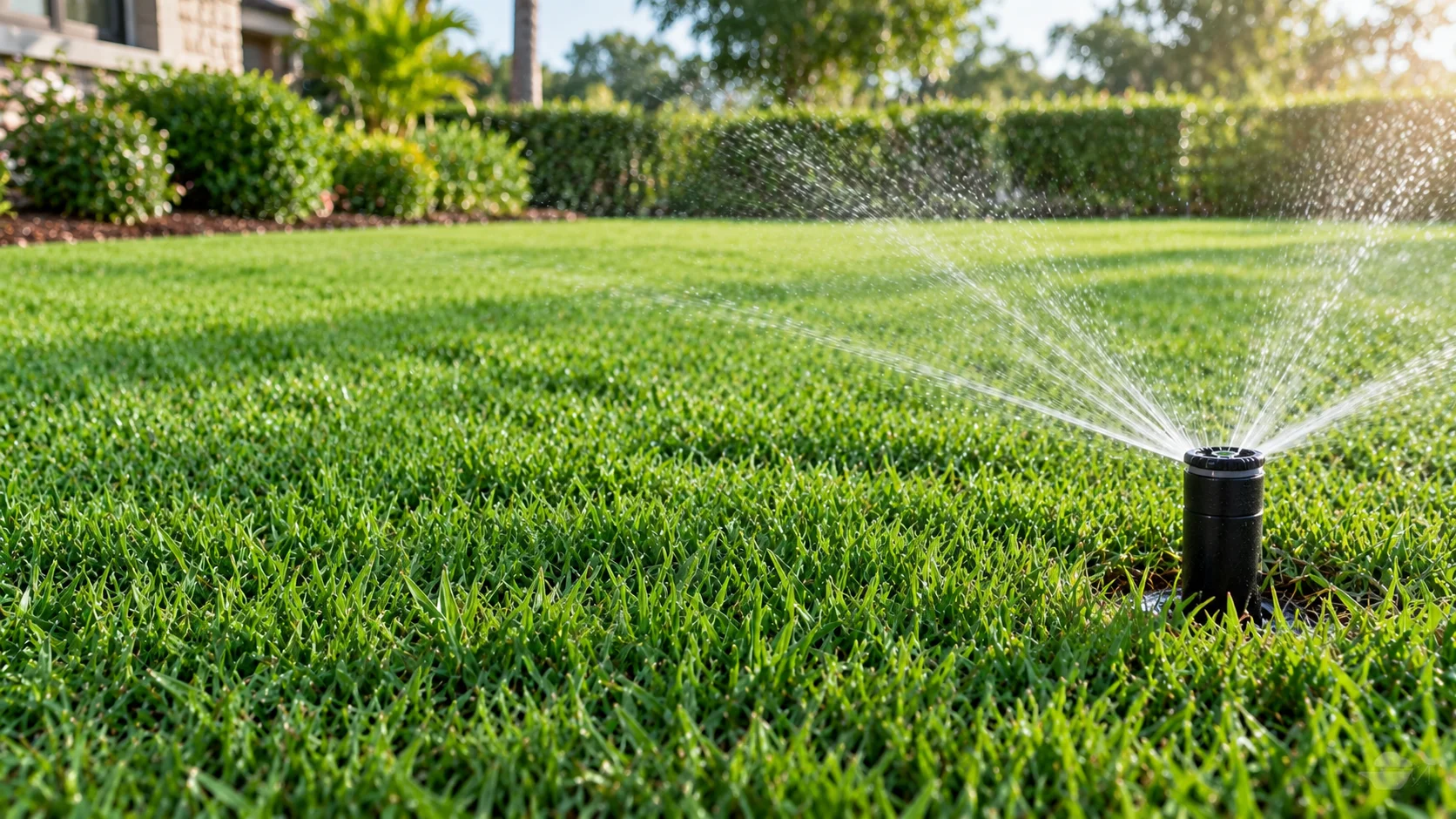
Advice on zoysia splits into two camps: an inch a week on a timer, or almost nothing because zoysia tolerates drought. Both are wrong somewhere. The lawn watering schedule calculator returns days per week and minutes per run for your own grass, soil and sprinklers, and this guide explains the method behind it.
Zoysia (Zoysia spp.) is a warm-season grass that uses about a quarter less water than cool-season turf,3 yet it builds thatch quickly and punishes overwatering.1 Below you will find weekly totals, days between waterings by soil, run times, and what to do for new sod and for brown, dormant turf.
Key takeaways
- Weekly use = ETo × 0.6. That gives 0.42 to 1.26 inches (11 to 32 mm) a week depending on weather, and NC State's 0.5 to 1 inch covers most climates.
- Apply 0.5 to 0.75 inch (13 to 19 mm) per watering, enough to wet the top 4 to 6 inches.
- In a mild summer, loam and clay need water every 4.2 to 6.9 days, while sand needs it every 2.1 to 3.5 days.
- Zoysia can go brown in drought and regain its color when water returns, so a dormant lawn needs far less than summer rates.
- Too much water brings thatch and large patch disease, so water for depth and wait for the turf or the soil to ask.
- Minutes per run = depth to apply ÷ precipitation rate × 60. Measure the rate instead of guessing it.
How much water does zoysia grass need each week?
NC State Extension puts zoysiagrass at 0.5 to 1 inch (13 to 25 mm) of water a week and says to irrigate when rain falls short.1 That range is a starting point, because weather moves the real number. Irrigation engineers measure weather demand as reference evapotranspiration (ETo), the water a short, well-watered grass loses to evaporation and plant use.4 A lawn's use is ETo times a crop coefficient, and ANSI/ASABE S623 gives warm-season turf, zoysia included, a plant factor of 0.6 against 0.8 for cool-season turf.3 In identical weather, zoysia needs 25% less than fescue (0.6 ÷ 0.8 = 0.75).
Table 1 applies that factor to four weather patterns. The ETo values are round planning numbers; your state weather network or controller data gives the local figure, and the lawn water requirement calculator does the multiplication.
Zoysia water use per week by weather
| Weather | Reference ET (ETo) | Zoysia use per day (ETo × 0.6) | Zoysia use per week |
|---|---|---|---|
| Spring or fall, most regions | 0.10 in/day (2.5 mm) | 0.06 in (1.5 mm) | 0.42 in (11 mm) |
| Mild summer (coastal, northern states) | 0.15 in/day (3.8 mm) | 0.09 in (2.3 mm) | 0.63 in (16 mm) |
| Hot, humid summer (Southeast, Midwest) | 0.20 in/day (5.1 mm) | 0.12 in (3.0 mm) | 0.84 in (21 mm) |
| Hot, dry summer (inland West, desert) | 0.30 in/day (7.6 mm) | 0.18 in (4.6 mm) | 1.26 in (32 mm) |
Planning values: typical daily ETo for each weather type, before rain. Weekly use is daily use × 7. Normal weather lands inside the 0.5 to 1 inch NC State range; only hot, dry climates exceed it.
To compare zoysia with other turf, use the grass type water needs calculator or the lawn watering by grass type chart.
How soil type changes the days between waterings
Soil works like a tank. Roots draw on a limited reserve, and you refill it before the grass runs short, which is about when half of the available water is gone.6 Days between waterings equal that refill depth divided by daily use. UC lists available water by soil texture,5 and NC State has you irrigate to a depth of 4 to 6 inches, checked by pushing a screwdriver into the soil.1 Table 2 uses the top 6 inches.
Days between waterings for zoysia, by soil and weather
| Soil | Water held per foot | Refill depth per watering (top 6 in) | Mild summer (0.09 in/day) | Hot, dry summer (0.18 in/day) |
|---|---|---|---|---|
| Sandy (coarse sand, fine sand, loamy sand) | 0.75–1.25 in (19–32 mm) | 0.19–0.31 in (5–8 mm) | Every 2.1–3.5 days | Every 1.0–1.7 days |
| Loam (very fine sandy loam, loam, silt loam) | 1.50–2.30 in (38–58 mm) | 0.38–0.58 in (10–15 mm) | Every 4.2–6.4 days | Every 2.1–3.2 days |
| Clay (sandy clay, silty clay, clay) | 1.60–2.50 in (41–64 mm) | 0.40–0.63 in (10–16 mm) | Every 4.4–6.9 days | Every 2.2–3.5 days |
Planning values: UC available water by texture, refilling half of it in the top 6 inches, no rain, uniformity ignored. Zoysia roots that reach below 6 inches stretch these intervals.5
NC State's sandy-soil guidance, up to 0.5 inch every third day,1 sits inside the 2.1 to 3.5 days the table gives for a mild summer. Sand holds so little that a heavy run drains below the roots, so smaller, more frequent watering suits it.
Clay and slopes shed water before it soaks in. When a run starts to puddle or reaches the pavement, split it into shorter cycles with a soaking break between them; the cycle and soak calculator sets the cycle length. To estimate your own soil, the available water capacity calculator converts texture and root depth into inches.
Zoysia grass watering schedule by season
Frequency should change with the seasons while the depth per watering stays about the same. UF/IFAS says exactly that: change how often you water, not how much.2 Table 3 turns the weekly totals from Table 1 into waterings per week on loam.
Waterings per week for zoysia on loam, by weather
| Weather | Zoysia use per week | Waterings per week | Applied per watering (DU 0.7) |
|---|---|---|---|
| Spring or fall, most regions | 0.42 in (11 mm) | 1 | 0.60 in (15 mm) |
| Mild summer | 0.63 in (16 mm) | 2 | 0.45 in (11 mm) |
| Hot, humid summer | 0.84 in (21 mm) | 2 | 0.60 in (15 mm) |
| Hot, dry summer | 1.26 in (32 mm) | 3 | 0.60 in (15 mm) |
Weekly use from Table 1. Waterings = weekly use ÷ 0.475 in (the loam midpoint from Table 2), rounded up. Applied depth = weekly use ÷ 0.7 ÷ waterings. Sandy soil needs more waterings than shown; clay on a slope may need cycle and soak.
A controller left on its July program overwaters in October by a wide margin. In the table, a spring or fall week needs 0.42 inch, half of the 0.84 inch of a hot, humid summer week. Adjust monthly, or use a seasonal percentage setting; the seasonal adjustment calculator gives the percentage for each month.
Rain resets the clock. About 0.5 inch that soaks in refills loam, so skip the next scheduled run, and use the effective rainfall calculator to estimate how much of a storm the lawn can use. Follow any local watering-day limits by splitting the same weekly depth across the allowed days.
Tip: change days first, minutes second
When weather cools, drop a watering day before you shorten the run. Each watering should still reach 4 to 6 inches, or roots stop following the water down.
How to set your zoysia watering schedule
The method takes four numbers and about ten minutes.
Formula
Waterings per week = weekly use ÷ refill depth per watering, rounded up
Weekly use = ETo × 0.6 − effective rain. Refill depth = root zone depth (ft) × water held per foot × 0.5. Minutes per watering = (weekly use ÷ DU ÷ waterings) ÷ precipitation rate × 60. DU is distribution uniformity as a decimal.
- Get weekly use. Multiply weekly ETo by 0.6, then subtract the rain that soaked in.
- Find the refill depth. Multiply root zone depth in feet by the soil's water held per foot, then by 0.5. The irrigation interval calculator turns refill depth and daily use into days between waterings.
- Divide and round up. Weekly use divided by refill depth gives waterings per week. Space them evenly.
- Convert to minutes. Divide the depth to apply by your precipitation rate. Run a catch-can test to measure that rate, assume a DU of 0.7 until you have tested, and let the how long to water lawn calculator convert inches to minutes per zone.
Enter grass, soil, sprinkler type and weather. The calculator returns waterings per week and minutes per zone.
Worked example: zoysia on loam in a hot, humid July
Take a 4,000 sq ft zoysia lawn on loam in a hot, humid July week. ETo averages 0.20 inch a day, no rain falls, the rotor zone measures 0.6 in/hr in a catch-can test, and DU is an assumed 0.7.
- Weekly ETo0.20 in/day × 7 = 1.4 in
- Zoysia use1.4 × 0.6 = 0.84 in
- Refill depth (loam, 6 in roots)0.5 ft × 1.9 in/ft × 0.5 = 0.475 in
- Waterings per week0.84 ÷ 0.475 = 1.8, round up to 2
- Water to apply per week0.84 ÷ 0.7 = 1.2 in
- Water per watering1.2 ÷ 2 = 0.6 in
- Minutes per watering0.6 ÷ 0.6 × 60 = 60 min
- Weekly volume4,000 × 1.2 × 0.623 ≈ 2,990 gal
2 waterings a week, about 60 minutes each
Space them every 3 to 4 days. Metric: 1.2 in is 30 mm a week, 15 mm per watering, or roughly 11,300 liters over 372 m².
Check the result against the soil. Each watering returns 0.42 inch of use (0.6 × 0.7), under the 0.475 inch the loam supplies, and the soil alone would allow about 4 days (0.475 ÷ 0.12 in/day), so a 3.5-day spacing has margin. The 0.6 inch applied also sits inside the 0.5 to 0.75 inch per application that UF/IFAS gives.2 If 60 minutes puddles, run two 30-minute cycles.
Signs your zoysia needs water, and signs of too much
The calendar sets the starting point and the turf corrects it. NC State lists a dark bluish-gray color, footprints that linger, and wilted, folded or curled leaves as the cue to water.1 Check a few times a week during the first month of a new schedule.
Water now
- Footprints stay visible after you walk across the lawn.
- Leaves turn dark bluish-gray, or fold and curl.
- Dry patches reappear in the same spots each week.
UF/IFAS adds that large patch becomes a problem with excess soluble nitrogen and irrigation together.2 If the lawn shows stress before the next scheduled day, add a watering. If the probe is wet at 6 inches, push the next one back a day, and change one thing at a time for two weeks.
How to water new zoysia sod, plugs and seed
New zoysia follows a different rhythm. UF/IFAS says to water new sod at least twice a day with 0.25 inch until new roots hold it fast, usually 2 to 3 weeks, and then drop to as-needed watering.2 That is 0.5 inch a day, about 310 gallons per 1,000 sq ft (1,180 liters per 93 m²). Plugs establish slowly, typically over two to four years, so keep them from drying out while they spread.1
Seeded zoysia (Zoysia japonica is the species sold as seed) needs light to germinate, so it cannot be buried, and the soil must stay moist until the grass is well rooted. UF/IFAS gives April to July as the best seeding window.2 The sod watering calculator and grass seed watering calculator give a day-by-day taper for each.
Should you water brown or dormant zoysia?
Usually not at summer rates. Zoysia responds to drought by turning brown and going dormant, can stay dormant for extended periods, and regains its color when rain or irrigation returns. UF/IFAS calls letting it go off-color an acceptable way to conserve water.2 If you want green turf through a dry spell, apply 0.5 to 0.75 inch when leaves wilt or turn blue-gray.2
In winter, NC State says a dormant lawn needs little water, but irrigate when the soil is powder dry and occasionally during a drought.1 Pushing a screwdriver into the ground answers the question faster than the calendar.
Frequently asked questions
Can you overwater zoysia grass?
Yes. NC State Extension links thick thatch to over-irrigation, and UF/IFAS lists large patch disease as a risk of excess irrigation and soluble nitrogen. Water only when the grass shows stress or the soil is dry at 4 to 6 inches, and apply 0.5 to 0.75 inch per watering rather than small daily amounts.
Does zoysia grass use less water than Bermuda grass?
Not by the standard plant factors. UC, citing ANSI/ASABE S623, lists the same 0.6 value for zoysia, Bermuda, St. Augustine and buffalo grass, so weekly need from ETo is the same. Real differences come from cultivar, shade, soil depth, thatch and how deeply you water, so judge by how your own lawn responds.
How many gallons of water does zoysia need per 1,000 square feet?
One inch of water over 1,000 square feet is about 623 gallons (2,360 liters). At 0.5 to 1 inch a week, a zoysia lawn needs about 312 to 623 gallons (1,180 to 2,360 liters) per 1,000 square feet each week. Multiply by your lawn area divided by 1,000, then subtract rain that soaked in.
How long should you run sprinklers on zoysia?
Run time equals the depth to apply divided by your precipitation rate, times 60. For 0.5 inch, a spray zone at 1.5 in/hr runs about 20 minutes and a rotor zone at 0.4 in/hr runs about 75 minutes. Those times ignore uneven coverage, so measure the real rate and stop early if water puddles.
Why is my zoysia turning brown even though I water it?
Three causes are common. Drought stress shows as dark bluish-gray leaves that fold or curl, and a deeper watering fixes it. Dormancy turns the whole lawn straw-brown and reverses when water returns. Large patch disease makes circular tan or brown sunken patches 2 to 10 feet wide, often after too much irrigation or rain.
Does rain count toward zoysia's weekly water?
Yes. The 0.5 to 1 inch weekly figure from NC State Extension is a total, and irrigation only fills the gap rain leaves. On loam, about 0.5 inch of rain that soaks in replaces one watering, because the top 6 inches refill by about that much. Check a rain gauge before the next scheduled run.
Sources
- Miller, G., Kerns, J. and Billeisen, T. (2025). Zoysiagrass Lawn Maintenance Calendar. AG-432. NC State Extension.
- Lindsey, A.J. Homeowners Guide to Zoysiagrass Management in Florida. UF/IFAS Environmental Horticulture, University of Florida.
- UC Center for Landscape & Urban Horticulture. Plant Factor or Crop Coefficient: What's the Difference? University of California Agriculture and Natural Resources. Values adapted from ANSI/ASABE S623.
- Allen, R.G., Pereira, L.S., Raes, D. and Smith, M. (1998). Crop Evapotranspiration: Guidelines for Computing Crop Water Requirements. FAO Irrigation and Drainage Paper 56. Food and Agriculture Organization of the United Nations.
- UC Center for Landscape & Urban Horticulture. Soil Water Holding Characteristics. University of California Agriculture and Natural Resources.
- Yonts, D. Irrigation Chapter 3: Soil Water. University of Nebraska-Lincoln Extension.
Written by Daniel Reeves, PE, CID. Figures in this article were calculated from the cited sources and checked against our lawn watering calculator. Read how we calculate and our editorial policy. Spotted an error? Tell us.