Watering Lawns on Slopes and Clay Soil (Stopping Runoff)
Clay absorbs water slowly and slopes shed it fast, so a standard run time sends much of it down the street. This guide gives the cycle length, soak time and sprinkler fixes that stop runoff.

By Daniel Reeves, PE, CID
Irrigation Design Engineer
Short answer
On clay, run each zone in cycles of about 4 to 6 minutes for spray heads or 15 to 20 minutes for close-spaced rotors, with at least 60 minutes of soak time between cycles.2
Watering lawns on slopes and clay soil works only when water goes on no faster than the ground absorbs it. Compacted clay under sod takes about 0.2 inch (5 mm) an hour, and a 6% to 11% slope cuts each cycle by roughly 25 to 40 percent.12
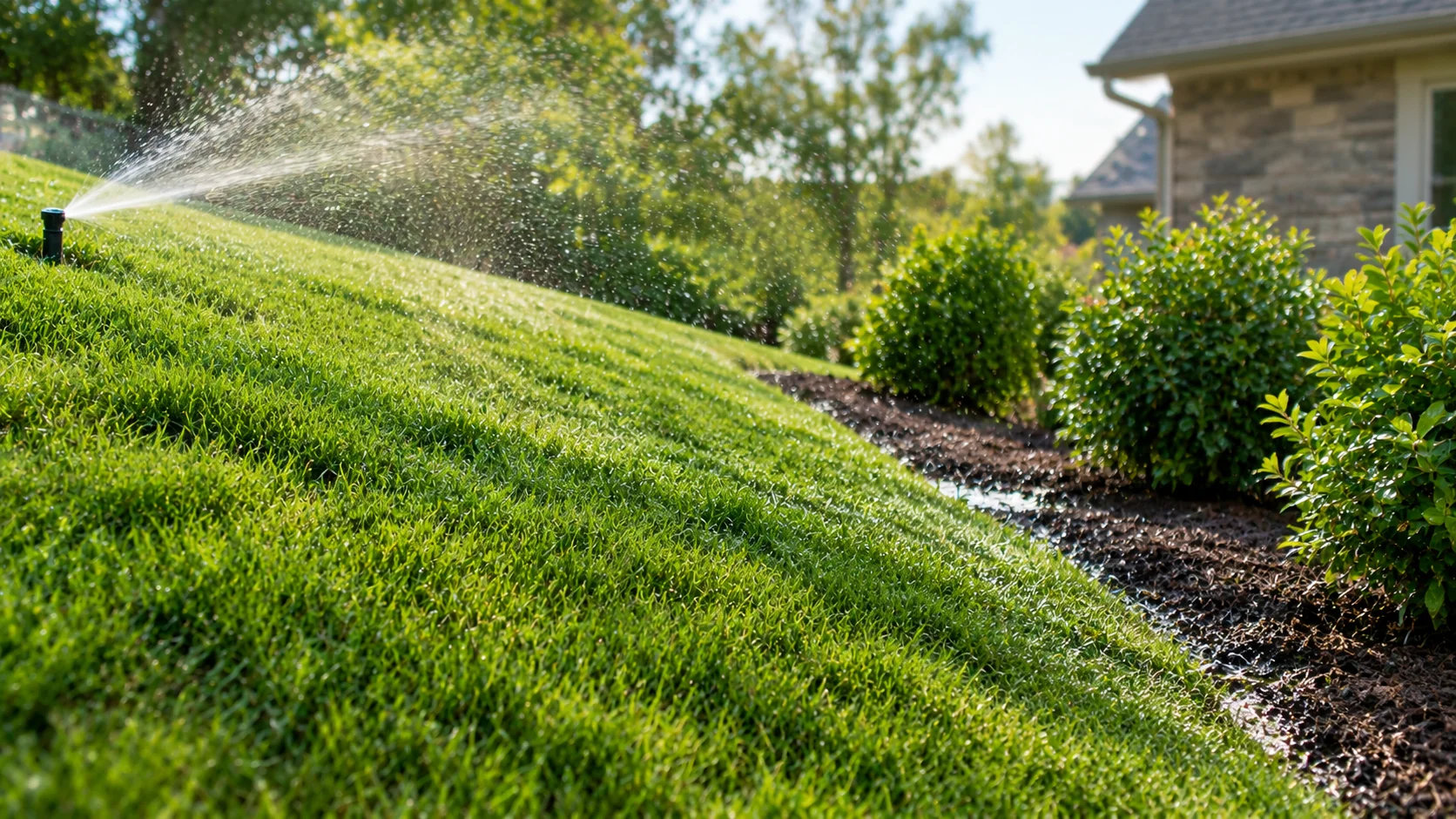
A standard 20-minute run gives clay more water than it can take in one go, and on a slope the surplus travels downhill. The cycle and soak calculator splits your run time into cycles that fit your soil, sprinkler and slope, and this guide shows the numbers behind it.
Below you will find how fast clay and other soils absorb water, the longest safe cycle for spray heads and rotors on flat and sloped ground, a formula with a worked example, and the changes that raise the limit.
Key takeaways
- Runoff starts when the sprinkler's precipitation rate beats the soil's intake rate. Compacted clay takes about 0.2 inch (5 mm) an hour; spray heads apply 1.4 to 2.0 inches (36 to 51 mm) an hour.
- On level clay, run spray zones 4 to 6 minutes and close-spaced rotor zones 15 to 20 minutes per cycle, then soak at least 60 minutes.
- A 6% to 11% slope shortens those cycles to 3 to 4 minutes for spray heads and 10 to 15 for rotors.
- Cycles per watering = total run time ÷ cycle limit. Several cycles in a day beat extra watering days.
- Aerate clay once or twice a year and match sprinklers to the soil to raise the limit.
Why is watering lawns on slopes and clay soil so prone to runoff?
Runoff starts when the sprinkler's precipitation rate exceeds the soil's intake rate. Clay has very small pores, so even healthy turf on clay absorbs slowly, and compaction from house construction makes it worse.1 Slope adds a second loss: water that has not soaked in moves downhill, so the top of a slope runs dry while the bottom stays wet.1
K-State's turf specialists rate a compacted clay slope as close to the hardest lawn to water.1 The fix is a combination of shorter cycles, slower sprinklers and better soil rather than a single setting.
How fast can your soil absorb water?
Intake rate is the depth of water the soil takes in per hour. K-State lists what soil absorbs without runoff under healthy sod:1
Water absorbed per hour without runoff, by soil
| Soil | Absorbed without runoff, under healthy sod |
|---|---|
| Coarse sandy loam | 1.3 in/hr (33 mm/hr) |
| Sandy loam | 1.0 in/hr (25 mm/hr) |
| Silt loam | 0.6 in/hr (15 mm/hr) |
| Silty clay loam | 0.5 in/hr (13 mm/hr) |
| Compacted clay | 0.2 in/hr (5 mm/hr) |
K-State planning values.1 FAO basic infiltration rates are 1 to 5 mm/hr (0.04 to 0.2 in/hr) for clay and 10 to 20 mm/hr (0.4 to 0.8 in/hr) for loam.3
Compare those numbers with your sprinklers. Spray heads apply 1.4 to 2.0 inches an hour (36 to 51 mm/hr) and rotors 0.3 to 0.7 inch (8 to 18 mm/hr).2 Against compacted clay at 0.2 inch an hour, spray heads apply water 7 to 10 times faster than the soil absorbs it and rotors 1.5 to 3.5 times faster.
Depth matters as well. Soaking compacted clay 6 to 8 inches deep takes 1 to 1.3 inches of water and about 5 hours to absorb, against about 2 hours per inch on loam.1 Find your rate with the soil infiltration rate calculator or the soil infiltration rate chart, and your sprinkler's side with the sprinkler precipitation rate calculator.
How much does slope shorten each cycle?
Slope percent is the drop divided by the run, times 100, so 8 feet over 100 feet is 8%. Texas A&M AgriLife treats slopes under about 5% as flat to low and 6% to 11% as medium, and sets a ceiling on each cycle for both:2
Maximum runtime per cycle on clay soil, by sprinkler, spacing and slope
| Sprinkler and spacing | Precipitation rate | Under 3% to 5% slope | 6% to 11% slope |
|---|---|---|---|
| Spray heads under 12 ft (3.7 m) apart | 1.4–2.0 in/hr (36–51 mm/hr) | 4–6 min | 3–4 min |
| Spray heads over 12 ft apart | 1.4–2.0 in/hr (36–51 mm/hr) | 7–10 min | 4–6 min |
| Rotors under 25 ft (7.6 m) apart | 0.3–0.7 in/hr (8–18 mm/hr) | 15–20 min | 10–15 min |
| Rotors over 25 ft apart | 0.3–0.7 in/hr (8–18 mm/hr) | 45–60 min | 30–45 min |
Assumes at least 60 minutes of soak between cycles.2 These are ceilings, not targets, and slopes steeper than 11% fall outside the table. Sandy loam allows longer cycles.
K-State gives the same direction as a percentage: cut the watering rate 0 to 10 percent on 0% to 5% slopes, 10 to 20 percent on 5% to 10%, 20 to 45 percent on 10% to 15%, 45 to 60 percent on 15% to 20%, and 60 percent or more beyond 20%.1 Compacted soil needs shorter cycles still.2
How to set up cycle and soak
Cycle and soak divides one long run into several short ones, with a pause so each pulse soaks in before the next arrives. Several cycles in one day work better than adding watering days.2 Each watering should still wet the top 6 to 8 inches of soil, which keeps roots deep.4
Formula
Cycles = (depth ÷ precipitation rate × 60) ÷ cycle limit, rounded up
Depth is inches to apply, precipitation rate is in/hr, and the cycle limit is minutes from the table. Start times are spaced by cycle runtime plus soak time, with at least 60 minutes of soak on clay.
- Measure the precipitation rate. Run a catch-can test on each zone, because spray heads and rotors on the same lawn differ widely.
- Pick the cycle limit. Read the maximum runtime for your sprinkler, spacing and slope from Table 2.
- Find the total run time. The how long to water lawn calculator converts the depth you need into minutes per zone. Divide by the cycle limit and round up.
- Program the start times. Set 3 or 4 start times per day. If four or more cycles are needed, split them between early morning and late afternoon, and follow any local watering hours.2
Enter soil, slope, sprinkler rate and run time. The calculator returns cycles and soak minutes.
Tip: confirm the limit in the field
Run one zone and note the minute water starts to pool or flow toward the curb. Texas A&M advises fine-tuning cycle runtimes by watching each cycle in operation.2
Worked example: rotors on an 8% clay slope
Take a 3,000 sq ft tall fescue zone on clay, dropping 8 feet over 100 feet. Close-spaced rotors measure 0.5 inch an hour in a catch-can test, and you want to apply 0.5 inch per watering day.
- Slope8 ÷ 100 × 100 = 8%, medium
- Total run time0.5 ÷ 0.5 × 60 = 60 min
- Cycle limit (rotors, close, 6%–11%)10–15 min, use 10
- Cycles60 ÷ 10 = 6
- Depth per cycle0.5 × 10 ÷ 60 = 0.083 in
- Start-time spacing10 + 60 soak = 70 min
- First start to last stop5 × 70 + 10 = 360 min
- Water per watering3,000 × 0.5 × 0.623 ≈ 935 gal
6 cycles of 10 minutes, starting every 70 minutes
Metric: 279 m², 12.7 mm (2.1 mm per cycle), about 3,540 liters. Starting at 3:00 a.m. finishes at 9:00 a.m.
Six cycles of 0.083 inch add up to the 0.5 inch you planned. If water pools before a cycle ends, shorten it by a minute or two and add a cycle. The lawn watering schedule calculator sets how many days a week to repeat it.
How to raise the limit: aeration, nozzles and drip
Cycle and soak buys time but does not change what the soil can absorb. Three changes do. K-State advises aerating clay 2 to 3 inches deep once or twice a year, in spring and fall on slopes, and replacing clay compacted during construction with 6 to 8 inches of sandy loam when a lawn is rebuilt.1
Slower sprinklers help most. Rotors at 0.3 to 0.7 inch an hour suit clay far better than spray heads,2 and the matched precipitation calculator checks that nozzles in one zone apply water at the same rate. The sprinkler precipitation rate chart lists typical rates by head type. Keep water on the turf and off pavement, and fix misaligned heads.1
Above the 11% slope in the table, cycles shrink to a few minutes, and drip or bubblers are the practical choice. The drip irrigation calculator sizes emitters and run times. Large or steep sites, or runoff onto public streets that your city regulates, may need a licensed designer.
Frequently asked questions
How long should I run sprinklers on clay soil?
Run each cycle only until just before water pools. On level clay that is about 4 to 6 minutes for spray heads and 15 to 20 minutes for close-spaced rotors, with at least 60 minutes of soak time between cycles. Watch the first run, and shorten the cycle if puddles or runoff appear.
How do I water a lawn on a steep slope without runoff?
Shorten each cycle by roughly 25 to 40 percent on slopes of 6 to 11 percent, keep a 60-minute soak, and use sprinklers with a low precipitation rate. Slopes steeper than that leave very short cycles, so drip or bubblers are usually more practical. Large or steep sites may need a licensed designer.
Should I water more days instead of using cycle and soak?
No. Texas A&M AgriLife guidance says several short cycles in one day work better than adding watering days. Extra days wet only the surface and encourage shallow roots. Keep the weekly depth the same, apply it in cycles, and still aim to wet the top 6 to 8 inches of soil each time.
Does aerating clay soil help water soak in?
Yes. K-State Extension recommends aerating clay soil 2 to 3 inches deep once or twice a year to improve water penetration and root growth, and in spring and fall on slopes. Aeration raises the intake rate, so cycles can run a little longer, but it does not remove the need for soak time.
How can I tell my sprinklers apply water too fast?
Water pooling, running onto pavement or darkening the bottom of a slope before the cycle ends means the precipitation rate exceeds the soil intake rate. A catch-can test gives the rate in inches per hour. Compare it with about 0.2 inch per hour for compacted clay under sod.
Sources
- Hoyle, J. and Braun, R. (2018). Watering Your Lawn. MF2059. Kansas State University Agricultural Experiment Station and Cooperative Extension Service.
- Swanson, C. and Fipps, G. (2022). Landscape Irrigation Cycling Quick Guide. AGEN-PU-217. Texas A&M AgriLife Extension Service.
- Brouwer, C., Prins, K., Kay, M. and Heibloem, M. Annex 2: Infiltration rate and infiltration test. Irrigation Water Management: Irrigation Methods, Training Manual No. 5. Food and Agriculture Organization of the United Nations.
- UC Statewide IPM Program. How to Water. The UC Guide to Healthy Lawns. University of California Agriculture and Natural Resources.
Written by Daniel Reeves, PE, CID. Figures in this article were calculated from the cited sources and checked against our lawn watering calculator. Read how we calculate and our editorial policy. Spotted an error? Tell us.