How to Water After Overseeding
Newly sown seed needs light, frequent watering rather than a deep soak, and the pattern changes at germination and again after the third mowing. Here are the times per day, minutes per pass and signs to adjust by.

By Daniel Reeves, PE, CID
Irrigation Design Engineer
Short answer
To water after overseeding, give 2 to 3 light waterings a day that keep the top 1 to 2 inches (25–50 mm) of soil damp until germination, then taper to deep weekly watering.
Each pass needs only about 0.07 to 0.10 inch (1.7 to 2.6 mm), roughly 3 to 12 minutes depending on your sprinklers. Stay on this schedule until the slowest grass in your seed mix is up.
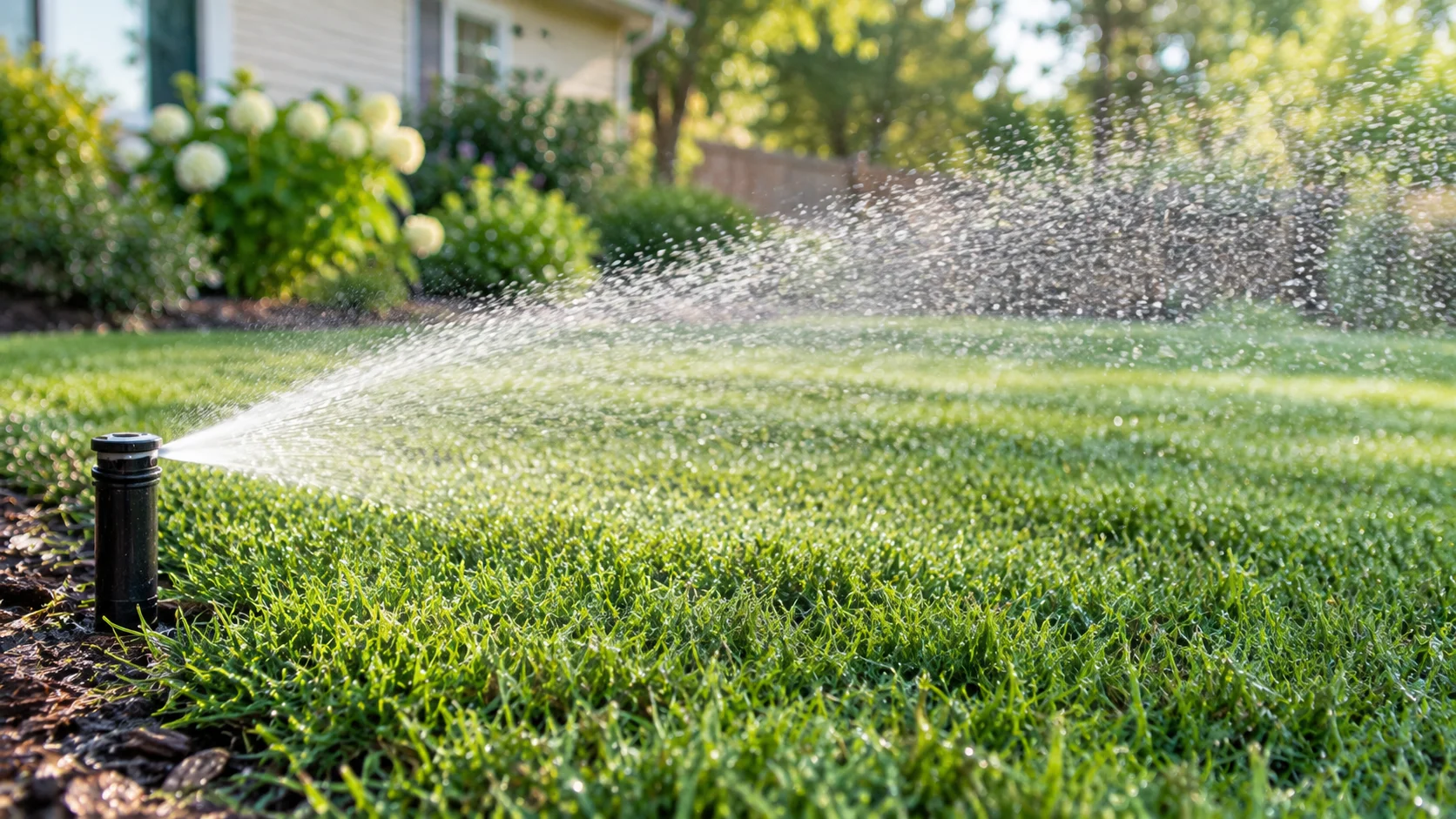
Most advice on new seed stops at “keep it moist.” The grass seed watering calculator returns a day-by-day plan for your lawn, and this guide gives the method behind it.
Below are the three watering stages, germination times by species, a formula and worked example for minutes per pass, how to taper off, and the signs of too much or too little water.
Key takeaways
- Keep the top 1 to 2 inches (25–50 mm) of the seedbed damp, not soaked, from seeding day until germination.
- Water 2 to 3 times a day in light passes, up to 4 in hot, windy weather. Each pass applies only about 0.07 to 0.10 inch (1.7 to 2.6 mm).
- Perennial ryegrass sprouts in 5 to 10 days, tall fescue in 7 to 12 and Kentucky bluegrass in 14 to 30. Run the light schedule until the slowest species in your blend is up.
- After sprouting, water less often but longer. When you halve the passes per day, double the minutes per pass.
- After the third mowing, treat the lawn as established and soak to 6 to 8 inches (150–200 mm) once or twice a week.
- A mild September day needs about 3 minutes per pass from spray heads at 1.5 in/hr and about 10 minutes from rotors at 0.5 in/hr.
How to water after overseeding: the three stages
New seed moves through three phases, and each wants a different pattern. Before germination the water has to stay in the surface layer. After sprouting, roots move down and the gaps between waterings should grow. A lawn counts as established after three mowings, and from then on it takes deep, infrequent watering.1
Watering schedule by stage after overseeding
| Stage | How often | Depth to wet | Typical amount |
|---|---|---|---|
| 1. Seeding to germination | 2–3 times a day; up to 4 in hot, windy weather | Top 1–2 in (25–50 mm), damp not soaked | 0.07–0.10 in (1.7–2.6 mm) per pass |
| 2. First sprouts to third mowing | Taper from daily to every other day | Deepen gradually; probe with a screwdriver | Double each run when you halve the passes |
| 3. After the third mowing | Once or twice a week | 6–8 in (150–200 mm) | About 0.5 in (13 mm) per watering is typical |
Stage 1 amounts come from the run-time table below. The daily step in stage 2 is a planning bridge between 2 to 3 passes a day and the every-other-day pattern in the extension guidance.12
NC State puts the opening stage at light watering two or three times a day for 7 to 21 days, and UC allows up to 30 days, with more passes in hot periods.12
How wet should the seedbed be?
Aim for the top 1 to 2 inches of soil. UC says to keep it moist but not soaked, and NC State specifies the top 1.5 inches.21 If the soil dries out during germination, UC warns that seedlings are likely to die, and too much water makes the seed rot.2
The surface is also the layer that dries first. FAO Paper 56 puts evaporation from a frequently wetted bare soil surface at up to 1.15 times reference evapotranspiration (ETo).6 On a day with an ETo of 0.15 inch (3.8 mm), the seedbed can lose up to 0.17 inch (4.4 mm). Two or three light passes replace that loss; one deep soak would sink below the seed layer.
Tip: probe after the first pass
Push a screwdriver into the seedbed after a pass, as UC suggests.2 Damp soil at 1 to 2 inches means the pass was enough. Dry soil at 1 inch means add a pass.
What should you do on seeding day?
UC advises watering the seedbed thoroughly to a depth of 6 to 8 inches a few days before seeding, then letting the surface dry.2 That fills the soil below the seed layer once, so later passes only wet the top inch or two.
After spreading, rake or firm the seed into the top 1/16 to 1/8 inch of soil.5 For summer seeding, UC allows a mulch layer no thicker than 1/4 inch (6 mm) to protect the seed and hold moisture.5 Start the first light pass as soon as the seed is down.
Spread the passes across the morning and afternoon, for example 7 a.m., 11 a.m. and 3 p.m. UC advises against evening watering on new lawns to help prevent disease.2 If you water with a hose-end sprinkler, set a kitchen timer for each pass and use the lawn hose watering time calculator to turn its output into minutes.
Caution: skip the hard spray
A strong stream moves seed into piles and low spots. Clemson warns that overwatering washes seed away and encourages disease, so use a mist or fan setting or a sprinkler.4
How long does germination take?
The light schedule lasts as long as germination does, and species differ widely. UC lists perennial ryegrass at 5 to 10 days, tall fescue at 7 to 12 and Kentucky bluegrass at 14 to 30.3
Germination time and how long to keep the seedbed damp
| Grass seed | Germination (days) | Keep light watering through about day |
|---|---|---|
| Perennial ryegrass | 5–10 | 10 |
| Annual ryegrass | 5–10 | 10 |
| Tall fescue | 7–12 | 12 |
| Red and hard fescue | 7–14 | 14 |
| Kentucky bluegrass | 14–30 | 30 |
| Bermudagrass (seeded) | 10–30 | 30 |
Germination ranges are from UC IPM.3 The last column is the upper end of each range and assumes you taper only once the whole area is up. For a blend, use its slowest species. NC State's general guide for cool-season seed is 7 to 21 days of light watering.1
A blend runs on the clock of its slowest member. NC State notes that Kentucky bluegrass takes 7 to 14 days longer to germinate than other cool-season grasses, and it warns against cutting back as soon as the first seedlings appear in a bluegrass mix.1 For weekly needs once the lawn is established, see the lawn watering by grass type chart.
How many minutes should each pass run?
Formula
Minutes per pass = (1.15 × ETo ÷ passes per day ÷ DU) ÷ precipitation rate × 60
ETo is in inches per day. The factor 1.15 is the upper-limit evaporation rate for a wet, bare soil surface.6 DU is distribution uniformity as a decimal; use 0.7 if you have not tested. Precipitation rate is in inches per hour.
- Get ETo. Use the daily figure from a local weather station or the reference ET calculator.
- Find the daily seedbed loss. Multiply ETo by 1.15.
- Split it. Divide by 2 or 3 passes a day (4 in hot, windy weather), then by DU.
- Convert to minutes. Divide the depth per pass by your precipitation rate and multiply by 60. Measure the rate with a catch-can test or look it up with the sprinkler precipitation rate calculator, then let the how long to water lawn calculator turn inches into minutes per zone.
Enter your grass, sprinkler type and weather. The calculator returns a day-by-day plan for new seed.
Worked example: tall fescue on a mild September day
Take 5,000 sq ft of tall fescue overseeded in mid-September. ETo is 0.15 inch a day, rotors apply 0.5 inch an hour, DU is an untested 0.7 and you plan 3 passes a day.
- Daily seedbed loss1.15 × 0.15 = 0.1725 in
- Depth per pass0.1725 ÷ 3 = 0.0575 in
- Corrected for DU0.0575 ÷ 0.7 = 0.08214 in
- Minutes per pass (rotors, 0.5 in/hr)0.08214 ÷ 0.5 × 60 = 9.86 min
- Minutes per pass (sprays, 1.5 in/hr)0.08214 ÷ 1.5 × 60 = 3.29 min
- Applied per day3 × 0.08214 = 0.2464 in
- Daily volume5,000 × 0.2464 × 0.623 = 767.6, about 770 gal
3 passes a day, about 10 minutes each with rotors
Metric: 2.1 mm per pass, 6.3 mm a day, about 2,900 liters a day over 465 m². Ten days of this uses about 7,700 gallons (29,000 liters).
If the surface dries before the next pass, add a pass rather than minutes.
Light-watering run times by weather and sprinkler type
| Weather | ETo (in/day) | Daily seedbed loss | Passes per day | Depth per pass | Sprays, 1.5 in/hr (min) | Rotors, 0.5 in/hr (min) |
|---|---|---|---|---|---|---|
| Cool, overcast | 0.08 (2.0 mm) | 0.09 in (2.3 mm) | 2 | 0.07 in (1.7 mm) | 3 | 8 |
| Mild, sunny | 0.15 (3.8 mm) | 0.17 in (4.4 mm) | 3 | 0.08 in (2.1 mm) | 3 | 10 |
| Hot, dry, windy | 0.25 (6.4 mm) | 0.29 in (7.3 mm) | 4 | 0.10 in (2.6 mm) | 4 | 12 |
Planning values at DU 0.7, rounded to the nearest minute, using example rates of 1.5 and 0.5 in/hr. ETo values are examples, not forecasts; use your local figure. Existing turf shades the soil a little, so treat the loss column as a ceiling.6
When should you cut back and switch to deep watering?
After the seed sprouts
Start the taper when seedlings cover the area, not when the first few appear. NC State says to water less often but for longer periods as seedlings grow and root, and UC says every other day may be enough once they are established.12 If you halve the passes per day, double the depth per pass to deliver the same daily water.
With spray heads, three 3.3-minute passes become one 9.9-minute run that applies 0.25 inch. NC State notes that few clay-soil lawns absorb more than 0.5 inch of water per hour,1 and sprays apply three times that, so the longer run will puddle on clay. Split it into two runs about 30 minutes apart, as NC State describes for clay, slopes and compacted ground,1 and use the cycle and soak calculator to set the run length.
NC State says to start mowing when the grass is 50 percent taller than its target height, for example cutting tall fescue back to 3 inches when it reaches 4.5 inches, and to mow when the soil and plants are dry.1 Cut before the first pass of the day.
After the third mowing
Three mowings make the lawn established. NC State then says to water to a depth of 6 to 8 inches about once a week or when needed, and UC says deep watering once or twice a week is all that is needed once roots have developed.12 Use the lawn watering schedule calculator for the days and minutes that match your grass and climate.
For scale, a 0.5 inch watering, which NC State calls adequate for most situations,1 uses about 1,560 gallons (5,900 liters) on 5,000 sq ft. The inches of water to gallons calculator converts any depth and area.
What are the signs of too much or too little water?
UC calls uniform coverage essential on new lawns,2 so check several spots in the seedbed.
Too little water
- The surface looks pale or crusty between passes.
- A screwdriver or finger finds dry soil in the top inch.
- Seedlings sprout, then thin out in the sunniest or windiest spots.
- The same dry patches show up every day, which points to uneven coverage.
Change the number of passes before you change the minutes. If water collects, the run is too long or the sprinkler applies faster than the soil absorbs, so shorten the run and add a pass.
How do soil, slope, rain and local rules change the schedule?
Soil and slope
Clemson notes that during dry periods, poorly drained clay soils may need less irrigation than sandy soils,4 and NC State says sandy soils need more frequent watering.1 On slopes and compacted ground, shorter runs spaced apart keep water from running off. Measure your own intake with the soil infiltration rate calculator, or compare typical values in the soil infiltration rate chart.
Rain and heat
Keep a rain gauge on the lawn. If a rain delivers about the day's seedbed loss in the run-time table, between 0.09 and 0.29 inch, skip the remaining passes that day and check the surface the next morning. The effective rainfall calculator estimates how much of a storm soaked in. In hot, windy weather, add a pass.2
Watering rules
Some water suppliers limit sprinkler days or hours, and some exempt new seed for a limited time. Check with your supplier before seeding. A rule of two watering days a week cannot deliver 2 to 3 passes a day, so you may need an exemption, hand watering where allowed, or a later seeding date. For large, commercial or athletic sites, have a designer audit the zones first.
How do you water a bermudagrass lawn overseeded with ryegrass?
Clemson recommends overseeding only bermudagrass lawns. The extra irrigation, fertilizer and shade from ryegrass can damage centipedegrass, zoysiagrass and St. Augustinegrass in spring and early summer.4 It places seeding about 30 days before the first frost, when highs are near 70°F (21°C) and lows are usually above 50°F (10°C).4
The seed-stage watering is the same: light watering two or three times a day until germination, with the amount set by soil type and how fast the air dries the surface.4 Once the ryegrass is established and has been mowed several times, Clemson says to water only as needed to prevent wilt. Over-watered, over-fertilized ryegrass in warm, humid weather can develop Pythium blight.4 In spring, a drier lawn stresses the ryegrass and helps the bermudagrass take over, but the permanent grass should not go short of water.4
Frequently asked questions
Do you water new grass seed every day?
Yes, and more than once. Until the seed germinates, water 2 to 3 times a day in light passes so the top 1 to 2 inches of soil never dries out. Extension guidance runs 7 to 21 days for most cool-season seed and up to 30 days for Kentucky bluegrass. Rain can replace a pass.
What happens if overseeded grass seed dries out?
UC guidance says seedlings are likely to die if the soil dries out during germination. If you miss passes on a hot or windy day, restart the light schedule right away. After the grass is up, NC State advises replanting bare spots larger than 4 inches (10 cm) across rather than waiting for them to fill in.
Can you use a hose instead of a sprinkler?
Yes, with a mist or fan nozzle or a hose-end sprinkler, not a jet. A hard stream moves seed into piles and low spots. A light pass applies about 0.07 to 0.10 inch (1.7 to 2.6 mm), so set out a few straight-sided cans and time how long that takes.
Should you water new grass seed in the evening?
Avoid it. UC guidance says to skip evening watering on new lawns to help prevent disease. Schedule passes from early morning through mid-afternoon, for example 7 a.m., 11 a.m. and 3 p.m., so the surface starts to dry before dark.
Does rain count as a watering for new seed?
Only if it keeps the seedbed damp. Compare the rain gauge reading with the day's seedbed loss, which runs about 0.09 to 0.29 inch (2.3 to 7.3 mm) in early-fall weather. If the gauge meets that figure, skip the remaining passes that day, then check the surface by touch the next morning.
How much water does overseeding use?
In mild weather, about 0.25 inch (6.3 mm) a day, which is roughly 150 gallons per 1,000 square feet. A 5,000 square foot lawn uses about 770 gallons (2,900 liters) a day, or about 7,700 gallons (29,000 liters) over a 10-day germination period. Hot, windy weather raises the total.
Does mulch reduce how often you need to water new seed?
It helps, but it does not replace the light passes. NC State says weed-free straw conserves moisture and reduces surface crusting, at one to two bales per 1,000 square feet on cool-season seed. UC allows a layer no thicker than 1/4 inch (6 mm) for summer establishment. Keep the same schedule until the seed germinates.
Sources
- NC State Extension. 9. Lawns. North Carolina Extension Gardener Handbook. NC State Extension Publications.
- UC Statewide IPM Program. Irrigating New Lawns. The UC Guide to Healthy Lawns. University of California Agriculture and Natural Resources.
- UC Statewide IPM Program. Grass Seed Germination Rates. The UC Guide to Healthy Lawns. University of California Agriculture and Natural Resources.
- Clemson Cooperative Extension Home & Garden Information Center. Overseeding With Ryegrass. HGIC 1206. Clemson University.
- UC Statewide IPM Program. Overseeding: Seed, Fertilize, and Irrigate. The UC Guide to Healthy Lawns. University of California Agriculture and Natural Resources.
- Allen, R.G., Pereira, L.S., Raes, D. and Smith, M. (1998). Annex 7: Background and computations for Kc for the initial stage for annual crops. Crop Evapotranspiration: Guidelines for Computing Crop Water Requirements, FAO Irrigation and Drainage Paper 56. Food and Agriculture Organization of the United Nations.
Written by Daniel Reeves, PE, CID. Figures in this article were calculated from the cited sources and checked against our lawn watering calculator. Read how we calculate and our editorial policy. Spotted an error? Tell us.