Should You Water Your Lawn After It Rains?
Rain does not always replace a watering. Skip the next one once a steady rain reaches 0.5 inch (13 mm), then use your soil and grass to work out how many days you can wait.

By Daniel Reeves, PE, CID
Irrigation Design Engineer
Short answer
Skip your next watering when steady rain leaves 0.5 inch (13 mm) or more in the gauge, and water on schedule when it leaves under 0.25 inch (6 mm).
Whether to water your lawn after it rains also depends on soil: the top 6 inches of loam can take only 0.38 to 0.58 inch (10 to 15 mm) when watering is due, so extra rain drains away. A soaking rain buys a cool-season lawn on loam about 2 to 4 days of summer water, not a full week.
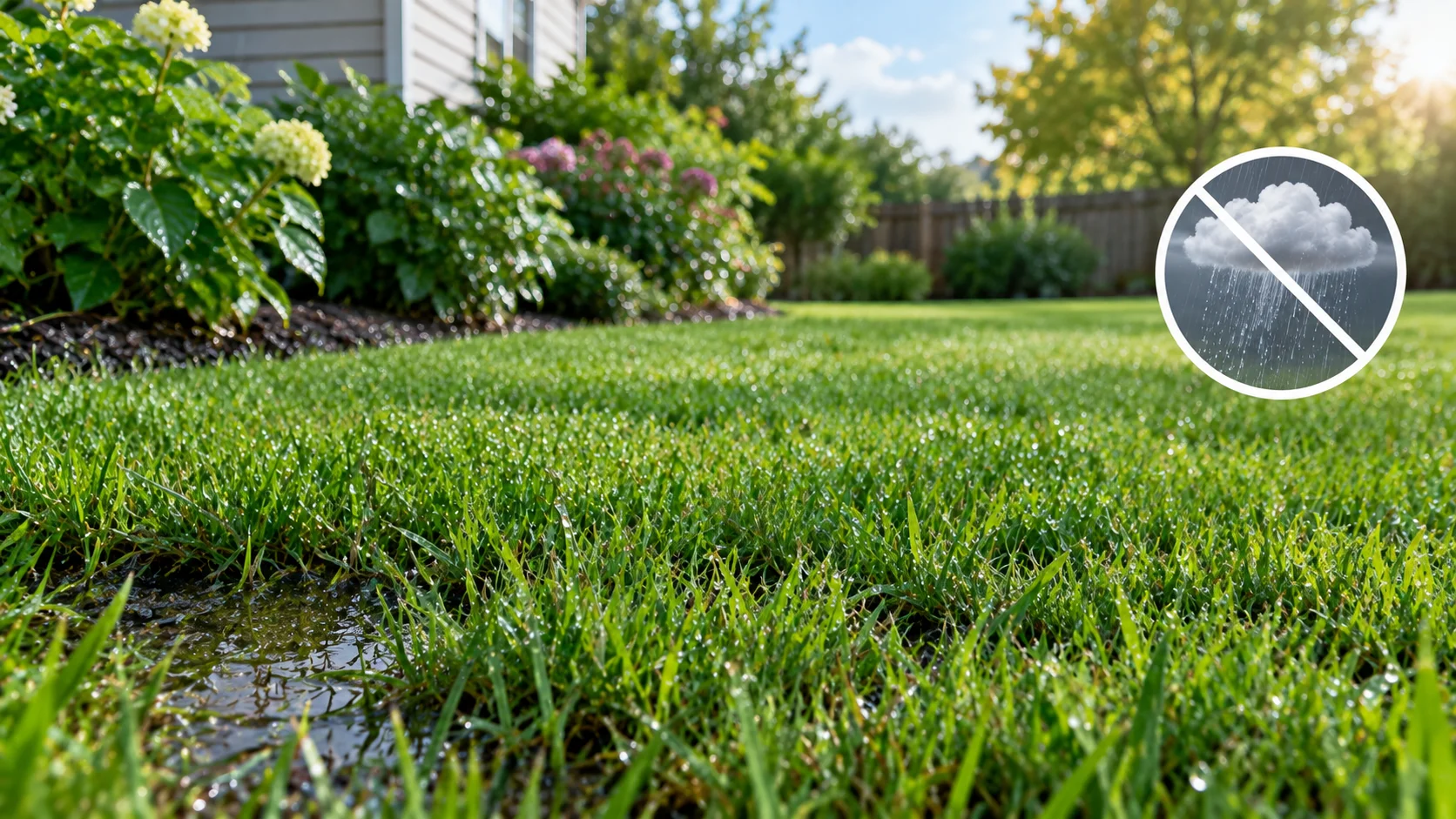
The effective rainfall calculator estimates how much of a storm your lawn can use, and this article shows the arithmetic behind it. The usual advice says one inch of rain replaces a week of watering, but that holds only if the soil can store the inch. The top 6 inches under most lawns cannot: loam has room for about 0.38 to 0.58 inch (10 to 15 mm) when watering is due, and the rest drains below the roots.2
Below are the rain totals that justify a skip, the soil math that sets the limit, a formula for how many days to wait, and a worked example. Later sections cover downpours, rain sensors and new seed, where the rule changes.
Key takeaways
- Skip the next watering when steady rain reaches 0.5 inch (13 mm). Under 0.25 inch (6 mm), keep your schedule.
- The top 6 inches of loam refills only 0.38 to 0.58 inch (10 to 15 mm), so rain beyond that is lost and one inch does not cover a week.
- Days to skip = effective rain ÷ daily lawn use. A soaking rain buys about 1 to 7 days, depending on soil and grass.
- A downpour faster than the soil's intake, about 0.5 inch (13 mm) an hour in many soils, runs off. Count only what soaked in.
- Probe the soil after it drains. If a screwdriver slides easily to about 6 inches, hold off another day.
- A rain sensor resets in about 19 hours, sooner than most soils dry, so it is not a schedule.
How much rain counts as a watering?
Count only rain you measured. A straight-sided can or a rain gauge works, the same tool Missouri extension uses to measure sprinkler output.4 Read it after the rain stops and find the band below.
What to do after rain, by gauge reading
| Gauge reading (steady rain) | Action | Reason |
|---|---|---|
| Under 0.25 in (6 mm) | Water on schedule | Light showers can be caught entirely by the leaves and never refill the soil.1 |
| 0.25 to 0.5 in (6 to 13 mm) | Skip any run due within a day, then probe the soil | Canal engineers often treat showers under 10 mm (0.4 in) as making no difference to schedules,1 and a rain sensor holds off runs for about 19 hours.5 |
| 0.5 to 1 in (13 to 25 mm) | Skip the next watering, then count days with Table 3 | Matches the 0.38 to 0.58 in (10 to 15 mm) refill space of loam in Table 2. |
| Over 1 in (25 mm) | Same skip; the extra rain is lost | Even a wilting lawn on loam can store only 0.75 to 1.15 in (19 to 29 mm) in the top 6 in. |
Bands assume steady rain that soaks in. If your city restricts watering days, local rules override any skip schedule.
The 0.5 inch line comes from the soil. On loam, a watering replaces 0.38 to 0.58 inch when the soil reaches the point where you would normally water (Table 2), so a half inch of rain does the job of one watering.
Tip: put the gauge in the open
Trees, eaves and awnings block rain, and sprinkler spray adds water that did not fall from the sky. UF/IFAS gives the same advice for rain sensors.5
How much rain can the soil actually hold?
Soil is a tank with a fixed size. UC lists the plant-available water it holds by texture, in inches per foot.2 Missouri extension treats moisture 6 to 8 inches deep as enough for summer,4 so this article uses the shallow end, 6 inches (0.5 ft). Irrigation has historically been scheduled before half of the available water is gone,3 which makes the refill space half of the tank.
Water held in the top 6 inches of soil, by texture
| Soil texture | Water held per foot | Total in top 6 in | Refill space when watering is due |
|---|---|---|---|
| Loamy sand | 0.75–1.25 in (19–32 mm) | 0.38–0.63 in (10–16 mm) | 0.19–0.31 in (5–8 mm) |
| Sandy loam | 1.25–1.75 in (32–44 mm) | 0.63–0.88 in (16–22 mm) | 0.31–0.44 in (8–11 mm) |
| Loam | 1.50–2.30 in (38–58 mm) | 0.75–1.15 in (19–29 mm) | 0.38–0.58 in (10–15 mm) |
| Clay loam | 1.75–2.50 in (44–64 mm) | 0.88–1.25 in (22–32 mm) | 0.44–0.63 in (11–16 mm) |
| Clay | 1.60–2.50 in (41–64 mm) | 0.80–1.25 in (20–32 mm) | 0.40–0.63 in (10–16 mm) |
Water held per foot is from UC.2 Total = per-foot value × 0.5 ft. Refill space = half of the total. If the lawn is already wilting, the soil is drier than the watering point and can take up to the full total.
Sandy soil has the smallest tank. A loamy sand has room for only 0.19 to 0.31 inch (5 to 8 mm), so a soaking rain buys it just 1.2 to 3.5 days (Table 3), and the rain credit is gone by the next morning's probe. Clay loam refills 0.44 to 0.63 inch (11 to 16 mm). The available water capacity calculator estimates your own soil, and the management allowed depletion calculator adjusts the half-tank rule.
Timing matters too. FAO notes that a shower recharges a dry soil but becomes surplus on soil that was just irrigated, lost to deep percolation or runoff.1
How many days can you skip after rain?
Rain pushes back the next watering by the days the lawn needs to use that much water. The soil caps the credit: rain beyond the refill space does not stretch the delay.
Formula
Days to skip = effective rain ÷ daily lawn use
Daily lawn use = weekly use ÷ 7. Effective rain = the smallest of the gauge reading, the rain the soil absorbed during the storm, and the refill space (root depth in ft × water held per foot × 0.5). The formula assumes the rain arrives when watering is due.
- Read the gauge. Note the total in inches and how many hours the rain fell.
- Find daily use. Divide the weekly need by 7. Missouri extension lists weekly needs for green turf, shown in the Table 3 headings.4 The lawn water requirement calculator and the lawn watering by grass type chart give a figure for your own grass.
- Find the refill space. Multiply root depth in feet by the water held per foot, then by 0.5, using Table 2.
- Cap the rain. Use the smaller of the gauge reading and the refill space. After a fast storm, count only the rain that soaked in.
- Divide and round down. Effective rain divided by daily use is the days to wait. The irrigation interval calculator confirms the days between waterings.
Table 3 does the division for a soaking rain, 0.6 inch (15 mm) or more absorbed, which fills every refill space in that table.
Days a soaking rain buys in summer, by soil and grass
| Soil (refill space) | Ryegrass, 1.5 in/wk (38 mm) | Bluegrass, 1.2 in/wk (30 mm) | Tall fescue, 0.8 in/wk (20 mm) | Zoysia or bermuda, 0.5 in/wk (13 mm) |
|---|---|---|---|---|
| Loamy sand (0.25 in, 6 mm) | 1.2 days | 1.5 days | 2.2 days | 3.5 days |
| Sandy loam (0.38 in, 10 mm) | 1.8 days | 2.2 days | 3.3 days | 5.3 days |
| Loam (0.48 in, 12 mm) | 2.2 days | 2.8 days | 4.2 days | 6.7 days |
| Clay loam (0.53 in, 13 mm) | 2.5 days | 3.1 days | 4.6 days | 7.4 days |
Assumes 6 in (0.5 ft) roots, the midpoint of each UC range in Table 2, weekly use from the Missouri guide,4 rain arriving when watering is due, and all rain absorbed. Deeper roots enlarge the refill space and lengthen the delay.
Tall fescue on loam gets 4.2 days from a soaking rain, and ryegrass on the same soil gets 2.2. Hot, windy weather shortens every cell because daily use rises. To keep a running tally instead of working storm by storm, the soil water balance calculator tracks rain, use and soil water daily.
Enter the rainfall, how long it fell and your soil. The calculator returns the part of the storm that reached the root zone.
Worked example: 0.8 inch of rain on Kentucky bluegrass
A 4,000 sq ft (372 m²) Kentucky bluegrass lawn on clay loam is due for water in July when 0.8 inch of rain falls over 8 hours, 0.1 inch an hour. Roots reach 6 inches, and the soil takes in about 0.5 inch an hour.4
- Weekly lawn use (green bluegrass)1.2 in (30 mm)
- Daily use1.2 ÷ 7 = 0.17 in (4.4 mm)
- Water held per foot (clay loam)2.1 in/ft, rounded midpoint of 1.75–2.50
- Refill space (6 in roots)0.5 ft × 2.1 × 0.5 = 0.525, about 0.53 in (13 mm)
- Rain intensity vs intake0.1 in/hr is under 0.5 in/hr, so all 0.8 in (20 mm) soaks in
- Effective rainsmaller of 0.8 and 0.53 = 0.53 in (13 mm)
- Days to skip0.53 ÷ 0.17 = 3.1 days
- Rain lost below the roots0.8 − 0.53 = 0.27 in (7 mm)
- Water saved by skipping one watering4,000 × 0.53 × 0.623 ≈ 1,320 gal
Skip about 3 days; the lawn reaches its watering point again 3.1 days after the rain
Metric: 13 mm of effective rain over 372 m² is about 5,000 liters. Counting all 0.8 in (20 mm) against daily use would add 4.7 days instead of 3.1 and leave the lawn about 1.6 days overdue.
The 0.623 factor is gallons per square foot per inch: 1/12 ft × 7.48 gallons per cubic foot. The inches of water to gallons calculator converts any lawn size. Probe the soil on day 3; if a screwdriver still slides easily to 6 inches, wait another day.
Does a downpour count as much as a steady rain?
Not always. Soil takes in water only as fast as its surface allows. Missouri extension puts the intake of most Missouri soils at about 0.5 inch (13 mm) an hour.4 FAO notes that higher rainfall intensity lowers the effective share of rain by increasing runoff.1
A thunderstorm that drops 1 inch in 20 minutes arrives at 3 inches an hour, six times that intake rate. On a flat lawn the surplus ponds and soaks in later. On a slope much of it leaves, because the time water has to soak in is shorter on sloping land.1
Rain soaked in
- A screwdriver slides easily to about 6 inches.
- The lawn is moist and firm with no standing water.
- Slopes and flat areas feel equally damp.
Rain ran off
- The probe stops short of 6 inches on slopes or hard soil.
- Low spots are soggy while high spots are dry.
- Muddy water crossed the pavement or filled the gutter.
After a fast storm, treat the gauge as an upper limit and credit only what soaked in. The soil infiltration rate calculator and the soil infiltration rate chart give a starting intake for your soil texture. If you water after a storm on clay or a slope, split the run into short cycles with the cycle and soak calculator.
How to check the soil before you water again
Let the soil settle first. After saturation, sandy soil drains to field capacity in about 24 hours, and soils with more silt and clay take 2 to 3 days.3 Probe after that window.
Push a foot-long screwdriver into the ground in several places. It slides easily to the depth that has enough water.4 For a second check, squeeze a golf-ball-sized plug of soil: dripping water means it is full, a moist ball that holds together is right, and dry dusty soil that will not form a ball needs water.4
Then let the grass confirm it. Blue-purple blades, rolled leaves and footprints that stay for hours signal a thirsty lawn. Missouri extension says to delay irrigation after rain until wilt symptoms appear, then water within a day.4
Wet wilt looks like drought
A lawn can wilt on a hot afternoon while the soil is soaked. This wet wilt happens when shallow roots cannot keep up with demand, and more water makes it worse by starving the roots of oxygen.4 Probe first, and add water only if the soil is dry.
Can a rain sensor make the call for you?
A rain sensor is a safeguard, not a schedule. It interrupts the controller once a set amount of rain has fallen and lets it run again as the sensor dries.5 UF/IFAS advises the smallest set point available, 1/8 inch (3 mm) on most devices, and no more than 1/4 inch (6 mm), because smaller set points saved the most water in testing.5
The catch is the reset. Rain sensors allowed watering again about 19 hours after the rain stopped in UF/IFAS tests, which is sooner than the soils dried out in the textures modeled.5 A sensor can therefore green-light a run on soil that still holds a full tank. Let it cover the first day, then apply the skip days with a controller rain delay.
Test the sensor each year by starting a zone and spraying the sensor with a hose; a disk sensor should shut the zone off within a few minutes.5 A few states, Florida among them, require a rain shutoff device, so check local rules.5
When should you water your lawn after it rains anyway?
Two situations override the skip rule, and sandy soil, covered above, needs a next-day probe instead of a long wait.
New seed and new sod
Seedlings root in the top inch or two, so the seedbed must stay moist but not saturated until germination. Missouri extension advises 1/8 to 1/4 inch (3 to 6 mm), one to four times a day.4 A steady rain can replace those light runs for the day, so skip them while the surface is wet. New sod needs the sod strip and the top inch of soil beneath it wet; lift a corner to check.4 The grass seed watering calculator and sod watering calculator give a day-by-day taper.
Dormant lawns
Missouri extension says dormant lawns need at least 1 inch (25 mm) of water every two or three weeks in summer, so a 1 inch rain resets that clock and a 0.5 inch (13 mm) rain supplies half of it.4
Frequently asked questions
Is it OK to water your lawn the day after it rains?
Yes, if the soil has dried to the point where you would normally water, which is unusual within a day of 0.5 inch or more of rain. Probe first. If a screwdriver slides easily to about 6 inches, the root zone still holds water, and extra watering adds only runoff and disease pressure.
Does a light drizzle count as watering?
Usually not. Rain under 0.25 inch (6 mm) can be caught by the leaves and never reach the roots, and canal engineers often treat showers under 10 mm (0.4 inch) as ineffective. Keep your normal schedule. Drizzle counts only when it keeps falling long enough to pass 0.5 inch (13 mm).
Why does my lawn look wilted when the soil is wet?
It may be wet wilt. Waterlogged soil with shallow roots cannot keep up with hot-day water demand, so blades curl even though the soil is soaked. Do not add water, because it starves the roots of oxygen. Check again after the soil drains, which takes 2 to 3 days in heavier soils.
Do I still need to water if it rained a week ago?
Probably yes. Rain credit runs out as the lawn uses the stored water, which takes 1.2 to 7.4 days after a soaking rain depending on soil and grass. After a week, most lawns are back at the watering point. Probe the soil before running the sprinklers.
How do I measure how much rain my lawn got?
Set a straight-sided can or rain gauge in the open, away from trees, eaves and sprinkler spray, and read it after the rain stops. One gauge represents a small area, so add a second on slopes or under tree canopy.
Is an inch of rain the same as an inch from a sprinkler?
Only when it arrives slowly. A steady rain at 0.1 inch an hour soaks in fully, but a downpour at 3 inches an hour far exceeds the 0.5 inch an hour intake of most Missouri soils, and the surplus runs off. Sprinklers are managed to stay under the intake rate, so an inch from a sprinkler soaks in.
Sources
- Dastane, N.G. (1978). Effective Rainfall in Irrigated Agriculture, Chapter I: Introduction. FAO Irrigation and Drainage Paper 25. Food and Agriculture Organization of the United Nations.
- UC Center for Landscape & Urban Horticulture. Soil Water Holding Characteristics. University of California Agriculture and Natural Resources.
- Sharma, V. Basics of Irrigation Scheduling. University of Minnesota Extension. Draws on the NRCS Irrigation Guide, National Engineering Handbook.
- University of Missouri Extension. Home Lawn Watering Guide. Publication G6720.
- Dukes, M.D. and Cardenas, B. Residential Irrigation System Rainfall Shutoff Devices, or Rain Sensors. UF/IFAS Extension publication AE221 (ABE325). University of Florida.
Written by Daniel Reeves, PE, CID. Figures in this article were calculated from the cited sources and checked against our lawn watering calculator. Read how we calculate and our editorial policy. Spotted an error? Tell us.