Should You Let Your Lawn Go Dormant in Summer?
Keeping cool-season grass green through summer takes about 1 inch (25 mm) of water a week, while dormant turf survives on a fraction of that. This guide gives the numbers, the limits and the lawns that should keep their water.

By Daniel Reeves, PE, CID
Irrigation Design Engineer
Short answer
Usually yes for cool-season grass: let your lawn go dormant in summer, watering 0.25 to 0.5 inch (6 to 13 mm) every 2 to 3 weeks versus 1 inch (25 mm) weekly to stay green.
Dormant turf generally survives 4 to 6 weeks with little or no water, so a longer dry spell calls for one deep rescue watering. The choice applies to Kentucky bluegrass, fescue and ryegrass; a new, thin or stressed lawn is better kept watered.
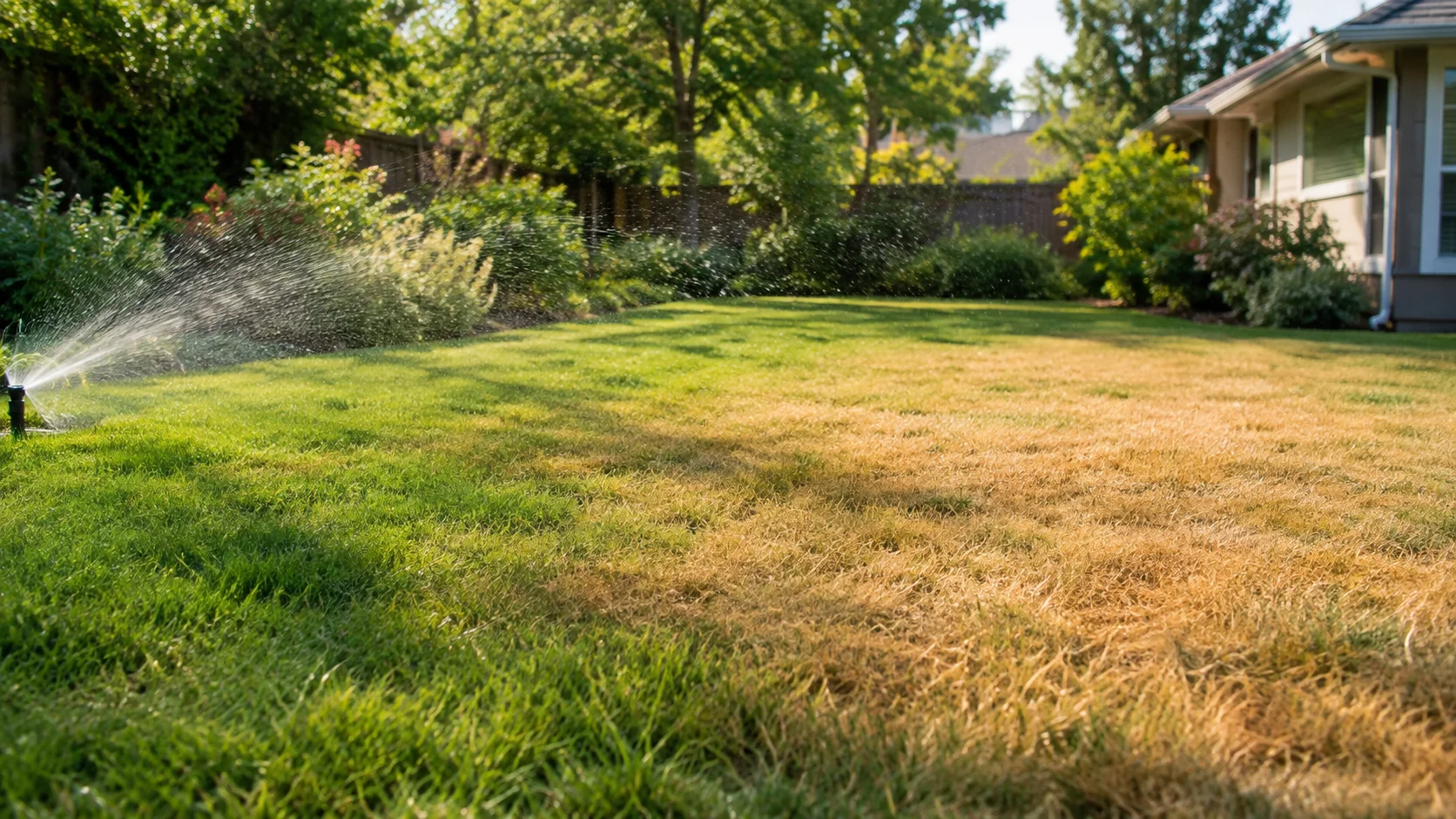
Cool-season lawns brown in midsummer heat unless water holds the color. The lawn water requirement calculator returns that cost for your grass and climate, roughly 1 inch (25 mm) a week for most cool-season lawns.1 This article covers the other side of the trade: what a dormant lawn needs, what it risks and how much water you keep.
Below you will find water use by grass type, the survival amounts extension services recommend, a season's savings in gallons, and the lawns that should keep their water.
Key takeaways
- Keeping cool-season turf green takes about 1 inch (25 mm) of water a week. Dormant turf survives on 0.25 to 0.5 inch (6 to 13 mm) every 2 to 3 weeks.
- Dormancy is safe for about 4 to 6 weeks. If the dry spell runs longer, give 1 to 1.5 inches (25 to 38 mm) in one soaking and repeat it 7 days later.
- Dormant is not dead. The crowns and roots stay alive under brown leaves, and new leaves appear within about 2 weeks of rain returning.
- Keep watering instead if the lawn is new, thin or struggling, or sits on a slope or shallow soil.
- Choose one path at the start of summer. Greening a dormant lawn drains its reserves, and watering usually will not turn it green again until fall.
- While dormant, mow at 3 inches (76 mm) or taller, skip nitrogen and stay off the turf.
Is it OK to let your lawn go dormant in summer?
For a healthy, established cool-season lawn, yes. Dormancy is the grass's own drought defense: the leaves stop growing and turn brown while the crowns and roots below stay alive.2 Kentucky bluegrass, fescue and perennial ryegrass all brown this way in midsummer when heat or a lack of water hits them.3
Virginia Cooperative Extension says summer dormancy in the mid-Atlantic usually follows 2 or more weeks of high heat, low humidity and little rain.4 If the lawn entered that stretch in good shape on good soil, its suggested strategy is to stop irrigating and let the grass go dormant, then expect a quick rebound in green color once significant rain arrives.4
Time is the limit. Turfgrass can generally stay dormant for 4 to 6 weeks without significant damage, and lawns are at risk beyond that.2 Nebraska Extension puts typical survival at 4 to 5 weeks, falling to 3 to 4 weeks when temperatures stay above 80°F (27°C).5
Species matter too. Tall fescue roots can reach 3 feet (0.9 m) or more if the soil allows,5 and Illinois Extension notes the species often stays green longer in summer, though it can push its limits and die instead of going dormant.6 Warm-season grasses such as Bermuda, zoysia and buffalograss are a different case. They are adapted to hot, dry summers and almost always survive, with slower growth and some color loss under extreme drought.4
How much water does green turf need compared with dormant turf?
Missouri Botanical Garden publishes the most direct comparison, in inches of water per week by grass.3 Green means the lawn stays green and growing; dormant means it may brown but will not die.
Weekly water to keep lawns green and to keep them alive, by grass type
| Lawn type | Green turf (in/week) | Dormant turf (in/week) | Dormant as share of green |
|---|---|---|---|
| Perennial ryegrass | 1.5 (38 mm) | 1.0 (25 mm) | 67% |
| Kentucky bluegrass | 1.2 (30 mm) | 0.7 (18 mm) | 58% |
| Tall fescue | 0.8 (20 mm) | 0.5 (13 mm) | 63% |
| Zoysia or Bermuda grass | 0.5 (13 mm) | 0.2 (5 mm) | 40% |
| Buffalograss | 0.3 (8 mm) | 0.2 (5 mm) | 67% |
Inch values are from Missouri Botanical Garden's Table 1.3 Millimeter conversions and the share column are calculated here, rounded to the nearest whole number.
The sources do not agree on one dormant number. Missouri's run 40 to 67 percent of its green figures, while the Nebraska, Purdue and Illinois guidance in the next section works out to far less. Heat, soil and the length of the dry spell decide where you land, so use the higher figures if the lawn is thinning or the dry spell passes 4 weeks.1
The green figure is not fixed either. Nebraska Extension estimates full water use for home lawns in July at 1.5 to 2 inches (38 to 51 mm) a week in the east of the state and 2 to 2.25 inches (51 to 57 mm) in the west, against 0.75 to 1 inch (19 to 25 mm) in April and May in the east.5 Dormancy saves the most in the hottest weeks, when the green lawn is thirstiest.
Your own green-lawn number depends on grass and climate. The grass type water needs calculator compares species, the lawn watering by grass type chart lists them in one place, and the lawn water deficit calculator shows how far rain and irrigation fall short of what your lawn uses.
Enter your grass and climate to get the weekly depth, then compare it with the dormant amounts in this article.
How much water keeps a dormant lawn alive?
Extension services give survival watering as a small depth at long intervals instead of a weekly rate. The aim is to keep the crowns hydrated without greening the lawn.1
Survival watering for dormant cool-season lawns, by extension source
| Source | Survival watering | Weekly equivalent (in/week) |
|---|---|---|
| Nebraska Extension, cool-season turf5 | 0.25 to 0.5 in (6 to 13 mm) every 2 to 3 weeks | 0.08 to 0.25 in (2 to 6 mm) |
| Nebraska Extension, Kentucky bluegrass5 | 0.25 in (6 mm) every 3 to 4 weeks | 0.06 to 0.08 in (about 2 mm) |
| Purdue Extension1 | 0.5 in (13 mm) every 2 weeks | 0.25 in (6 mm) |
| Illinois Extension, extreme drought6 | 0.25 to 0.5 in (6 to 13 mm) every 2 to 4 weeks | About 0.13 in (3 mm) |
| Iowa State Extension, after 4 to 6 weeks dormant2 | 1 to 1.5 in (25 to 38 mm) at once, repeated 7 days later | One-time soaking, not a weekly rate |
Weekly equivalents are calculated here as depth divided by interval. Illinois pairs the smaller depth with the shorter interval, so both ends work out to the same rate. Illinois defines extreme drought as more than 4 weeks of hot weather with no rain.
Those schedules work out to 6 to 25 percent of the 1 inch a week that keeps turf green. Purdue's 0.5 inch every 2 weeks sits at the top of that range, at 0.25 inch a week.1 Nebraska's 0.25 inch every 3 to 4 weeks for Kentucky bluegrass sits at the bottom.5
Soil decides how deep a given amount goes. Nebraska's soil table shows 1 inch of water wetting about 16 inches of sandy soil, 8 inches of loam and 5 to 6 inches of clay, so a 1 to 1.5 inch rescue soaking reaches roughly 8 to 12 inches (20 to 30 cm) in loam.5 The same table gives infiltration rates of 0.25 to 0.50 inch an hour for loam and only 0.10 to 0.25 inch an hour for clay, so a large soaking on clay runs off unless you split it.5
The soil infiltration rate calculator estimates your own rate, and the cycle and soak calculator splits a soaking into cycles. If puddles form, Nebraska Extension advises stopping for one to two hours and then resuming.5
How much water does dormancy save in a season?
The savings are the difference in depth multiplied by the area. Use depths that land on the grass, as measured in catch cans, so sprinkler coverage is already built in.
Formula
Water saved (gal) = area (sq ft) × (green depth − dormant depth, in) × 0.623
Both depths are totals for the same period. The constant 0.623 is the gallons in 1 inch of water over 1 square foot. In metric, liters = area (m²) × depth (mm).
Take a 6,000 sq ft Kentucky bluegrass lawn through an 8-week dry stretch. The green option uses Missouri Botanical Garden's 1.2 inches a week for bluegrass,3 and the dormant option uses Purdue's 0.5 inch every 2 weeks.1
- Lawn area6,000 sq ft
- Green-lawn depth1.2 in/week × 8 weeks = 9.6 in
- Dormant-lawn depth4 waterings × 0.5 in = 2.0 in
- Green-lawn water6,000 × 9.6 × 0.623 = 35,885 gal
- Dormant-lawn water6,000 × 2.0 × 0.623 = 7,476 gal
- Water saved35,885 − 7,476 = 28,409 gal
- Share saved28,409 ÷ 35,885 = 79%
About 28,400 gallons saved, 79% less water
Metric: 6,000 sq ft is 557 m². The depths are 244 mm green and 51 mm dormant, so the lawn takes about 136,000 liters green, about 28,000 liters dormant, and saves about 108,000 liters.
To turn gallons into dollars, divide gallons saved by 1,000 and multiply by your price per 1,000 gallons. The lawn watering cost calculator does that with your own rate, and the inches of water to gallons calculator converts any depth and area.
When should you keep watering instead of going dormant?
Dormancy suits some lawns and gambles with others. The costs are a brown lawn, harder ground and more room for weeds. Illinois Extension lists appearance and weed invasion as the main downsides,6 and Purdue adds that dormant turf is more easily injured and may thin or die if a dry spell reaches 4 to 6 weeks with no rain or irrigation.1
Dormancy fits when
Keep watering when
If you choose to water, deep and infrequent beats light and daily. Iowa State recommends 1 to 1.5 inches a week in a single application, or two applications 3 or 4 days apart.2 The lawn watering schedule calculator turns that into days and minutes. If neither a brown lawn nor a water bill is acceptable, the turf removal savings calculator estimates what replacing part of the lawn would save.
Caution: check watering rules first
Budgets, site conditions and watering restrictions can all limit what you are able to apply.6 If your city restricts lawn irrigation by day or hour, confirm that survival watering is allowed before you plan a schedule, and follow the local rule over any figure here.
How to care for a lawn in summer dormancy
- Commit before the heat arrives. Breaking dormancy draws down the plant's stored reserves, and in continued heat it may not rebuild them,6 so choose one path for the whole summer instead of switching.
- Mow high, and less often. Keep cool-season grass at 3 inches (76 mm) or taller. Illinois Extension suggests 3 to 4 inches (76 to 102 mm) and never cutting more than one third of the blade at a time.6 Taller turf shades the soil and holds in the moisture that is there.6
- Skip nitrogen and weed treatments. Illinois Extension says to fertilize in early September, not summer,6 and Missouri Botanical Garden says midsummer weed killers can further damage the turf and work better in fall.3
- Stay off the grass. Mowers and heavy equipment can cause substantial damage to stressed turf, which will not recover until rain returns.1
- Pick one survival schedule and measure it. Either give 0.25 to 0.5 inch (6 to 13 mm) every 2 to 3 weeks, or leave the lawn alone for 4 to 6 weeks and then apply 1 to 1.5 inches (25 to 38 mm) once and again 7 days later.2 Do not stack the two. Place 2 or 3 rain gauges in the spray pattern to measure what lands.2 The catch-can test calculator turns those readings into your sprinkler's rate, and the how long to water lawn calculator converts a depth into minutes. Count soaking rain toward the schedule; the effective rainfall calculator estimates how much of a storm your lawn can use.
- Water in the early morning. Iowa State puts the best window at 5 a.m. to 9 a.m., and evening watering can add to disease problems.2
Should you water a dormant lawn to turn it green again?
Usually not. Once cool-season turf has browned, Illinois Extension advises leaving it dormant instead of watering heavily to force green-up, because breaking dormancy drains reserves the plant may not replace in hot, dry weather.6 Missouri Botanical Garden adds that watering a lawn already dormant in midsummer generally will not turn it green until fall.3
The exception is the rescue soaking after 4 to 6 weeks, where survival is the goal. Iowa State says the grass should begin to green up after the second application.2 Otherwise wait for rain or cooler weather, then fertilize at the right time. Nebraska Extension puts most nitrogen for cool-season grass in fall,5 and Illinois Extension names early September for most lawns.6
How can you tell dormant grass from dead grass?
Dormant and dead turf look the same until water or rain returns. Purdue's turfgrass specialist says you cannot tell whether a dormant lawn is dying unless you water it and watch the response.1 After the rain or rescue soaking, Virginia Cooperative Extension suggests checking within a few days, often the next day. Brush aside the brown leaf tops and look at the base of the canopy for green tissue and for new leaves coming from the growing points.4
Expect new leaves within about 2 weeks of the rains returning.1 Kentucky bluegrass spreads by rhizomes and fills in quickly,5 and Nebraska Extension says spreading grasses can reclaim areas up to 6 inches (15 cm) across, while larger bare areas need reseeding or sodding.5 Perennial ryegrass and other bunch-type grasses cannot spread into voids, so weeds fill the gaps.5 Virginia Cooperative Extension advises planning fall reestablishment if grass is lost.4
Frequently asked questions
How long can a lawn stay dormant before it dies?
Most cool-season turf survives about 4 to 6 weeks of dormancy without significant damage, according to Iowa State. Nebraska Extension puts it at 4 to 5 weeks, dropping to 3 to 4 weeks when temperatures stay above 80°F (27°C). Past those limits, thinning and turf death can occur unless the lawn gets rain or a deep rescue watering.
Should you fertilize or treat weeds on a dormant lawn?
No. Nitrogen in hot, dry weather pushes excess growth when the grass should be going dormant, and Illinois Extension advises waiting until early September to fertilize most lawns. Missouri Botanical Garden says midsummer weed treatments can further damage the turf and work better in early fall. Wait for cooler weather and renewed growth before applying either.
Does tall fescue go dormant like Kentucky bluegrass?
It can, but it holds out longer. Tall fescue roots can reach 3 feet (0.9 m) or more, which helps it stay green through dry spells. Illinois Extension warns that turf-type tall fescue sometimes dies from drought instead of going dormant, so a fescue lawn that shows stress is a better candidate for watering than for waiting.
Do warm-season lawns need to go dormant in summer?
No. Bermuda, zoysia and buffalograss are adapted to hot, dry summers, and Virginia Cooperative Extension says they almost always survive, with slower growth and some color loss under extreme drought. Nebraska Extension notes most warm-season grasses enter dormancy only after soil moisture runs out. Missouri Botanical Garden lists 0.5 inch a week to keep Bermuda or zoysia green.
What time of day should you water a dormant lawn?
Early morning. Iowa State recommends 5 a.m. to 9 a.m., when water soaks in with little loss to evaporation and the foliage dries quickly. Watering in late afternoon or evening can increase disease problems. Purdue also warns that evening watering can encourage disease or pests, so a morning schedule suits survival watering as well as regular irrigation.
Sources
- Merzdorf, J. (2012). Home lawn during drought: To water ... or not? Purdue University Agricultural Communication, quoting turfgrass specialist Aaron Patton.
- Jauron, R. Watering Home Lawns. Yard and Garden, Iowa State University Extension and Outreach. Last reviewed June 2022.
- Missouri Botanical Garden. How do I care for my dormant cool-season lawn? Gardening Help FAQs. Table adapted from Missouri Environment and Garden, May 23, 2012.
- Virginia Cooperative Extension. Lawn Recovery from Drought. Turf and Garden Tips. Virginia Tech.
- Schild, J.A. and Dworak, S. (2013). Water Wise: Drought Effects on Turf in the Landscape. NebGuide G2191. University of Nebraska–Lincoln Extension.
- Illinois Extension. Managing Lawns During Drought. University of Illinois Urbana-Champaign.
Written by Daniel Reeves, PE, CID. Figures in this article were calculated from the cited sources and checked against our lawn watering calculator. Read how we calculate and our editorial policy. Spotted an error? Tell us.