St. Augustine Grass Watering Guide
Water when the grass shows stress, apply ½ to ¾ inch each time, and let the season set the gap. This guide gives the days, inches and sprinkler minutes for St. Augustine lawns.

By Daniel Reeves, PE, CID
Irrigation Design Engineer
Short answer
Apply ½ to ¾ inch (13 to 19 mm) when St. Augustine grass shows stress: every 1 to 5 days in summer and every 1 to 4 weeks in north Florida winters, without rain.3
Those intervals assume 6-inch roots and no rain. Good St. Augustine grass watering also depends on soil, shade and weather: sandy soil and full sun sit at the short end of each range, while shade and any rain of ½ inch or more push you to the long end.
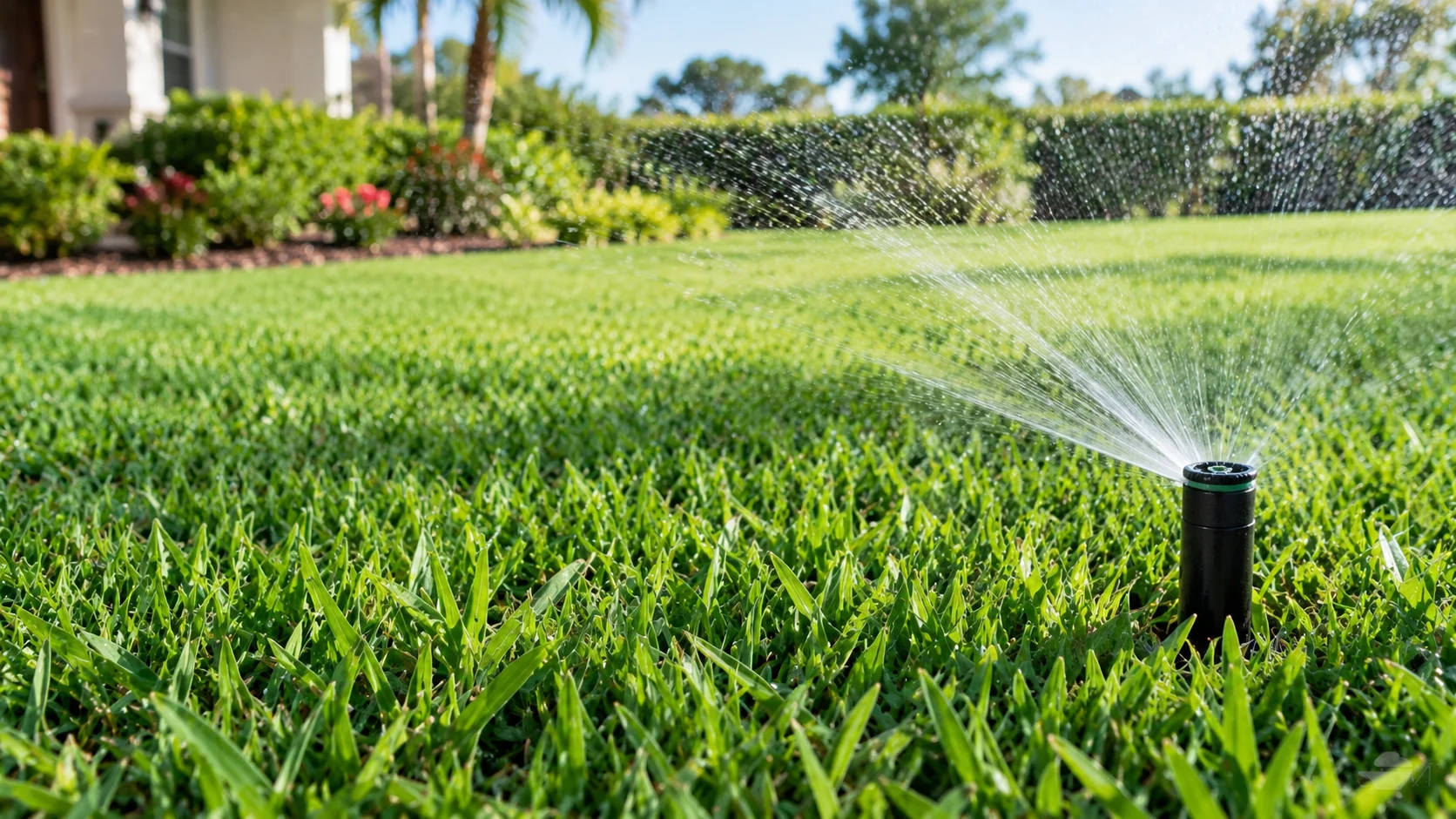
Most St. Augustine advice stops at "1 inch a week," which hides the two numbers that matter: how much goes on at once and how many days the lawn can wait. Both change with the season, so a controller left on its July program overwaters in October. The lawn watering schedule calculator turns your inputs into days and minutes, and this guide shows the method behind it.
Below are the weekly totals, the University of Florida intervals by season, a formula you can run for any climate, a worked example that ends in minutes on the controller, and the signs that tell you the schedule is wrong. Most published research on this grass comes from Florida, so the tables lean on it and the formula covers everywhere else.
Key takeaways
- Apply ½ to ¾ inch (13 to 19 mm) per watering, and wait for visible stress before watering again.
- With no rain, 6-inch roots can wait 1 to 5 days in summer, 2 to 9 days in spring and fall, and 7 to 28 days in a north Florida winter.
- Weekly use is reference ET multiplied by 0.6. At 0.2 inch of ET a day that is 0.84 inch (21 mm) a week before rain.
- Amount per watering stays the same all year; only the number of days between waterings changes.
- Sandy soil holds about ½ inch in the top 6 inches, so it needs the shortest intervals.
- Time a run with catch cans: ¼ inch in 15 minutes means 30 to 45 minutes for ½ to ¾ inch.
How much water does St. Augustine grass need each week?
Start with the total, because frequency is only a way of splitting it. Grass loses water through evaporation and transpiration, together called evapotranspiration (ET), and engineers measure it against a reference grass as ETo.1 A warm-season lawn uses ETo multiplied by a plant factor of 0.6.2 Local ETo comes from a weather station or your state's ET network.
On a hot summer day ETo of 0.2 to 0.3 inch (5 to 8 mm) is common in the Southeast. That gives St. Augustine grass 0.12 to 0.18 inch a day, or about 0.84 to 1.26 inches (21 to 32 mm) a week. In spring and fall, when ETo falls to 0.10 to 0.15 inch a day, the lawn needs only 0.42 to 0.63 inch (11 to 16 mm). The lawn water requirement calculator returns your own weekly figure, and the landscape coefficient calculator shows how plant factor is built if you want to adjust the 0.6 for shade or a drought-tolerant cultivar.
UF/IFAS research supports the 0.6 figure: replacing 60 percent of ET kept St. Augustine grass adequately watered during drought on well-designed, well-maintained systems.4
These are net figures. Rain that soaks in counts against them, and an uneven sprinkler pattern raises what you must apply, which the schedule section handles.
How much water should each watering apply?
Apply ½ to ¾ inch when the lawn begins to show drought stress, and do not apply again until stress returns. That is the University of Florida guidance for lawns, and it adds that the amount per watering should not change by season.3 Florida soils are typically sandy and hold about 1 inch of water in the top 12 inches, so a lawn rooted to 12 inches needs ½ to ¾ inch to wet the zone thoroughly. Roots at 6 inches hold only about ½ inch, which is why shallow-rooted lawns on sand need the short intervals in the table below.
Light, frequent watering is the common mistake. It wets only the surface, encourages shallow roots and keeps the grass blades damp.3 A second UF/IFAS publication states the trigger more precisely: irrigate ½ to ¾ inch when 30 to 50 percent of the turf shows wilt during the day.4
To turn inches into minutes, set straight-sided cans in a line out from a head, run the zone for 15 minutes and read the depth. If the cans hold ¼ inch, the zone needs 30 to 45 minutes for ½ to ¾ inch.3 The catch-can test calculator averages the cans and flags uneven coverage, and the sprinkler precipitation rate calculator gives inches per hour from nozzle data when you cannot run a test.
How often should you water St. Augustine grass?
The University of Florida lists how many days St. Augustine grass with 6-inch roots can go between irrigations in three climates, assuming no rain.3 Treat the ranges as planning limits and let the grass confirm them.
Days St. Augustine grass can go between waterings, by season and city
| Season | Pensacola (days) | Gainesville (days) | Miami (days) |
|---|---|---|---|
| Winter | 8–28 | 7–23 | 3–10 |
| Spring | 3–11 | 3–9 | 2–7 |
| Summer | 1–5 | 1–5 | 1–4 |
| Fall | 2–9 | 2–8 | 2–6 |
Source: UF/IFAS, Watering Your Florida Lawn, Table 1 (data from Meyers and Horn, 1969). Values assume 6-inch roots and no rainfall, and vary with soil, shade and fertilization.3
The spread inside each range is the weather. A cloudy, humid week sits at the long end and a hot, windy one at the short end. Miami's winter range is the shortest of the three, a reminder that local ET, not the month name, sets the interval. The seasonal adjustment calculator converts these swings into a monthly percentage for controllers that use one.
Reset the controller each season
UF/IFAS notes that failing to adjust for the season usually leads to overwatering.3 Change the days between waterings first and leave the run time alone.
St. Augustine grass watering schedule: how to build one
The Florida table is a good start. Anywhere else, or on soil that differs from the typical, build the schedule from ET with four numbers.
Formula
Days between waterings = refill depth ÷ (ETo × 0.6)
Refill depth is the inches you apply per watering, net of waste. Waterings per week = (ETo × 7 × 0.6) ÷ refill depth, rounded up. Minutes per watering = (net depth ÷ DU) ÷ precipitation rate × 60. DU is distribution uniformity as a decimal.
- Get daily ETo. Use a local weather station or a state ET network, and multiply by 0.6 for grass use. Subtract any rain that soaked in; the effective rainfall calculator estimates how much of a storm counts.
- Set the refill depth. Use ½ inch as the working figure, the low end of the UF/IFAS range.
- Find the interval. Divide refill depth by daily grass use. The irrigation interval calculator does it from soil and ET inputs.
- Convert to minutes. Divide the gross depth by your measured precipitation rate. Use a DU of 0.7 as a planning figure if you have not tested the system, then let the how long to water lawn calculator set each zone.
Weekly use and watering frequency for St. Augustine grass by daily ETo
| Daily ETo | Weekly grass use (ETo × 0.6) | Waterings per week | Days between waterings |
|---|---|---|---|
| 0.10 in (2.5 mm) | 0.42 in (11 mm) | 1 | 8.3 |
| 0.15 in (3.8 mm) | 0.63 in (16 mm) | 2 | 5.6 |
| 0.20 in (5.1 mm) | 0.84 in (21 mm) | 2 | 4.2 |
| 0.25 in (6.4 mm) | 1.05 in (27 mm) | 3 | 3.3 |
| 0.30 in (7.6 mm) | 1.26 in (32 mm) | 3 | 2.8 |
Calculated with a 0.5 inch (13 mm) refill depth, a plant factor of 0.6 and no rain. Waterings per week are rounded up, so the first row reads 1 a week even though the interval is 8.3 days; a weekly watering is the practical schedule.
Enter grass, soil, sprinkler type and weather. The calculator returns waterings per week and minutes per zone.
Worked example: 6,000 sq ft on sandy soil in June
Take a 6,000 sq ft St. Augustine lawn on sandy soil in a hot June week. ETo averages 0.2 inch a day, no rain falls, spray heads apply 1.5 inches an hour, and DU is an untested 0.7.
- Daily grass use0.2 × 0.6 = 0.12 in
- Weekly grass use0.12 × 7 = 0.84 in
- Refill depth (sand, 6 in roots)0.5 in
- Waterings per week0.84 ÷ 0.5 = 1.68, round up to 2
- Net depth per watering0.84 ÷ 2 = 0.42 in
- Gross depth per watering0.42 ÷ 0.7 = 0.6 in
- Minutes per watering0.6 ÷ 1.5 × 60 = 24 min
- Weekly volume6,000 × 1.2 × 0.623 ≈ 4,490 gal
2 waterings a week, about 24 minutes each
Space them 3 to 4 days apart. Metric: 0.84 in is 21 mm net a week, 1.2 in is 30 mm gross, or roughly 17,000 liters over 557 m².
Check it against the table. A 4.2-day interval at 0.2 inch of ET matches the 1 to 5 days UF lists for summer. Each watering returns 0.42 inch to the root zone, which is under the 0.5 inch the sand can hold, so water stays where the roots are. If heads run longer than the soil absorbs, split the 24 minutes into two cycles an hour apart with the cycle and soak calculator.
Signs St. Augustine grass needs water now
UF/IFAS bases its "as-needed" guideline on what the grass shows. Check every few days for the first month of a new schedule, and adjust one variable at a time.3
Water now
- Leaf blades fold in half lengthwise.
- The lawn takes on a blue-gray tint instead of green.
- Footprints or tire tracks stay visible long after they are made.
- The same patches wilt first, usually the sunny or sandy spots.
Hold off a day
- Blades are flat and the grass springs back after you walk on it.
- A soil probe slides easily to about 6 inches.
- Rain has delivered ½ to ¾ inch since the last watering.
- Water pools or runs onto pavement, so shorten the run.
If the lawn shows stress before the next scheduled day, add a watering. If it never shows stress between waterings, stretch the interval by a day.
When to water: time of day, rain and shade
Water in the early morning. Daytime watering loses water to evaporation, and late-afternoon or late-morning runs can extend the period the blades stay wet from dew, which speeds disease.3
Rain resets the clock. When ½ to ¾ inch falls, suspend irrigation until stress returns, and skip a scheduled day if that much fell the day before.3 A rain gauge or rain sensor makes this automatic.
Shaded turf uses less. UF/IFAS says to cut irrigation to the shaded part of the lawn, which usually means a separate zone or a hand-watering schedule. Sprinkler zones that mix turf and shrubs also over- or under-water one of them.3 If your city limits watering days, keep the same depth per watering and use the allowed days; local rules override any schedule here. The lawn watering by grass type chart compares St. Augustine with other lawn grasses.
How often to water new St. Augustine sod
A new lawn flips the rule. UF/IFAS Extension in Volusia County advises ¼ to ½ inch daily for the first two weeks to establish new turf, then 2 to 3 times a week or whatever local ordinances allow, before moving to the as-needed schedule.5 The sod watering calculator lays out the day-by-day taper.
What happens if you overwater St. Augustine grass?
UF/IFAS lists the damage: greater disease susceptibility, more thatch, a shorter root system that lowers stress tolerance, and more weeds such as dollarweed and sedges.3 Overwatering is also the likeliest outcome of an unadjusted controller. A lawn that runs every other day in October on a July program gets many times the water it can use.
The cure is the interval table above, not shorter runs. Two checks catch most problems: whether the soil is still wet a day after watering, and whether runoff appears. For help sizing how much water a zone can hold before drainage, try the available water capacity calculator.
Frequently asked questions
Can you water St. Augustine grass every day?
Only in two cases. New sod needs light daily watering for its first two weeks. Established lawns on very sandy soil may reach a one-day interval in peak summer heat. Otherwise daily watering keeps roots shallow and the surface wet, and it raises disease and weed pressure. Wait for stress signs between waterings.
How many minutes should sprinklers run on St. Augustine grass?
Divide the depth you want by your precipitation rate and multiply by 60. A spray head at 1.5 inches an hour needs 20 minutes for ½ inch and 30 minutes for ¾ inch. A rotor at 0.5 inch an hour needs 60 and 90 minutes. Measure the rate with catch cans rather than guessing.
Does shade change how much St. Augustine grass needs?
Yes. Shaded grass loses less water, so UF/IFAS advises reducing irrigation to shaded parts of a lawn. If one zone covers both sun and shade, base the schedule on the sunny side and check the shaded side by hand for soggy soil, or water the shade separately with a hose.
How often should you water St. Augustine grass in winter?
Much less often. UF/IFAS data show 6-inch roots can go 7 to 23 days between waterings in Gainesville and 8 to 28 days in Pensacola, assuming no rain. Miami is shorter at 3 to 10 days. Keep the same ½ to ¾ inch per watering and reset the controller before the cool season starts.
Does rain count as a watering for St. Augustine grass?
Yes, once it is enough. UF/IFAS says to suspend irrigation after a rainfall of ½ to ¾ inch until the grass shows stress again. A light shower under that depth mostly wets the surface and evaporates. A rain gauge or rain sensor takes the guesswork out of skipping a cycle.
Is 1 inch of water a week enough for St. Augustine grass?
It is a fair average, not a rule. At 0.2 inch of ETo a day, St. Augustine grass uses 0.84 inch a week, and at 0.3 inch it uses 1.26 inches, both before rain and sprinkler waste. Use the ET method in this guide for your own weather, then check the lawn for stress signs.
Sources
- Allen, R.G., Pereira, L.S., Raes, D. and Smith, M. (1998). Crop Evapotranspiration: Guidelines for Computing Crop Water Requirements. FAO Irrigation and Drainage Paper 56. Food and Agriculture Organization of the United Nations.
- UC Center for Landscape & Urban Horticulture. Plant Factor or Crop Coefficient: What's the Difference? University of California Agriculture and Natural Resources. Values adapted from ANSI/ASABE S623.
- Trenholm, L.E., Unruh, J.B. and Cisar, J.L. Watering Your Florida Lawn. ENH9/LH025. UF/IFAS Extension, University of Florida.
- Dukes, M.D., Cardenas, B., Trenholm, L.E. et al. Frequently Asked Questions about Landscape Irrigation for Florida-Friendly Landscaping Ordinances. WQ142. University of Florida.
- UF/IFAS Extension Volusia County. December 2025 Newsletter: Turfgrass of Florida, St. Augustinegrass. University of Florida.
Written by Daniel Reeves, PE, CID. Figures in this article were calculated from the cited sources and checked against our lawn watering calculator. Read how we calculate and our editorial policy. Spotted an error? Tell us.