How to Tell if Your Lawn Needs Water (7 Signs)
Footprints that stay, rolled blades and a blue-gray cast show up before the grass browns. This guide covers the seven signs, three quick field tests to confirm them, and how much water to give once you see them.

By Daniel Reeves, PE, CID
Irrigation Design Engineer
Short answer
Your lawn needs water when footprints stay, blades fold lengthwise and the grass turns blue-gray. Confirm with a screwdriver: it pushes in easily when soil is moist 6 to 8 inches (15 to 20 cm).
That is how to tell if your lawn needs water while the grass can still recover. Water within a day of seeing the signs and apply about 0.5 to 0.75 inch (13 to 19 mm) a time. Wilting on soil that is already wet is a different problem, so check the soil before you turn on the sprinklers.
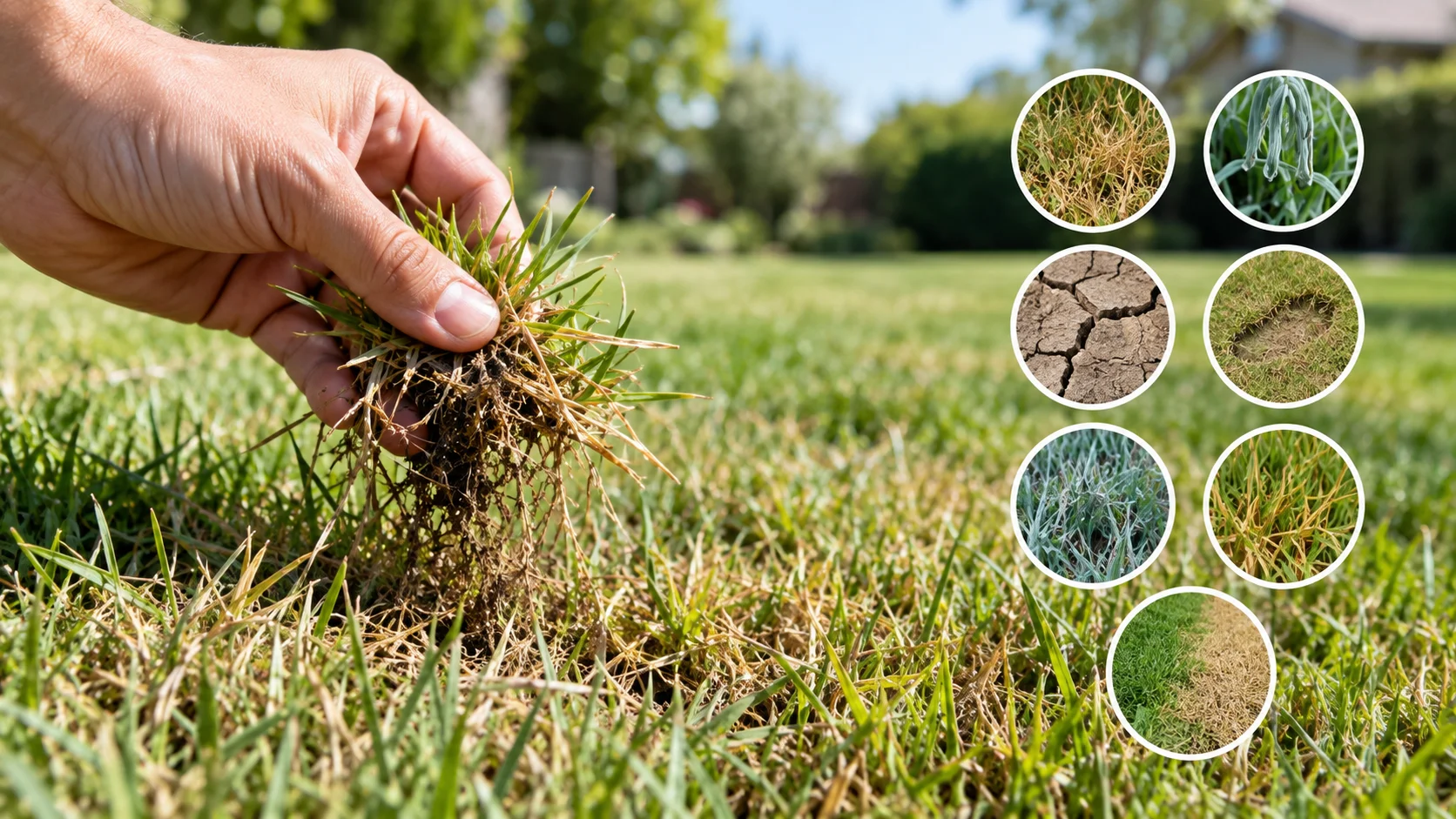
The lawn water deficit calculator turns what you see into inches to put back, but first you have to read the lawn correctly. Brown grass is a late sign, and wilting on soggy ground means the opposite of what it seems.
Below, the seven signs run from earliest to latest, followed by three field tests, the cases where the signs mislead, and a worked example that ends in minutes on your controller.
Key takeaways
- The earliest signs are footprints that stay in the grass, a blue-gray cast and blades that fold lengthwise. Straw-brown grass is a late sign.
- Confirm with the soil. A screwdriver pushes in easily when the root zone is moist 6 to 8 inches (15 to 20 cm) down, and dry, dusty soil that will not hold a ball needs water.
- Water within a day of the signs. To keep a lawn uniformly green, water when 30 to 50 percent of it shows wilt.
- Apply about 0.5 to 0.75 inch (13 to 19 mm) per watering, and stop and resume if runoff starts.
- Wilting on obviously wet soil is wet wilt, and more water makes it worse.
- Hot spots on slopes, south sides and next to pavement show stress first, so use them as gauges.
How to tell if your lawn needs water: the 7 signs
Lawns show water stress in a fairly fixed order. The first three signs appear while the grass is still green.
1. Footprints stay in the grass
Walk across the lawn and look back at your track. Blades with plenty of water are rigid and spring upright quickly. Blades short of water lose that internal pressure, called turgor, and stay trampled, so tracks or wheel marks that last several hours are an early sign of stress.1 UF/IFAS extension reads the same pattern, footprints or tire tracks that remain long after they were made, as drought stress.2
2. The color shifts to blue-gray
Before it browns, stressed turf changes from green to a dull bluish-gray.2 University of Missouri extension describes the tint as bluish-purple.1
3. Blades fold or roll lengthwise
Dry grass curls its blades up lengthwise to reduce leaf area.2 Look at the older leaves, because young leaves are not fully developed and can look wilted when the plant is fine.2
4. The soil is dry down to root depth
Missouri extension treats adequate moisture at 6 to 8 inches (15 to 20 cm) as enough to carry summer grass,1 so that is the depth to check. If you are unsure how deep your roots reach, the root zone depth calculator helps you pick a depth to test.
5. The same spots wilt first
Some areas always show stress ahead of the rest: hard soils that take up water slowly, slopes, south-facing exposures and warm strips beside driveways and walks.1 Treat them as gauges, because they give the earliest warning.
6. Blades turn straw-brown
With continued heat and no water, grass wilts first and then browns completely as it goes dormant.1 The crown, the lower part of the plant, usually stays alive but stops growing.1 That is why brown is a late sign rather than proof the lawn is dead.
7. Turf thins, weeds move in and the ground cracks
A prolonged shortage thins the turf and can raise weed pressure.2 Extended dry periods can also open large cracks in the soil and cause heavy loss of turf cover, even after watering resumes.1
The seven signs by stage, with the check that confirms each
| Stage | Signs | What the lawn is telling you | Check to run |
|---|---|---|---|
| Early, lawn still green | 1 Footprints, 2 blue-gray, 3 folded blades | Blades have lost turgor and the root zone is drying | Walk the lawn; screwdriver test to 6–8 in (15–20 cm) |
| Middle | 4 Dry root zone, 5 hot spots | Moisture below the surface is gone | Squeeze test; shovel wedge 6–8 in (15–20 cm) deep |
| Late | 6 Straw-brown, 7 thinning, weeds, cracks | Dormancy or turf loss | Water thoroughly and watch for new growth at the crown |
Three quick tests that confirm the signs
Run each test in two places, one hot spot and one ordinary spot, to see whether to water everything or only the problem areas.
- Screwdriver test. Push a slender, foot-long screwdriver into the lawn in several places. It slides in easily where the soil has had enough water.1 Compare a hard spot with a patch you watered yesterday, because compacted soil can resist even when it is moist.
- Squeeze test. Press a golf-ball-sized handful of root-zone soil together. Soil that holds together without crumbling and looks moist has been watered properly. Soil that is dry and dusty and will not form a ball has had too little water, or the water ran off instead of soaking in.1
- Shovel wedge test. The day after a watering, cut a slender wedge of turf about 2 inches (5 cm) wide and 6 to 8 inches (15 to 20 cm) deep. The soil, roots and turf go back in without harm.1 For a number instead of a feel, use the soil moisture calculator.
How much of the lawn has to show signs before you water?
Extension sources give two rules, and the right one depends on how green you want the lawn to stay. University of Missouri extension says to water within a day of seeing the symptoms.1 UF/IFAS says to consider watering when you see at least one of the three classic signs, and to irrigate when 30 to 50 percent of the lawn shows wilt if you want it uniformly green through a dry spell, unless rain is forecast within 24 hours.2
Grass type changes the slack you have. Warm-season grasses can survive extended drought by going dormant, if you accept some wilt and browning.2 Cool-season turf needs more: UC data put survival-level watering for tall fescue at about 60 percent of ETo, against about 40 percent for bermudagrass.4
Tip: hand-water the hot spots first
If only the hot spots show signs, water them by hand or with a soaker hose to put off a full-lawn run.1
Check local rules before you water
Many cities limit watering days and hours, and those limits override anything the lawn is telling you.
When wilting does not mean the lawn needs water
Grass can wilt in wet soil. Missouri extension calls this wet wilt: the soil is obviously wet, but the roots cannot keep up with what the atmosphere demands, and the curling looks almost identical to drought wilt.1 Lawns with shallow roots after a rainy spring are the most exposed, and adding water starves the roots of oxygen.1
Overwatering is the most common lawn mistake, and UF/IFAS lists shallow roots, more weeds, insects and disease, and more thatch among the costs.2
Water it
- Footprints stay and the soil is dry beneath the surface.
- Blades are folded and the screwdriver meets resistance.
- Squeezed soil is dusty and will not form a ball.
- Hot spots are wilting while the rest of the lawn still springs back.
If the lawn looks stressed on wet soil, ask your county extension office or a local turf professional to look at it before you add water.
How much water to give once the signs show
Two extension figures cover most lawns. UF/IFAS puts the right amount at 0.5 to 0.75 inch (13 to 19 mm) per watering for most Florida soils, and notes that sandy soil wets down about 12 inches (30 cm) for each inch applied while heavier soil may need only half an inch.2 Missouri extension works by the week: once you decide to irrigate, supply a week of water, spread over two or three days if the soil takes it in slowly, then wait for the signs before irrigating again.1
Weekly water once irrigation starts, by grass and lawn condition
| Grass | Green, growing lawn (in per week) | Dormant lawn (in per week) |
|---|---|---|
| Perennial ryegrass | 1.5 in (38 mm) | 1.0 in (25 mm) |
| Kentucky bluegrass | 1.2 in (30 mm) | 0.7 in (18 mm) |
| Tall fescue | 0.8 in (20 mm) | 0.5 in (13 mm) |
| Zoysia or bermuda | 0.5 in (13 mm) | 0.2 in (5 mm) |
| Buffalograss | 0.3 in (8 mm) | 0.2 in (5 mm) |
Missouri extension figures, where turf ET in central Missouri in July and August is about 4 inches (100 mm) a month. Hotter, drier climates need more. Dormant means the lawn may turn brown but will not die.1 For other grasses, see the lawn watering by grass type chart or the grass type water needs calculator.
Water only as fast as the soil can take it in. Most Missouri soils absorb about 0.25 to 0.5 inch (6 to 13 mm) an hour,1 so a sprinkler that applies more than that causes runoff. UC suggests watching one cycle from the start until runoff begins to find the longest run your soil allows.3 The soil infiltration rate calculator helps you estimate your own soil's intake.
Formula
Water to apply (in) = ETo × Kc × days since last watering ÷ DU
ETo is daily reference evapotranspiration, and ETo × Kc is the lawn's daily water use.5 Kc averages 0.8 for cool-season turf and 0.6 for warm-season turf over a year.4 DU is distribution uniformity as a decimal. Minutes per run = water to apply ÷ precipitation rate (in/hr) × 60.
- Estimate what the lawn used. Multiply daily ETo by Kc, then by the days since the last watering or soaking rain. Get daily ETo from a local weather network or the evapotranspiration calculator.
- Correct for uneven coverage. Divide by DU. Use 0.7 as a planning figure if you have not tested, or measure it: set straight-sided cans, such as tuna cans, across the zone, run the system and compare depths, which should all be about equal.2 The catch-can test calculator handles the arithmetic.
- Convert depth to minutes. Divide the depth by your precipitation rate and multiply by 60. If you do not know the rate, the sprinkler precipitation rate calculator finds it, and the how long to water lawn calculator returns minutes per zone.
- Split long runs. If runoff starts before the run ends, stop and resume after the water has soaked in. The cycle and soak calculator sets the cycle length.
Enter your grass, weather and days since the last watering to estimate the deficit in inches.
Worked example: tall fescue on loam, signs on day 3
Take a 5,000 sq ft (465 m²) tall fescue lawn. Three days after the last watering, with no rain, footprints stay in the grass and a blue-gray cast shows across the sunny side. ETo has averaged 0.2 inch a day (5 mm), the rotors apply 0.5 inch an hour (13 mm/h), and DU is an assumed 0.7.
- Daily lawn use0.2 × 0.8 = 0.16 in
- Used in 3 days0.16 × 3 = 0.48 in
- Water to apply0.48 ÷ 0.7 = 0.686 in
- Run time0.686 ÷ 0.5 × 60 = 82 min
- Cycles2 × 41 min, 0.34 in each
- Volume5,000 × 0.686 × 0.623 ≈ 2,137 gal
About 82 minutes, split into two 41-minute cycles
Metric: 0.16 in is 4 mm a day, 0.48 in is 12 mm used, and 0.686 in is 17 mm applied at 13 mm/h for 82 minutes, about 8,100 liters over 465 m².
Check the result against the extension ranges. The 0.686 inch applied falls inside the 0.5 to 0.75 inch per watering that UF/IFAS gives,2 and each 41-minute cycle puts down 0.34 inch, inside the 0.25 to 0.5 inch that Missouri soils take before runoff.1
What if the lawn is already brown?
Brown blades usually mean dormancy before they mean death. The crown normally stays alive, and a thorough watering or soaking rain brings the lawn out of dormancy as new leaf tissue resumes.1 Recovery is not guaranteed after a long dry spell, because extended dryness can still cause cracking and loss of turf cover.1
Keeping a lawn alive takes far less water than keeping it green. Missouri extension lists 0.5 inch (13 mm) a week for dormant tall fescue against 0.8 inch (20 mm) for green fescue, and 0.2 inch (5 mm) against 0.5 inch (13 mm) for zoysia or bermuda in the weekly water table above.1
To test a brown patch, water a small area thoroughly and watch the base of the plants for new leaf tissue. A patch that stays brown while the lawn around it recovers may have dead crowns or another problem, and your county extension office can diagnose it.
A weekly routine for checking your lawn
A five-minute check twice a week in warm weather is enough once you know the signs.
- Pick your gauge spots. Choose one hot spot, such as a slope, a south side or a strip beside pavement, and one ordinary spot, and check both every time.1
- Run the checks. Walk across the lawn, look at color and blade shape, and push the screwdriver into both spots.
- Water within a day of the signs. The best window is 6 to 8 a.m., when pressure is highest, wind is low and evaporation is small. Avoid midday and windy conditions.1
- Verify the next day. Use the shovel wedge or screwdriver to confirm moisture at 6 to 8 inches (15 to 20 cm), and adjust the run time if it is not there.1
Rain resets the clock. Missouri extension says to delay the next irrigation until wilt symptoms return,1 and a rain gauge shows how much fell. The effective rainfall calculator estimates how much of a storm your lawn can use. After a few weeks, the interval between signs becomes your schedule, and the lawn watering schedule calculator converts it into days and minutes.
Frequently asked questions
Is it better to water the lawn in the morning or the evening?
Morning. Missouri extension puts the best window at 6 to 8 a.m., when pressure is highest, wind is low and evaporation is negligible. Early watering also shortens the time blades stay wet, which cuts diseases that need long periods of leaf moisture. Avoid midday and windy conditions, and follow any local watering hours.
How do I know I watered enough?
The day after watering, cut a narrow wedge of turf 6 to 8 inches (15 to 20 cm) deep and look at the soil. It should be moist and hold together when squeezed. Dry, dusty soil at that depth means the run was too short or the water ran off. A screwdriver should also push in easily.
Does rain count as a watering?
A rain that soaks the root zone does. Missouri extension says to delay the next irrigation until wilt symptoms return after rain. A rain gauge shows how much fell, and the screwdriver test shows whether it reached 6 to 8 inches (15 to 20 cm). A light shower may wet only the surface.
Do warm-season and cool-season grasses show thirst the same way?
The signs are the same: footprints, blue-gray color and folded blades. The tolerance differs. Warm-season grasses such as bermudagrass and zoysiagrass use about 20 percent less water than cool-season tall fescue, ryegrass and bluegrass, and they can survive long dry periods by going dormant. Cool-season turf needs about 60 percent of ETo to survive, against about 40 percent for bermudagrass.
How many gallons does one watering take?
One inch of water over 1,000 sq ft takes about 623 gallons (2,360 liters), so a 0.5 to 0.75 inch watering takes about 310 to 470 gallons (1,180 to 1,770 liters) per 1,000 sq ft (93 m²). Divide by your distribution uniformity to allow for uneven coverage: at 0.7, those figures become about 445 to 667 gallons.
Why does my lawn still look dry after I watered it?
Either too little water went in or it ran off before soaking in. Missouri extension says soil that is dry and dusty and will not form a ball points to one of those two causes. Most Missouri soils absorb about 0.25 to 0.5 inch (6 to 13 mm) an hour, so split long runs into cycles. Hard soils and slopes often show stress first.
Sources
- Fresenburg, B.S. (2012). Home Lawn Watering Needs. Missouri Environment & Garden. University of Missouri Integrated Pest Management Program.
- Trenholm, L.E. and Unruh, J.B. Let Your Lawn Tell You When To Water. ENH63. UF/IFAS Extension, University of Florida.
- UC Statewide IPM Program. How Many Times a Week to Water. The UC Guide to Healthy Lawns. University of California Agriculture and Natural Resources.
- UC Center for Landscape & Urban Horticulture. Turfgrass Crop Coefficients (Kc). University of California Agriculture and Natural Resources.
- Allen, R.G., Pereira, L.S., Raes, D. and Smith, M. (1998). Crop Evapotranspiration: Guidelines for Computing Crop Water Requirements. FAO Irrigation and Drainage Paper 56. Food and Agriculture Organization of the United Nations.
Written by Daniel Reeves, PE, CID. Figures in this article were calculated from the cited sources and checked against our lawn watering calculator. Read how we calculate and our editorial policy. Spotted an error? Tell us.