What Does "1 Inch of Water" Mean in Gallons?
An inch is a depth, not a volume, so the gallons depend on the area it covers. This guide gives the exact conversion, gallons for common lawn sizes and how to measure an inch from your own sprinklers.

By Daniel Reeves, PE, CID
Irrigation Design Engineer
Short answer
1 inch of water in gallons is 0.623 gallons per square foot, or about 623 gallons (2,360 liters) on every 1,000 square feet.
The figure comes from geometry, 144 square inches in a square foot and 231 cubic inches in a gallon, so it holds for rain and irrigation alike.1 An acre takes 27,154 gallons per inch.2 How long that takes depends on your sprinklers.
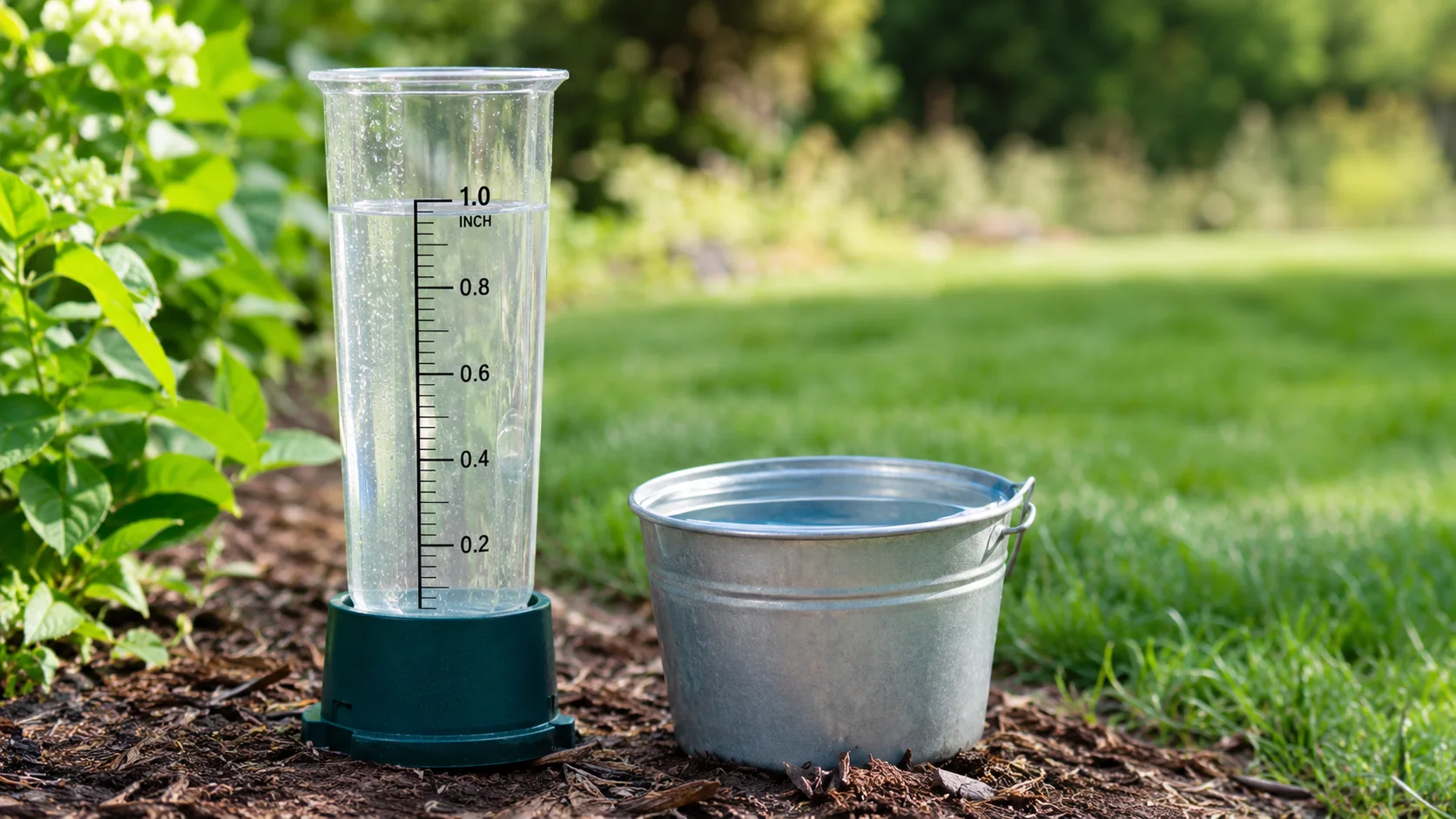
"Give your lawn an inch of water a week" is easy advice to repeat and hard to act on, because your hose, meter and water bill count gallons. An inch is a depth, so the volume depends on how much ground it covers. The inches of water to gallons calculator does the conversion for any depth and area in one step.
Purdue Extension rounds the conversion to 0.62, which suits a garden bed but drifts on a large lawn.1 This guide gives the exact factor, a table of gallons by lawn size, a worked example with metric results, how deep an inch wets your soil, and how to measure an inch from your own sprinklers or hose.
Key takeaways
- Gallons = area in square feet × inches of water × 0.623. In metric, 1 mm of water over 1 m² is exactly 1 liter.
- 1,000 sq ft takes 623 gallons (2,360 liters) per inch, and an acre takes 27,154 gallons.
- Rounding the factor to 0.62 is fine for a garden bed but undercounts a 10,000 sq ft lawn by about 34 gallons.
- One inch wets sandy soil about 12 inches deep, loam 6 to 8 inches and clay about 5 inches.
- Run time for an inch is 60 ÷ precipitation rate: about 34 minutes for spray heads and 120 minutes for rotors at typical rates.
- Check your own sprinklers with catch cans; a ruler reading beats any chart.
What is 1 inch of water in gallons on a lawn?
One inch of water spread over 1 square foot is 0.623 gallons, about 80 fluid ounces. Spread over 1,000 square feet it is 623 gallons, which weighs roughly 5,200 pounds (2,360 kg) at 8.33 pounds a gallon.2 A typical suburban lawn of 5,000 square feet therefore needs about 3,117 gallons for each inch.
The depth is the same whether it falls from the sky or leaves a sprinkler. A rain gauge reading of 1 inch and a catch can reading of 1 inch both mean 0.623 gallons on each square foot, which is why one measure works for rain, hose and irrigation system alike.
The formula: from inches to gallons
Everything follows from two fixed facts: 1 square foot is 144 square inches, and 1 gallon is 231 cubic inches.1 A layer 1 inch deep over 1 square foot holds 144 cubic inches, and 144 ÷ 231 = 0.6234 gallons.
Formula
Gallons = area (sq ft) × depth (in) × 0.623
The factor is 144 ÷ 231 = 0.6234. Metric: liters = area (m²) × depth (mm), because 1 mm over 1 m² is 0.001 m³, or 1 liter. Use 1 inch = 25.4 mm to convert.
- Measure the area. Multiply length by width for a rectangle and add the pieces for an irregular lawn. Subtract beds and paving that the sprinklers do not water.
- Pick the depth. Use the inches you want to apply: 0.5 inch for one watering, 1 inch for a weekly total.
- Multiply. Area × depth × 0.623 gives gallons. Divide by 1,000 if you want thousands of gallons for a bill.
- Convert if needed. Multiply gallons by 3.785 for liters.
Purdue's rounded 0.62 is accurate enough for a 200 sq ft garden bed, where it gives 124 gallons against the exact 125.1 Over a big lawn the error adds up: at 10,000 sq ft, 0.62 gives 6,200 gallons against the exact 6,234.
Gallons in 1 inch of water by lawn size
The table applies the formula to common areas. Halve any figure for a half-inch watering, or multiply by 1.5 for a hot-weather week.
Gallons and liters for 1 inch of water, by area
| Area | Metric area | Gallons for 1 in | Liters for 25.4 mm | Gallons for 0.5 in |
|---|---|---|---|---|
| 100 sq ft | 9.3 m² | 62 | 236 | 31 |
| 500 sq ft | 46.5 m² | 312 | 1,180 | 156 |
| 1,000 sq ft | 92.9 m² | 623 | 2,360 | 312 |
| 2,500 sq ft | 232.3 m² | 1,558 | 5,899 | 779 |
| 5,000 sq ft | 464.5 m² | 3,117 | 11,799 | 1,558 |
| 10,000 sq ft | 929.0 m² | 6,234 | 23,597 | 3,117 |
| 1 acre (43,560 sq ft) | 4,047 m² | 27,154 | 102,790 | 13,577 |
Calculated as area × 0.6234 gallons per square foot, then × 3.785 for liters. All gallons are US gallons. The acre row matches the 27,154 gallons per acre-inch in the Oklahoma State conversion sheet.2
For a lawn that is not on the list, scale from the nearest row: a 3,000 sq ft lawn is three times the 1,000 sq ft figure, or 1,870 gallons. For gallons over a whole season, try the lawn water usage calculator.
Worked example: a 4,000 sq ft lawn after rain
Take a 50 ft by 80 ft lawn watered by rotors. The target is 1 inch a week from rain and irrigation together.3 A rain gauge shows 0.4 inch fell this week, and a catch can test measured the rotors at 0.5 inch per hour.
- Lawn area50 × 80 = 4,000 sq ft
- Depth still needed1.0 − 0.4 = 0.6 in
- Gallons per square foot0.6 × 0.6234 = 0.374 gal
- Gallons to apply4,000 × 0.374 = 1,496 gal
- Run time at 0.5 in/hr0.6 ÷ 0.5 × 60 = 72 min
- Flow check1,496 ÷ 72 = 20.8 gpm
About 1,496 gallons, or 72 minutes of rotor run time
Metric: 0.6 in is 15.2 mm; 4,000 sq ft is 371.6 m²; 15.24 liters per m² × 371.6 m² ≈ 5,663 liters.
The flow check closes the loop. Your zones should draw about 20.8 gallons per minute together for the rotors to apply 0.5 inch an hour on 4,000 sq ft. A large gap between the expected and measured flow points to worn or clogged heads, or to the wrong pressure.
How deep does 1 inch of water go into the soil?
An inch of water is a depth on top of the soil, and the soil decides how far it sinks. Texas A&M AgriLife Extension reports that 1 inch of water that does not run off wets dry sand about 12 inches deep, while loam needs 1.5 to 2.0 inches and clay about 2.5 inches to reach the same 12 inches.4
Depth wetted by 1 inch of water in dry soil
| Soil | Water to wet 12 in | Depth wetted by 1 inch | Infiltration rate |
|---|---|---|---|
| Sand | 1.0 in (25 mm) | 12 in (30 cm) | 2.0–6.0 in/hr |
| Loam | 1.5–2.0 in (38–51 mm) | 6–8 in (15–20 cm) | 0.6–2.0 in/hr |
| Clay | 2.5 in (64 mm) | about 5 in (12 cm) | 0.2–0.6 in/hr |
Water to wet 12 inches and infiltration rates are from Texas A&M AgriLife. Depth wetted by 1 inch is calculated as 12 ÷ the water needed, assuming dry soil and no runoff. Metric values are rounded.4
This is why the same inch behaves differently from one yard to the next. On sand it can carry water well below the top few inches where most turf roots sit, while on clay it stops about 5 inches down. NDSU Extension advises splitting the week's water into two or three applications on sandy soil, which cannot hold a full inch at once, and watering clay once or twice a week.3
Soil also limits how fast you can add the water. Clay absorbs only 0.2 to 0.6 inch an hour, slower than a spray head delivers it, so a full inch in one run puddles and drains off.4 The wetting front depth calculator estimates how far your applied depth reaches in your soil.
How long does it take to apply 1 inch of water?
Time depends only on how fast your sprinklers deliver water, their precipitation rate in inches per hour. Colorado State Extension gives typical rates of 1 to 2.5 inches an hour for pop-up spray heads and 0.25 to 0.75 inch for rotors, with planning values of 1.75 and 0.5.5 The sprinkler precipitation rate calculator and the sprinkler precipitation rate chart give rates by nozzle and spacing.
Minutes to apply 1 inch of water, by sprinkler type
| Sprinkler type | Typical rate | Planning rate | Minutes for 1 in | Minutes for 0.5 in |
|---|---|---|---|---|
| Pop-up spray head | 1–2.5 in/hr | 1.75 in/hr | 34 | 17 |
| Rotor head | 0.25–0.75 in/hr | 0.5 in/hr | 120 | 60 |
Rates are planning values from Colorado State Extension.5 Minutes = depth ÷ rate × 60, rounded. At the ends of the typical ranges, 1 inch takes 24 to 60 minutes with spray heads and 80 to 240 minutes with rotors.
One inch in one run usually runs off
Colorado State's cycle guidance for its soils calls for 3 cycles when a spray run exceeds 24 minutes or a rotor run exceeds 72 minutes.5 At planning rates, an inch is three 11-minute spray runs or three 40-minute rotor runs, spaced at least an hour apart. The how long to water lawn calculator converts a target depth into minutes per zone.
How to measure 1 inch of water with catch cans
Charts give a starting point, but real sprinklers vary with pressure, spacing and wear. A catch can test measures what your system actually delivers. University of Minnesota Extension uses at least 20 cans per zone, spaced 5 to 8 feet apart for spray heads and 10 to 20 feet for rotors, and runs the zone 30 to 60 minutes.6
- Set out straight-sided cans. Minnesota Extension accepts tuna or coffee cans, while Colorado State prefers taller soup cans because tuna cans are shallow and let water splash out.65
- Run the zone for a timed period. Use 30 minutes or more for the best accuracy.
- Average the depths. Add the ruler readings and divide by the number of cans.
- Convert to inches per hour. Average depth ÷ run minutes × 60. For example, 0.75 inch in 30 minutes is 1.5 in/hr.6
- Set the run time. Divide the depth you want by the rate and multiply by 60.
A shortcut from Colorado State: set out six identical cans, run the zone for exactly 10 minutes, and pour all six into one can. The depth in that can equals the zone's rate in inches per hour, because six cans over ten minutes add up to one hour of water.5 The catch can test calculator averages your readings into a precipitation rate.
Enter the area and the inches of water. The calculator returns gallons, liters and cubic feet.
How long to run a hose to apply 1 inch
With a hose or a hand-moved sprinkler there are no heads to rate, so work from gallons and flow instead. Time a one-gallon bucket as it fills and divide 60 by the seconds. Purdue Extension gives the example of 20 seconds, which is 3 gallons per minute.1 Then divide the gallons you need by that flow.
Formula
Minutes = (area × depth × 0.623) ÷ flow in gpm
Flow in gpm = 60 ÷ seconds to fill a 1-gallon bucket.
For a 600 sq ft bed that needs 1 inch, you need 600 × 0.6234 = 374 gallons. If the bucket fills in 12 seconds, the flow is 60 ÷ 12 = 5 gpm, and 374 ÷ 5 = 75 minutes. That is a long time for one hose, so move the sprinkler across the bed in sections. The lawn hose watering time calculator and the bucket test calculator cover the same steps.
How many inches does a lawn need in a week?
NDSU Extension puts the general figure at about 1 inch of water a week, from rain, irrigation or both.3 Colorado State's schedule for cool-season turf is lighter early and late in the season: 0.75 inch a week in late April and early October, 1 inch in May, June and September, and 1.5 inches in July and August.5
Weekly water for 1,000 sq ft at common weekly depths
| Weekly depth | Typical use | Gallons per 1,000 sq ft | Liters per 92.9 m² |
|---|---|---|---|
| 0.75 in (19 mm) | Spring and early fall | 468 | 1,770 |
| 1.0 in (25 mm) | General rule, rain included | 623 | 2,360 |
| 1.5 in (38 mm) | July and August, cool-season turf | 935 | 3,540 |
Depths are from NDSU and Colorado State Extension, and the Colorado values are for that state's cool-season turf.35 Volumes are calculated at 0.6234 gallons per square foot per inch. Subtract rain before irrigating.
Your own number depends on grass, climate and soil. The lawn water requirement calculator works it out from local evapotranspiration, and the effective rainfall calculator estimates how much of a storm your soil actually keeps.
Acre-inches, cubic feet and other units
Farm and utility sources use different units for the same inch. An acre-inch is the volume that covers 1 acre (43,560 square feet) 1 inch deep, and the Oklahoma State conversion sheet lists it as 27,154 gallons or 3,630 cubic feet.2 The acre-inches calculator converts between acre-inches and gallons.
1 inch of water over 1,000 sq ft and over 1 acre
| Unit | 1,000 sq ft (92.9 m²) | 1 acre (4,047 m²) |
|---|---|---|
| US gallons | 623 | 27,154 |
| Cubic feet | 83.3 | 3,630 |
| Cubic meters | 2.36 | 102.8 |
| Liters | 2,360 | 102,790 |
| Weight of water | about 5,200 lb (2,360 kg) | about 226,000 lb (102,800 kg) |
Cubic feet = area ÷ 12. Gallons use 7.481 gallons per cubic foot and weights use 8.33 pounds per gallon.2 Cubic meters = area in m² × 0.0254, and the acre weight matches the 113.1 tons per acre-inch Oklahoma State lists.
Some utilities bill in units of 100 cubic feet (CCF), which is 748 gallons at 7.481 gallons per cubic foot. An inch over 1,000 square feet is 0.83 CCF. Multiply gallons by the rate on your own bill to estimate cost; the lawn watering cost calculator does it for any lawn size.
The same factor sizes a rain barrel. One inch of rain on a 1,000 sq ft roof footprint is 623 gallons before losses to splash and overflow, and a 2,000 sq ft footprint gives 1,247 gallons. The rainwater irrigation supply calculator compares that supply with what your garden needs.
Frequently asked questions
Is 0.62 or 0.623 gallons per square foot correct?
Both are the same figure at different rounding. One inch over 1 square foot is 144 cubic inches, and dividing by 231 cubic inches per gallon gives 0.6234. Use 0.62 for a small bed and 0.623 for a lawn, where the rounding adds up to tens of gallons.
Does 1 inch of water per week include rainfall?
Yes. The usual target of about 1 inch a week counts rain and irrigation together. If a gauge in an open spot shows 0.4 inch of rain, you still need 0.6 inch from the sprinklers. Multiply that remaining depth by 0.623 to get gallons for each square foot.
Is 1 inch of rain the same as 1 inch of irrigation?
As a depth, yes, so 1 inch of either puts 0.623 gallons on each square foot. The difference is how it arrives. Rain can come faster than soil absorbs it and run off, while sprinklers can be timed in cycles. A gauge reading shows what landed, not what soaked in.
How do I convert inches of water to liters per square meter?
Multiply inches by 25.4 to get millimeters, and each millimeter is 1 liter per square meter. One inch is therefore 25.4 liters per square meter. A 100 square meter lawn takes 2,540 liters for 1 inch, which is about 671 US gallons.
Does the same 1 inch apply to a vegetable garden?
The conversion is the same on any surface, so a 100 sq ft bed needs 62 gallons per inch. How much you apply is a separate question, because beds and lawns differ in roots and soil. Measure your own output, since hoses, drip lines and sprinklers deliver water at different rates.
How many inches of water is 1 gallon over a given area?
Divide 1.604 by the area in square feet, because 1 gallon covers 1.604 square feet to a depth of 1 inch. Spread over 100 sq ft, a gallon is only 0.016 inch. That is why a bucket or watering can adds almost no measurable depth to a lawn.
Sources
- Mitchell, K. (2023). What is an Inch of Water? Purdue Landscape Report. Purdue Extension.
- Taghvaeian, S. Water Measurement Units and Conversion Factors. Fact sheet BAE-1501. Oklahoma State University Extension.
- Kalb, T. The Right Way to Water Your Lawn. NDSU Extension, North Dakota State University.
- Stein, L. So What Constitutes An Effective Rain Event? Texas A&M AgriLife Extension Service, Earth-Kind Landscaping.
- Whiting, D. and Jones, K.M. Methods to Schedule Home Lawn Irrigation. CMG GardenNotes #265. Colorado State University Extension.
- Bauer, S. Auditing home lawn irrigation systems. University of Minnesota Extension.
Written by Daniel Reeves, PE, CID. Figures in this article were calculated from the cited sources and checked against our lawn watering calculator. Read how we calculate and our editorial policy. Spotted an error? Tell us.