How Often Should You Water Your Lawn?
Most lawns do best with deep watering two or three times a week, not a little every day. The right count depends on your grass, soil and weather, and this guide shows how to work it out.

By Daniel Reeves, PE, CID
Irrigation Design Engineer
Short answer
Water cool-season lawns about 3 times a week in summer and warm-season lawns 1 or 2 times, then cut back to 1 or 2 waterings a week in spring and fall.
How often to water your lawn also depends on soil: sandy soil needs short runs every day or two in hot weather, while loam and clay hold enough for a watering about every 2 to 4 days. Each watering should wet the top 6 inches of soil, the depth most lawn roots reach.
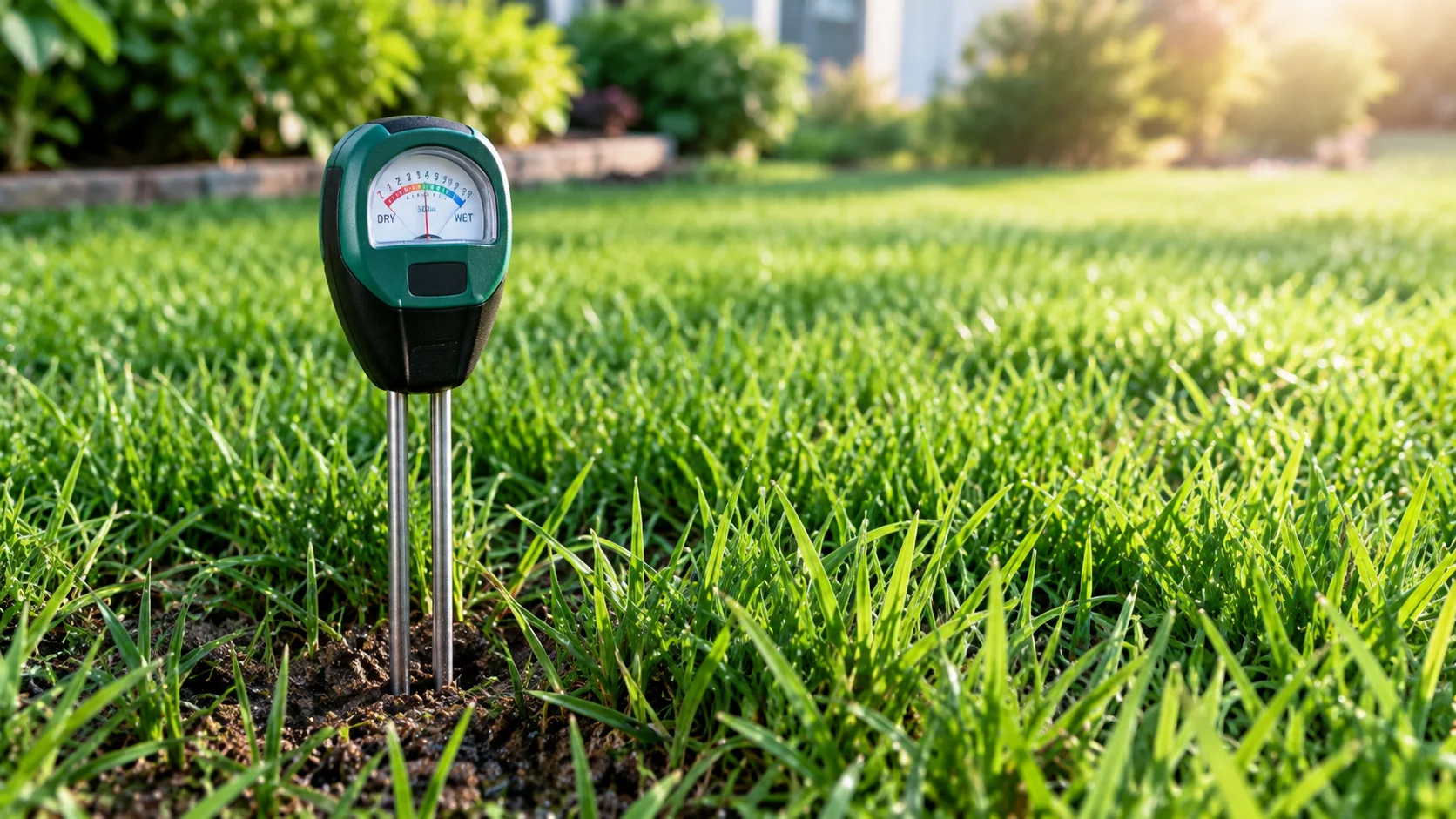
Ask ten people and you get ten schedules: daily, every other day, twice a week, or only when the grass browns. Each works somewhere, because frequency is not a fixed rule. The lawn watering schedule calculator returns days per week and minutes per day for your yard, and this guide shows the method behind it.
Frequency is the weekly water total divided by how much water your soil can hold and absorb at one time. Below you will find the weekly totals, the number of waterings for each grass type, how soil and season change the answer, and a worked example that ends in minutes on your controller.
Key takeaways
- Waterings per week = weekly water use ÷ the water your soil can hold per watering. The grass sets the total; the soil sets the limit per watering.
- Cool-season grasses need about 3 waterings a week in summer. Warm-season grasses usually need 1 or 2.
- Loam holds about 0.4 to 0.5 inch per watering and clay about 0.45 to 0.6 inch. Sand holds only 0.13 to 0.19 inch, so it needs short runs every day or two in hot weather.
- Spring and fall need 1 or 2 waterings a week, and a soaking rain can replace one.
- Stop a run when runoff starts, and split long runs into cycles an hour apart.
- Convert inches to minutes with a measured precipitation rate, not a guess.
How much water does a lawn need each week?
Frequency is a way of splitting a total, so start with the total. Grass loses water by evaporation and transpiration, together called evapotranspiration (ET), and irrigation engineers measure it against a reference grass as ETo.1 A lawn's weekly need is ETo multiplied by a crop coefficient: 0.8 for cool-season lawns and 0.6 for warm-season lawns.2
Across most of the US that works out to about 1 to 1.5 inches (25 to 38 mm) a week in summer, counting rain, and roughly half that in spring and fall. Hot, dry inland climates push a cool-season lawn toward 2 inches. The lawn water requirement calculator returns your own number from local ET and grass type.
How often to water your lawn by grass type
Roots decide the rhythm. Warm-season grasses such as Bermuda, zoysia, St. Augustine and buffalograss root deeply and do best with deep, infrequent watering, usually 1 or 2 times a week.3 Cool-season grasses such as tall fescue, Kentucky bluegrass and ryegrass root less deeply. UC advises dividing the week's watering time into about 3 equal irrigations spaced evenly through the week, with fewer in cooler months.3
Split the total evenly. A fescue lawn that needs 1.2 inches in a week gets three waterings of 0.4 inch each, not one long soak and not seven short ones.
Desert climates, slopes and shallow soils are the exceptions. They need shorter, more frequent irrigations even for warm-season grass.3 To compare species, use the grass type water needs calculator, or check the lawn watering by grass type chart.
How soil type changes the days between waterings
Soil works like a tank. Most established lawn roots reach 6 to 8 inches down,4 and the soil in that zone holds a limited amount of water. You refill it before the grass runs short, which is roughly when half of the available water is gone. The days between waterings equal that refill depth divided by the grass's daily water use.
Days between waterings for a cool-season lawn, by soil and weather
| Soil | Water held per foot | Refill depth per watering (top 6 in) | Mild summer (0.13 in/day) | Hot, dry summer (0.25 in/day) |
|---|---|---|---|---|
| Sandy | 0.5–0.75 in (13–19 mm) | 0.13–0.19 in (3–5 mm) | Every 1–1.5 days | Daily or twice a day |
| Loam | 1.5–2.0 in (38–51 mm) | 0.4–0.5 in (10–13 mm) | Every 3–4 days | Every 1.5–2 days |
| Clay | 1.8–2.4 in (46–61 mm) | 0.45–0.6 in (11–15 mm) | Every 3.5–4.5 days | Every 2 days |
Planning values: typical available water capacity, refilling half of it in the top 6 inches, no rain, uniformity ignored. Daily use of 0.13 and 0.25 inch is about 0.9 and 1.75 inches a week, typical of a mild and a hot, dry summer for cool-season turf.
Sand drains fast and holds little, so an inch applied at once mostly sinks below the roots. Clay holds plenty but absorbs slowly, often only 0.1 to 0.2 inch an hour, so a 0.5-inch watering needs 2.5 to 5 hours to soak in. A sprinkler that applies water faster than that causes runoff. UC recommends finding the longest run before runoff starts and never exceeding it.3
The fix for clay and slopes is cycle and soak: two or three short runs an hour apart. The cycle and soak calculator sets the cycle length, and the available water capacity calculator estimates how much your own soil holds.
How often to water in spring, summer and fall
Frequency falls with the weather because ET falls. The table pairs typical weekly needs (ETo × crop coefficient) with the UC frequency guidance.
Waterings per week by weather and grass type
| Weather | Cool-season lawn | Warm-season lawn |
|---|---|---|
| Spring or fall, most regions | 1–2 times; 0.45–0.65 in (11–17 mm) a week | 1 time; 0.35–0.5 in (9–13 mm) a week |
| Mild summer (coastal, northern states) | 2–3 times; 0.85–1.0 in (21–25 mm) a week | 1–2 times; 0.65–0.75 in (16–19 mm) a week |
| Hot, humid summer (Southeast, Midwest) | 3 times; 1.0–1.25 in (25–32 mm) a week | 1–2 times; 0.75–0.9 in (19–23 mm) a week |
| Hot, dry summer (inland West, desert) | 4–5 times; 1.4–1.95 in (36–50 mm) a week | 2 times; 1.05–1.45 in (27–37 mm) a week |
Weekly totals are before rain. Waterings per week are planning ranges built from the UC guidance; sandy soil needs more, clay may need fewer and longer. Warm-season counts are lower than the 6-inch soil table suggests because their roots reach deeper, so each watering can refill more.4
A Midwest lawn in October needs about half what it needed in July, so a controller left on its July program overwaters by a wide margin. Adjust the program each month, or use a seasonal percentage setting; the seasonal adjustment calculator shows the percentage for each month.
Tip: change days first, minutes second
When the weather cools, drop a watering day before you shorten the run. Each watering should still wet the top 6 inches, or roots stop reaching for deeper water.
How to build your watering schedule
The method takes four numbers and about ten minutes.
Formula
Waterings per week = weekly use ÷ refill depth per watering, rounded up
Weekly use = ETo × Kc − effective rain. Refill depth = root depth (ft) × water held per foot × 0.5. Minutes per watering = (weekly use ÷ DU ÷ waterings) ÷ precipitation rate × 60. DU is distribution uniformity as a decimal.
- Get weekly use. Multiply weekly ETo by 0.8 for cool-season grass or 0.6 for warm-season grass, then subtract the rain that soaked in.
- Find the refill depth. Multiply your root depth in feet by the soil's water held per foot, then by 0.5. The irrigation interval calculator turns refill depth and daily use into days between waterings.
- Divide and round up. Weekly use divided by refill depth gives waterings per week. Space them evenly across the week.
- Convert to minutes. Divide the water to apply by your precipitation rate. Correct for uneven coverage by dividing by DU; 0.7 is a fair planning figure if you have not tested. Measure the rate with a catch-can test, then let the how long to water lawn calculator convert inches to minutes per zone.
Enter grass, soil, sprinkler type and weather. The calculator returns waterings per week and minutes per zone.
Worked example: tall fescue on loam in July
Take a 5,000 sq ft tall fescue lawn on loam in a hot, humid July week. ETo averages 0.2 inch a day, no rain falls, rotors apply 0.5 inch an hour, and DU is an untested 0.7.
- Weekly ETo0.2 in/day × 7 = 1.4 in
- Grass water use1.4 × 0.8 = 1.12 in
- Refill depth (loam, 6 in roots)0.5 ft × 1.75 in/ft × 0.5 = 0.44 in
- Waterings per week1.12 ÷ 0.44 = 2.5, round up to 3
- Water to apply per week1.12 ÷ 0.7 = 1.6 in
- Water per watering1.6 ÷ 3 = 0.53 in
- Minutes per watering0.53 ÷ 0.5 × 60 = 64 min
- Weekly volume5,000 × 1.6 × 0.623 ≈ 4,990 gal
3 waterings a week, about 64 minutes each
Space them every 2 to 3 days. Metric: 1.6 in is 41 mm a week, about 14 mm per watering, or roughly 18,900 liters over 465 m².
Check the result against the soil. Each watering puts back 0.37 inch of grass use (0.53 inch applied × 0.7), below the 0.44 inch the loam can supply, so the roots are refilled before they run short. If 64 minutes at 0.5 in/hr causes runoff, run two 32-minute cycles an hour apart.
When to water: time of day and after rain
Water in the early morning. UC Master Gardeners give 2 a.m. to 8 a.m. as the most efficient window, with low wind, little evaporation and good pressure, and warn against evening watering because wet grass on cool nights invites disease.4 Afternoon watering wastes water to evaporation.
If your city limits watering days, keep the weekly depth and split it across the allowed days. Local rules override any schedule in this article.
Rain resets the clock. Keep a rain gauge, and if a storm delivers about as much as one watering (0.4 to 0.5 inch on loam), skip the next one. Drizzle under about 0.1 inch mostly evaporates. The effective rainfall calculator estimates how much of a storm your lawn can use.
How often to water new seed, new sod and dormant lawns
New seed and new sod
Frequency flips for a new lawn. Until seed germinates, the only roots are in the top half inch, so that thin layer has to stay damp, which can mean short runs two to four times a day in warm, sunny weather. As the seedlings root in, stretch the gap between waterings and lengthen each one. Fresh sod is the reverse problem: the roll dries from the top while the soil under it is still dry, so it needs a deep soak on day one and a daily watering until it can't be lifted at the corners. The grass seed watering calculator and sod watering calculator give a day-by-day taper for each.
Dormant lawns
Letting a cool-season lawn go brown in a drought changes the question from "how often" to "how rarely." The goal is only to keep the crowns alive, and extension guidance commonly puts that at roughly half an inch every two to three weeks. Decide at the start of summer and stick to it: greening the lawn up and letting it go dormant again several times costs the plant more than staying dormant.
Signs your lawn needs water now
The calendar sets the starting point and the lawn corrects it. Check a few times a week for the first month of a new schedule.
Water now
- Footprints stay visible several minutes after you walk across the lawn.
- Patches take on a dull, blue-gray cast and the blades roll inward.
- A screwdriver will not push more than about 2 inches into the soil.
- Dry patches show up in the same spots each week.
Hold off a day
- Grass springs back when you walk across it.
- A screwdriver slides easily to about 6 inches.
- The ground is still spongy a day after the last watering.
- Water pools or runs onto pavement, so shorten the run.
If the lawn shows stress before the next scheduled day, add a watering. If the probe is still wet at 6 inches, push the next one back a day. Change one thing at a time and give it two weeks.
Frequently asked questions
Is watering once a week enough for a lawn?
Once a week is enough only for an established warm-season lawn in mild weather or deep soil. UC guidance says 1 or 2 times a week usually works for warm-season grasses. Cool-season grasses root less deeply and need about 3 waterings a week in summer. If footprints linger or blades turn blue-gray, add a day.
Is it bad to water your lawn every day?
Usually yes, with one exception. Daily light watering wets only the top inch or so, which keeps roots shallow and the surface damp enough for disease. Deep, less frequent watering pushes roots toward the 6 to 8 inches most established lawns reach. The exception is very sandy soil in hot weather, which holds so little that daily short runs can be right.
How often should you water a lawn during a heat wave?
Water more often, not longer. In a hot, dry heat wave a cool-season lawn can use 1.4 to 1.95 inches a week, which on loam means a watering every 1.5 to 2 days. Sandy soil may need daily runs. Keep each run short enough to avoid puddles, and follow any local watering-day limits.
Can you water a lawn too often?
Yes. Watering before the root zone has dried down keeps the soil soggy and the roots shallow. Signs include spongy ground a day after watering, mushrooms, runoff onto pavement and turf that peels up easily. Push a screwdriver into the soil; if it is still wet at 6 inches, wait another day.
How long should each watering last?
Run time equals the depth you want to apply divided by your precipitation rate, times 60. A fixed spray head at 1.5 in/hr needs about 24 minutes for 0.6 inch; a rotor at 0.5 in/hr needs about 72 minutes. Stop earlier if water runs off, and finish the rest in a second cycle an hour later.
Sources
- Allen, R.G., Pereira, L.S., Raes, D. and Smith, M. (1998). Crop Evapotranspiration: Guidelines for Computing Crop Water Requirements. FAO Irrigation and Drainage Paper 56. Food and Agriculture Organization of the United Nations.
- UC Center for Landscape & Urban Horticulture. Plant Factor or Crop Coefficient: What's the Difference? University of California Agriculture and Natural Resources. Values adapted from ANSI/ASABE S623.
- UC Statewide IPM Program. How Many Times a Week to Water. The UC Guide to Healthy Lawns. University of California Agriculture and Natural Resources.
- UC Master Gardeners of San Joaquin County. Conserving Water with Lawns. University of California Agriculture and Natural Resources.
Written by Daniel Reeves, PE, CID. Figures in this article were calculated from the cited sources and checked against our lawn watering calculator. Read how we calculate and our editorial policy. Spotted an error? Tell us.