Fall and Winter Lawn Watering: When to Stop
Water use falls every week after September, and the real stop signal is frozen soil or a dormant lawn, not a date on the calendar. This guide gives the triggers, the final soak and the winter schedule by grass type.

By Daniel Reeves, PE, CID
Irrigation Design Engineer
Short answer
In most of the North, give a cool-season lawn one last deep soak of about 1 inch (25 mm) before the ground freezes,1 then stop; growth ends when daytime highs stay under 50°F (10°C).2
Fall and winter lawn watering depends on grass type as much as on climate. Warm-season lawns (Bermuda, zoysia, St. Augustine) go dormant and need water only in long dry spells, about 1 inch (25 mm) after 3 weeks without rain.3 Skip the last soak if recent rain has covered the lawn's use. Cool-season lawns in mild climates keep growing, so they have no fixed stop date and get water only when rain falls short.4
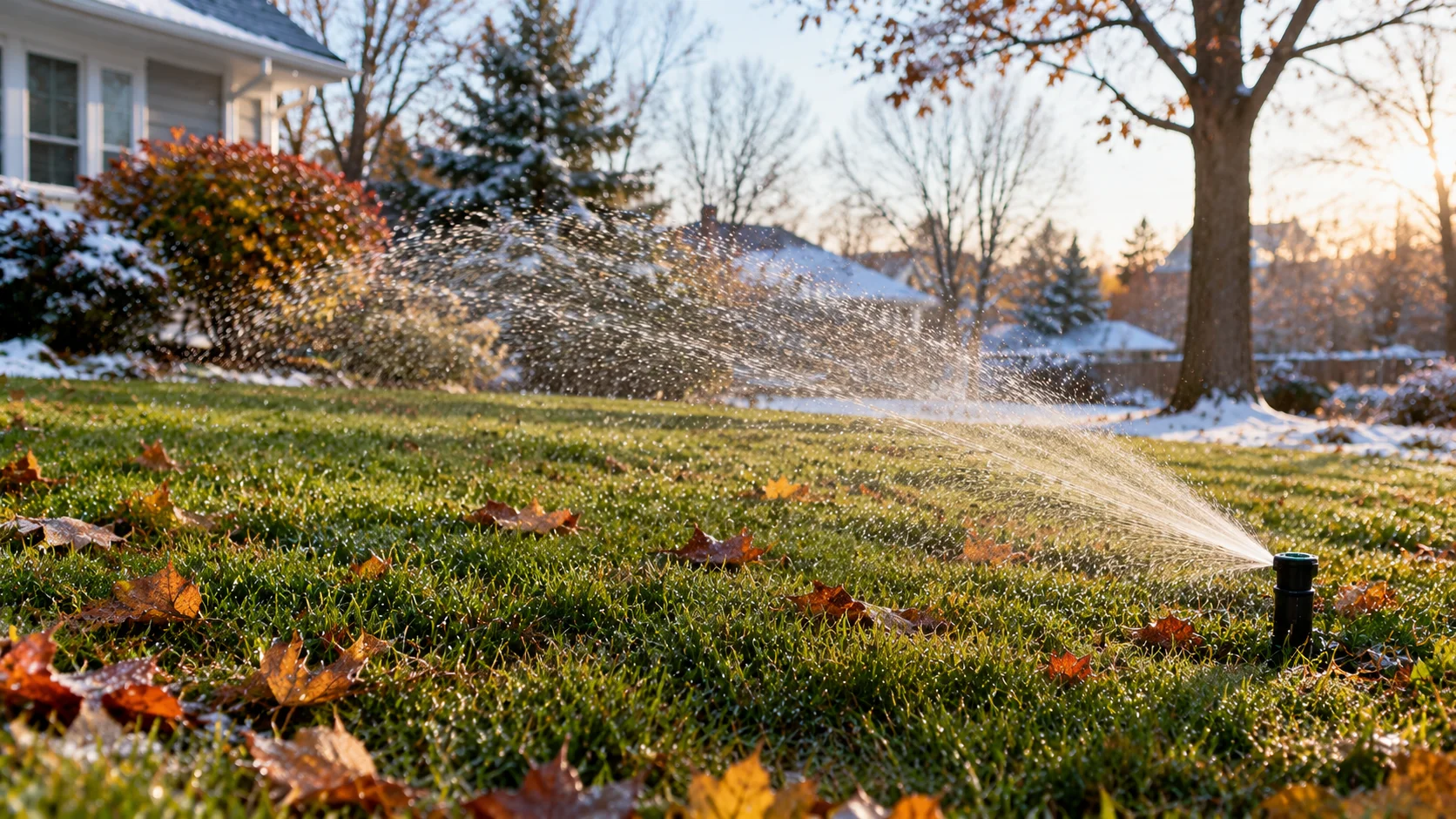
A calendar date is a poor stop signal. The seasonal adjustment calculator converts a summer run time into the percentage that fits each month, and this article gives the method and stop rules behind it, because water use falls steadily with the weather.
Below are the signals that end watering, how much water a lawn still uses from September to December, and a worked example for the last watering of the year. It also covers warm-season, overseeded and new lawns, and when to blow out the sprinkler system.
Key takeaways
- Growth ends when daytime highs stay under 50°F (10°C). The hard stop is frozen soil, snow cover or a drained sprinkler system.
- Water use keeps falling through fall. In the example below, a cool-season lawn drops from 0.62 inch (16 mm) a week in September to 0.19 inch (5 mm) in November.
- If rain has been short, give cool-season lawns one deep soak of about 1 inch (25 mm) before the soil freezes so the crowns go into winter moist.
- Dormant warm-season lawns need about 1 inch (25 mm) only after 3 weeks without rain.
- In dry winters without snow cover, water once or twice a month at midday, and only when air and soil are above 40°F (4°C).
- New seed, new sod and lawns facing south or west are the most vulnerable, so keep checking them after the established lawn has stopped.
When should you stop watering your lawn in fall?
Growth is the first signal. Cool-season foliage such as Kentucky bluegrass stops growing when daytime highs stay below 50°F (10°C), which Iowa State places in late October or early November for Iowa.2 By then the lawn's water use is a fraction of its summer level (see the table below), so routine watering can end while rain keeps arriving.
The soil is the second signal, and it sets the timing of the last watering. University of Minnesota Extension advises watering before soil temperatures freeze so the crowns can rehydrate, because plants that enter winter moisture-stressed suffer more winter stress.1 Frost on the blades does not end the season by itself. The target is the window after growth has stopped and before the soil locks up.
Rain is the third signal. When a week's effective rain equals or exceeds the lawn's weekly use, the sprinkler has nothing to add. The effective rainfall calculator estimates how much of a storm the lawn can use, since light showers and runoff do not count in full.
Frozen soil and snow cover are the hard stop. Colorado State's winter guidance limits watering to times when air and soil are above 40°F (4°C) and there is no snow cover.5
How much water does a lawn still need in fall?
Water use follows evapotranspiration (ET), the water lost from soil and leaves together, and ET falls as days shorten and temperatures drop. Multiply reference ET (ETo) by a turfgrass crop coefficient (Kc) to get the lawn's use. The reference ET calculator returns ETo from local weather data.
UC publishes monthly Kc values from California turf research. For cool-season grass they are 0.74 in September, 0.75 in October, 0.69 in November and 0.60 in December. For warm-season grass they are 0.62, 0.54, 0.58 and 0.55.6 Treat them as planning values outside California, and replace the example ETo in the table with your local figures.
Formula
Weekly lawn water use = ETo (in/day) × Kc × 7
Subtract effective rain for the week. Water to apply = use ÷ DU, where DU is distribution uniformity as a decimal. Metric: ETo in mm/day gives use in mm per week.
Weekly lawn water use as ETo falls (example ETo values)
| Month | Example ETo per day | Cool-season Kc | Cool-season use per week | Warm-season Kc | Warm-season use per week |
|---|---|---|---|---|---|
| September | 0.12 in (3.0 mm) | 0.74 | 0.62 in (16 mm) | 0.62 | 0.52 in (13 mm) |
| October | 0.07 in (1.8 mm) | 0.75 | 0.37 in (9 mm) | 0.54 | 0.26 in (7 mm) |
| November | 0.04 in (1.0 mm) | 0.69 | 0.19 in (5 mm) | 0.58 | 0.16 in (4 mm) |
| December | 0.02 in (0.5 mm) | 0.60 | 0.08 in (2 mm) | 0.55 | 0.08 in (2 mm) |
Kc values are UC's monthly turfgrass figures.6 The ETo values are illustrative inputs for a northern US lawn, not measured data. Use is before rain. A warm-season lawn that has gone dormant uses less than shown.
In the September row, a cool-season lawn uses 0.62 inch (16 mm) a week. Divide by a distribution uniformity of 0.7 and the sprinkler has to apply about 0.9 inch (23 mm), close to the 1 inch a week Iowa State gives for a lawn that is still actively growing.2 By October the applied amount is about 0.5 inch (13 mm), and a single 0.4-inch (10 mm) rain roughly covers the 0.37-inch (9 mm) use for the week. By November the lawn uses 0.19 inch (5 mm), so one light rain covers it.
The lawn water requirement calculator returns the weekly figure for your own ETo and grass type. Warm-season lawns follow the same math until dormancy and then use even less, because root activity in dormant turf is much slower.3
Enter your summer program and the month. The calculator returns the seasonal percentage and the adjusted run time.
How do you give the last watering before the ground freezes?
The final soak replaces the water the lawn has used since the last rain that soaked in, so the root zone and crowns go into winter moist. Minnesota's guidance is to water at least once before the irrigation system is turned off if you have an automatic system or the lawn is already dry.1
Formula
Final soak (in) = ETo × Kc × days since effective rain ÷ DU
Use the Kc for the month of the soak. Minutes = soak depth ÷ precipitation rate (in/hr) × 60. If the soil cannot absorb the whole depth at once, split the run into cycles an hour apart.
- Tally the rain. Add up the effective rain since the soil was last soaked. If it matches the lawn's use over the same days, skip the soak.
- Find the deficit. Multiply daily use (ETo × Kc) by the days since the last effective rain. The lawn water deficit calculator tracks the same balance for your lawn.
- Correct for uneven coverage. Divide the deficit by DU. UC notes that irrigation applied to turf usually equals or exceeds ETo because systems are not perfectly uniform,6 and 0.7 is a fair planning value if you have not tested. A catch-can test gives your real number.
- Convert to minutes. Divide the depth by your precipitation rate and multiply by 60. The how long to water lawn calculator does this per zone. If water puddles, the cycle and soak calculator splits the run.
- Pick the day. Run it at midday on a day when the air is above 40°F (4°C), so the water can soak in before any freeze that night.5
Tip: soak first, then shut down
Schedule the soak ahead of the blowout appointment. If you wait until the blowout date, the system you would run it with may already be drained.
Worked example: the last watering for a bluegrass lawn in late October
Take a 5,000 sq ft Kentucky bluegrass lawn in late October. ETo has averaged 0.07 inch a day, no effective rain has fallen for 14 days, rotors apply 0.5 inch an hour, and DU is an untested 0.7.
- Daily use (October Kc 0.75)0.07 × 0.75 = 0.0525 in/day
- Deficit since last rain0.0525 × 14 = 0.735 in
- Water to apply0.735 ÷ 0.7 = 1.05 in
- Total run time1.05 ÷ 0.5 × 60 = 126 min
- Three cycles126 ÷ 3 = 42 min each
- Volume5,000 × 1.05 × 0.623 ≈ 3,270 gal
About 1 inch applied: three 42-minute cycles, an hour apart
Metric: the net deficit is 19 mm, the soak is 27 mm, and the volume is about 12,400 liters over 465 m².
Cross-check the result with the table. Two weeks of October use at 0.37 inch a week is 0.735 inch, which matches the deficit. If 0.4 inch (10 mm) of effective rain had fallen during those 14 days, the deficit would drop to 0.335 inch, the soak to 0.48 inch (12 mm) and the run to about 57 minutes.
How does fall and winter lawn watering differ by grass type and region?
The stop date depends on whether the grass keeps growing. Warm-season grasses grow best at 90 to 95°F (32 to 35°C) and cool-season grasses at 65 to 75°F (18 to 24°C),4 so the cool-season lawn is the one still using water in a cool fall.
When routine watering ends, by lawn type and region
| Lawn and region | When routine watering ends | Winter watering |
|---|---|---|
| Cool-season, northern states (Minnesota, Iowa) | After growth ends2 and before soil freezes. Systems in much of Minnesota are typically blown out in the third or fourth week of October.1 | None once the ground is frozen. One soak beforehand if the lawn is dry. |
| Cool-season, dry high-plains winters (Colorado) | No fixed date. Water only in extended dry periods with no snow cover.5 | Once or twice a month, at midday, with air and soil above 40°F (4°C). |
| Warm-season, Southeast (Bermuda, zoysia, St. Augustine, centipede, bahia) | Dormancy commonly begins in November in inland South Carolina and less often on the coast.3 | 1 inch (25 mm) if no rain for 3 weeks, in the morning once frost has gone. |
| Cool-season or overseeded, Southeast | No stop date. These lawns keep growing through winter.4 | Water when rainfall falls short, using color, footprint and leaf tests.3 |
Regional rows come from extension guidance for those states. Check your local extension office for your frost dates and any watering restrictions.
The grass type water needs calculator compares species, and the lawn watering by grass type chart sets the numbers side by side.
How often should you water a lawn in winter?
Only in dry spells, and rarely. Colorado State recommends watering during extended dry periods without snow cover, about once or twice a month, applied at midday on days above 40°F (4°C).5 Winter drought matters most for new lawns and for lawns facing south or west, where the low winter sun dries the turf faster. Warm exposures are also prone to late-winter mite damage.5
Warm-season lawns in the Southeast need less. Clemson's guidance is 1 inch (25 mm) only when no rain has fallen for 3 weeks, applied in the morning once frost has gone and the grass is dry.3 Moist soil holds heat longer than dry soil, which may reduce cold injury, so a watering on a warm winter day after a long dry spell can do double duty.4
Caution: do not water into a freeze
Clemson warns that grass watered just before a freeze can be severely damaged.4 Colorado State also advises against watering over snow cover.5
A solid layer of ice that stays on a lawn for more than a month can suffocate it or mat the grass,5 so avoid applying water that will sit and freeze. If your system is already drained, a hose-end sprinkler handles winter watering, and the lawn hose watering time calculator estimates how long to run it for a target depth.
What about new seed, new sod and overseeded lawns?
These lawns keep their own schedule because their roots are shallow. Iowa State describes fall as a dry time of year and says regular watering matters most on newly renovated, seeded or sodded areas.2 After seeding, keep the top inch (25 mm) of soil moist with frequent, light watering, then water deeper and less often once seedlings reach 1 to 2 inches (25 to 50 mm) tall.2 The grass seed watering calculator and sod watering calculator set a schedule for each.
Winter is the second test. Colorado State lists newly established lawns, seeded or sodded, as especially susceptible to winter damage,5 so these are the lawns to keep watching after the established lawn next door has stopped. In the Southeast, lawns overseeded with a cool-season grass for winter color are watered when rainfall falls short.4
When should you shut off and blow out the sprinkler system?
When the soil is about to freeze to the depth of the pipe, and after the last watering. Minnesota Extension notes that many systems are blown out before the ground freezes, typically in the third or fourth week of October for much of that state.1 Pipe depth and frost depth set the rule in your area, so ask a local irrigation contractor or your water utility for the usual date.
In mild climates the answer can be no blowout at all. Clemson notes that South Carolina pipe is usually buried 12 inches (30 cm) deep, where the water does not freeze in that climate, and most systems drain through the lowest head, so winterizing is generally not required. The exception is an above-ground pump: as little as ¼ inch (6 mm) of water in a pump casing has been known to freeze and crack it.4
Blowouts are sized by air volume (CFM) as well as pressure, and the sprinkler blowout CFM calculator estimates the volume a system needs. Follow the manufacturer's pressure limits for your pipe and heads, or hire a contractor, and check municipal rules on shutdown dates.
How can you tell the lawn still needs water or is ready to stop?
Use the lawn as a check on the calendar. Iowa State's test is simple: walk across the lawn, and if footprints remain, it needs water; if the grass stands back up, it does not.2
Water it before shutdown
- Footprints stay in the turf after you walk across it.
- The past week's rain was below the lawn's weekly use (0.37 inch, or 9 mm, in the October example).
- The lawn is new seed, new sod, or faces south or west.
- The system is about to be shut down and the soil is dry.
Safe to stop
- Growth has ended and daytime highs stay under 50°F (10°C).
- The grass springs back when you walk on it.
- Recent rain has covered the week's use.
- The final soak is done and the system is drained or the soil is frozen.
Frequently asked questions
Should I water my lawn after the first frost?
Yes, if the soil is dry and has not frozen. Frost on the blades does not remove the lawn's need for water, and moisture stress going into winter increases winter injury. Water at midday so it soaks in before night, and only when the air is above 40°F (4°C). Once the soil freezes or snow covers it, stop.
Is it okay to water dormant grass?
Dormant does not mean dead. A dormant warm-season lawn still has living roots that take up a little water, and in a long dry spell patches can die. Clemson guidance is about 1 inch (25 mm) after 3 weeks without rain, applied in the morning once frost has gone. A lawn that browned in summer drought can be revived once temperatures cool.
At what temperature should you stop watering the lawn?
Routine watering can stop when daytime highs stay under 50°F (10°C), because cool-season grass stops growing. Occasional winter watering is a separate decision. Colorado State advises it only when air and soil are above 40°F (4°C) with no snow cover, and in extended dry spells that means about once or twice a month.
Will my lawn die if I stop watering too early?
Usually not, but it can be weakened. Dry soil going into winter raises the risk of winter injury, and root damage may not show until late spring or summer, when stressed turf can thin or die. A final deep soak before the freeze lowers that risk, especially for new lawns and for lawns facing south or west.
How long should the last watering run?
Divide the depth you need by your precipitation rate, then multiply by 60. For 1.05 inches (27 mm), rotors at 0.5 in/hr need 126 minutes and fixed spray heads at 1.5 in/hr need 42 minutes. Split the run into three cycles an hour apart if water puddles or runs off, which is common on clay and slopes.
Do I still need to water if my sprinkler system is blown out next week?
Yes, if the lawn is dry. Water at least once before the system is shut off, because the blowout ends your ability to irrigate automatically. After that, a hose-end sprinkler can cover the occasional winter watering. If soaking rain has fallen and the lawn passes the footprint test, skip it.
Sources
- Trappe, J. (2024, October 16). Should you water your lawn before winter? Yard and Garden News. University of Minnesota Extension.
- Jauron, R. and Steil, A. Late Summer and Fall Lawn Care. Yard and Garden. Iowa State University Extension and Outreach. Last reviewed August 2024.
- Park, D. (2020). Winter Irrigation for Turfgrass Lawns. Home & Garden Information Center. Clemson Cooperative Extension.
- Smith, W.B. and Park, D. Landscape Irrigation Management Part 4: Winter Irrigation & Winterizing. HGIC 1803. Clemson Cooperative Extension. Updated April 2024.
- Klett, J.E. and Cox, R. Fall and Winter Watering of Plants and Trees. CSU Fact Sheet 7.211. Colorado State University Extension. Reviewed August 2025.
- UC Center for Landscape & Urban Horticulture. Turfgrass Crop Coefficients (Kc). University of California Agriculture and Natural Resources. Monthly values from Meyer et al. (1985).
Written by Daniel Reeves, PE, CID. Figures in this article were calculated from the cited sources and checked against our lawn watering calculator. Read how we calculate and our editorial policy. Spotted an error? Tell us.