What Is the Best Time of Day to Water Your Lawn?
Early morning beats midday and evening, but the exact window shifts with wind, humidity and the kind of system you run. This guide gives the hours, the water you lose at other times, and how to set your start time.

By Daniel Reeves, PE, CID
Irrigation Design Engineer
Short answer
The best time of day to water your lawn is early morning, roughly 5 to 9 a.m. by hand or 2 to 8 a.m. on an automatic system, finishing before the heat builds.
Early runs lose the least water to evaporation and wind, and the blades dry within hours.1 Daytime runs are estimated to lose 20 to 30 percent of the water, and evening runs leave grass wet through cool nights, which raises disease risk.3 Humid climates and local watering rules can shift the window.
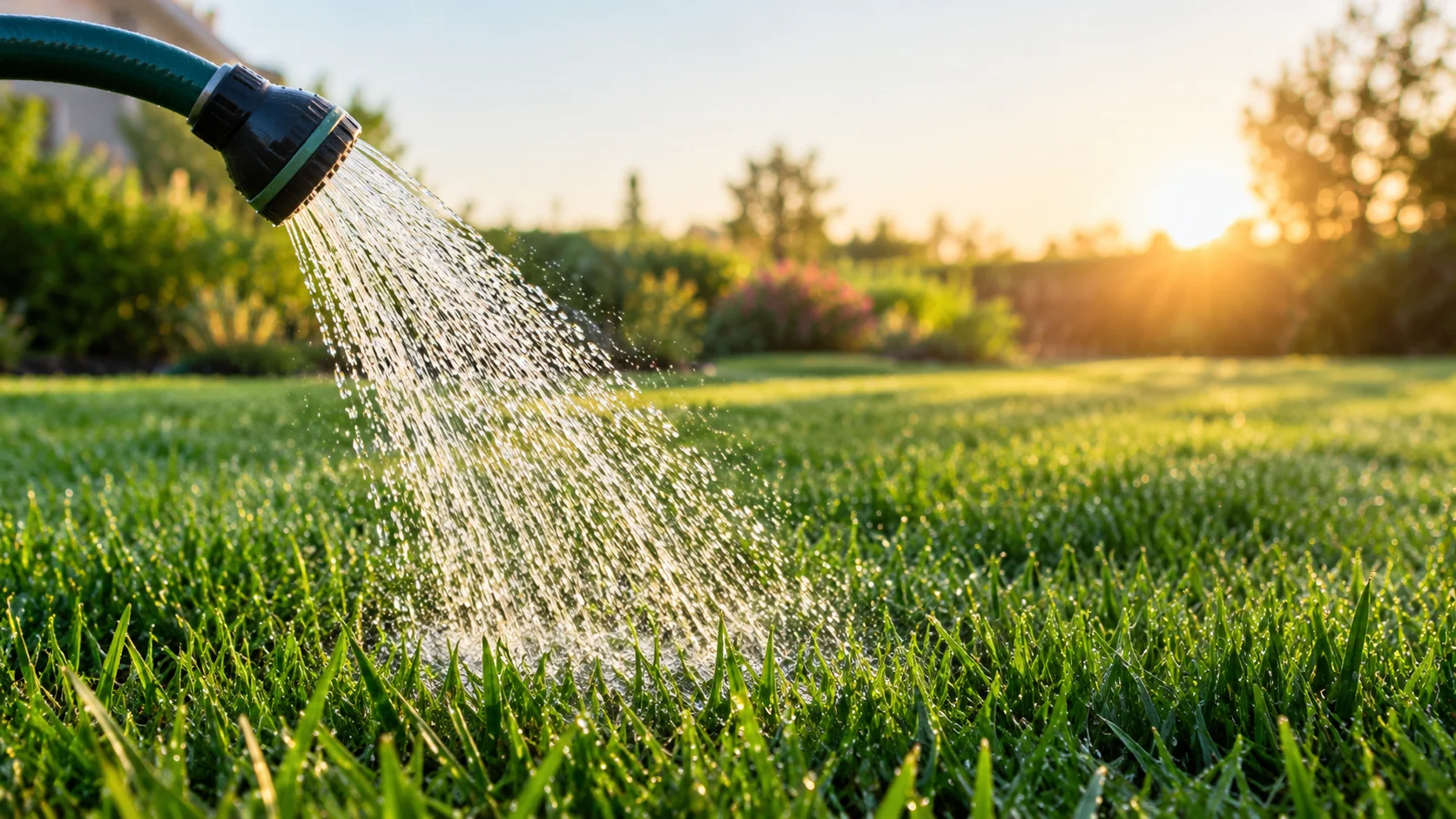
Most advice stops at "water in the morning," which leaves the practical questions open: how early, how much water the clock actually saves, and what to do when your city, your sprinkler type or your own schedule will not allow it. The answer also moves with wind and humidity. The lawn watering schedule calculator sets days and minutes per zone, and this guide covers when in the day to run them.
Below you will find the hours that university extension programs recommend, the water lost at other times of day, a wind table, a worked example in gallons, and a method for setting your controller's start time so the last zone finishes when you want it to.
Key takeaways
- Early morning is the best window: 2 to 8 a.m. for automatic systems and 5 to 9 a.m. for a hose or hand-moved sprinkler.
- Daytime sprinkler runs are estimated to lose 20 to 30 percent of the water, against about 15 percent at night. Wind alone raised the evaporation loss from 2.1 percent in still air to 8.0 percent at 15 mph (24 km/h) in one Florida calculation.
- Evening is the riskiest time for turf disease, because grass stays wet through the cool night.
- Set the start time by subtracting the total run time from the time you want the last zone to finish.
- Drip, soaker and buried lines wet little or no foliage, so evening is acceptable for them.
- Local watering hours and days always come first.
Why is the best time of day to water your lawn early morning?
Four conditions line up before and just after sunrise. The air is cool and often humid, so little water evaporates on its way to the ground. Wind is usually light, so the spray lands where the nozzles aim. Pressure on a city supply is good, which keeps spray patterns intact.2 And the morning sun dries the foliage within hours instead of leaving it wet all night.1
Iowa State gives 5 to 9 a.m. as the window for hand watering, and says a morning application soaks deeply with little evaporation loss.1 The UC lawn guide gives 2 to 8 a.m. for automatic systems.2 The two windows overlap from 5 to 8 a.m., the span both sources agree on, so aim there if you are unsure.
Lawn watering windows and what each one means for water loss and disease
| Time window | Water loss | Leaf wetness | Verdict |
|---|---|---|---|
| 2 a.m. to 8 a.m. | Minimal; low wind and good pressure | Foliage dries after sunrise | Best for automatic systems |
| 5 a.m. to 9 a.m. | Little; soaks in deeply | Foliage dries quickly | Best for hose and hand-moved sprinklers |
| 10 a.m. to 4 p.m. | Highest; peak evapotranspiration and wind | Dries quickly | Avoid when you can |
| Evening to midnight | Lower than midday | Wet through the cool night | Avoid for sprinklers |
Windows from Iowa State, the UC lawn guide and Clemson.123 Local climate can shift them by an hour or two.
How much water does the wrong time of day waste?
Evapotranspiration peaks between 10 a.m. and 4 p.m., when heat, sun and dry air are at their worst and sprinkler water is most exposed to drift and evaporation.3 Clemson estimates daytime sprinkler loss at 20 to 30 percent and nighttime loss at about 15 percent. Applying 1 inch (25 mm) in the day delivers roughly 0.7 to 0.8 inch to the lawn, against 0.85 inch at night.3
Estimated sprinkler water loss by time of day and conditions
| Case | Loss | Reaches the lawn per 1 inch (25 mm) applied |
|---|---|---|
| Daytime run, Clemson estimate | 20–30% | 0.70–0.80 in (18–20 mm) |
| Night run, Clemson estimate | About 15% | 0.85 in (22 mm) |
| Early-afternoon summer run, humid Gainesville, FL | About 3% | 0.97 in (25 mm) |
| 24-hour average, humid Gainesville, FL | About 1.5% | 0.99 in (25 mm) |
Clemson values are rule-of-thumb estimates that depend on humidity, wind and temperature.3 The Florida values are calculated for a 5/16-inch nozzle at 45 psi.4
The spread between 3 and 30 percent is the honest answer. Humid, calm places such as Gainesville lose little at any hour, while hot, dry, windy places lose a lot at midday. A Utah State field study of turf and zinnias measured wind drift and evaporation losses 7 percent greater with daytime sprinkler runs than with nighttime runs, and turf quality was not reduced by daytime timing.5 Daytime watering wastes water; it does not harm the grass.
How wind changes the loss
Wind is the second variable after the clock, and it is usually stronger in the afternoon than before dawn. In the Florida calculation, evaporation loss rose almost in a straight line from 2.1 percent in still air to 8.0 percent at 15 mph (24 km/h).4 The 5 and 10 mph rows below are interpolated along that line.
Sprinkler evaporation loss by wind speed
| Wind speed | Evaporation loss | Reaches the lawn per 1 inch (25 mm) applied |
|---|---|---|
| 0 mph (0 km/h) | 2.1% | 0.98 in (25 mm) |
| 5 mph (8 km/h) | About 4.1% | 0.96 in (24 mm) |
| 10 mph (16 km/h) | About 6.0% | 0.94 in (24 mm) |
| 15 mph (24 km/h) | 8.0% | 0.92 in (23 mm) |
Gainesville, FL June climate, 5/16-inch nozzle, 45 psi.4 Evaporation only. Water that drifts onto pavement is an extra loss, and Iowa State notes strong midday wind can carry water onto driveways and streets.1
Is it OK to water your lawn in the evening or at night?
For sprinklers, avoid it. The UC lawn guide says not to water in the evening or before midnight, because thatch and blades are prone to disease when they stay wet through cool nights.2 Iowa State gives the same warning for evening and night watering.1
Clemson explains the mechanism. Dew has already formed by evening, and a sprinkler knocks that moisture down into the thatch layer, trapping it and creating a humid microclimate that favors fungus.3 A run that finishes just before sunrise leaves the humid layer in place for a much shorter time.3
The same factsheet adds a counterpoint worth knowing. Night has the lowest loss, and disease rises mainly when lawns are routinely over-watered rather than because of the hour itself.3 If evening is your only option, apply no more than the lawn needs and inspect for disease for several weeks.
How to set your controller start time
Pick the time you want the last zone to finish, then count backward. A finish between 6 and 8 a.m. keeps the whole run inside the UC window and lets the sun dry the grass right after.
Formula
Start time = finish time − total run time
Total run time = zones × minutes per zone, plus any soak gaps between cycles. Minutes per zone = depth per watering ÷ precipitation rate × 60. To find the water to apply for a net depth: applied depth = net depth ÷ (1 − loss as a decimal).
- Get minutes per zone. Divide the depth per watering by the zone's precipitation rate and multiply by 60. The sprinkler run time calculator and the how long to water lawn calculator do this for each zone.
- Measure the rate. Guessing the precipitation rate throws off every later step. Run a catch-can test or use the sprinkler precipitation rate calculator, and compare the result with the sprinkler precipitation rate chart.
- Add the runs together. Multiply minutes per zone by the number of zones. Six zones at 25 minutes each need 150 minutes, or 2 hours 30 minutes.
- Count backward from the finish. A 5:30 a.m. finish with a 2 hour 30 minute program means a 3:00 a.m. start, inside the 2 to 8 a.m. window.
Tip: plan from the finish time
Controllers are set by start time, but the grass only cares about the finish. When you add a zone or lengthen a run, move the start earlier instead of letting the last zone creep into the afternoon.
Enter grass, soil, sprinkler type and weather. The calculator returns waterings per week and minutes per zone.
Worked example: what a midday schedule costs in water
Take a 5,000 sq ft lawn that needs 1 inch of water to reach the roots each week, watered with rotors that apply 0.5 inch an hour in three equal waterings. Compare the Clemson planning losses of 15 percent for a pre-dawn run and 25 percent, the middle of the daytime range, for a midday run. Uniformity is ignored to keep the comparison clean.
- Net volume needed5,000 × 1 × 0.623 = 3,115 gal
- Pre-dawn applied depth (15% loss)1 ÷ 0.85 = 1.18 in
- Midday applied depth (25% loss)1 ÷ 0.75 = 1.33 in
- Pre-dawn volume3,115 ÷ 0.85 = 3,665 gal
- Midday volume3,115 ÷ 0.75 = 4,153 gal
- Extra water at midday4,153 − 3,665 = 488 gal a week
- Pre-dawn minutes per watering1.18 ÷ 3 = 0.39 in; 0.39 ÷ 0.5 × 60 = 47 min
- Midday minutes per watering1.33 ÷ 3 = 0.44 in; 0.44 ÷ 0.5 × 60 = 53 min
About 488 extra gallons a week at midday, and 6 more minutes per watering
Metric: 25.4 mm over 465 m² is about 11,800 liters net; the pre-dawn run uses about 13,880 liters and the midday run about 15,730 liters, a difference of about 1,850 liters a week. Over a 20-week season that is roughly 9,800 gallons (37,000 liters).
The gap is a planning estimate, and it narrows in calm, humid weather. The lawn water usage calculator totals your own weekly gallons, and the lawn watering cost calculator turns the extra 488 gallons into dollars at your local rate.
Should you change the time in hot, humid or windy weather?
Mostly no. The early window holds through heat, and heat is the reason to protect it, since losses climb with temperature and sun.3 If the lawn needs more water in a heat wave, add a watering day instead of moving a run into the afternoon. The seasonal adjustment calculator shows how much to raise run times as the weather warms.
Wind and humidity are where the clock bends. On a windy morning, delay or skip the run, because the Florida data show loss rising with every mile per hour and UF advises against running sprinklers in high wind.4 In humid regions, Clemson warns that cool, damp spring and fall nights favor turf disease and suggests starting after the dew dries, around 10 a.m., for a month or two, then returning to early morning in summer.3
Keep the pre-dawn start
- Afternoons are hot, dry or windy.
- No disease has shown up on the lawn.
- You use city water and want the program done early.
- Your local rules limit daytime hours.
Shift to mid-morning
- Spring or fall nights are cool and damp, and disease is increasing.
- Dew is still on the blades when the program starts.
- Reducing how often you water has not stopped the problem.
- You can finish before the 10 a.m. to 4 p.m. peak.
Does the best time differ for hose, rotor, spray and drip?
The method changes how much the clock matters. Automatic rotors and spray heads throw water through the air, so they follow the 2 to 8 a.m. window. Fine droplets lose the most, and UF notes that smaller nozzles and higher pressures increase evaporation, so run heads inside the manufacturer's pressure range.4
A hose-end sprinkler moved by hand follows Iowa State's 5 to 9 a.m. window.1 The lawn hose watering time calculator converts your flow into minutes per spot, so you can finish before the heat arrives.
Drip, soaker and buried lines are the exception. Iowa State says mornings and evenings are both fine for them because they do not wet the foliage,6 and Clemson calls the choice between night and morning optional for subsurface drip.3 Size those runs with the drip run time calculator.
What if your city limits watering hours or days?
Follow the rule. UC notes that several counties restrict watering to one day a week or to certain days by address,2 and Clemson advises finishing city-water programs by 5 a.m. so lawn irrigation does not drain reservoirs during the morning rush.3 Your utility's schedule overrides every window here.
Do not stretch a run to make up for a lost day. Apply the same weekly depth on the days you are given, and use shorter back-to-back cycles on clay or slopes so the water soaks in instead of running off. The cycle and soak calculator sets the cycle length. Iowa State suggests the weekly amount go on in one application, or two spaced 3 or 4 days apart, because frequent light watering promotes shallow roots.1
Caution: large or commercial systems
Sports fields, commercial sites and multi-acre properties often need staggered start times to stay within pipe and pump capacity. Have a licensed irrigation designer review the program before you move many zones into one early window.
Frequently asked questions
What time is too late to water the lawn in the morning?
Aim to finish by about 9 a.m., the end of Iowa State's window. Evapotranspiration is greatest from 10 a.m. to 4 p.m., so a run that starts at 10 a.m. loses more to heat and wind. It will not hurt the grass, but it wastes water, and humid regions may start later on purpose.
Can you water your lawn at noon?
Yes. Noon watering does not damage grass, and a Utah State field study found turf quality was not reduced by daytime sprinkler runs. It just wastes more water, with daytime losses estimated at 20 to 30 percent against about 15 percent at night. Water a stressed lawn at noon if you must, then return to the early schedule.
Does watering in the sun burn grass?
Extension guidance names evaporation and wind, not leaf burn, as the problem with daytime watering. Iowa State says midday runs are less efficient because evaporation is rapid and strong winds distribute water unevenly. The documented cost is wasted water, not scorched blades, so the real reason to avoid midday is the water bill.
Is watering twice a day better than once?
Usually not. Iowa State says frequent, light applications promote shallow rooting and make turf less drought tolerant. For Iowa lawns it recommends 1 to 1.5 inches a week in one application, or two applications 3 or 4 days apart. Split a run into two short cycles in the same morning only when water starts to run off.
What is the best time to water a lawn in summer?
The same early morning window, finishing by about 9 a.m. Summer afternoons bring the highest temperatures, sun and wind, and Clemson puts peak evapotranspiration between 10 a.m. and 4 p.m. If the lawn needs more water in summer, add a watering day rather than running in the afternoon.
How do I know the early schedule is working?
Check the lawn before each scheduled run. The UC guide says to water when the top 2 inches of soil have dried out, and visible footprints or a color change mean you waited too long. Clemson suggests watching the turf for several weeks after changing timing and moving the start later if disease increases.
Sources
- Iowa State University Extension and Outreach. How and when should my lawn be watered? Yard and Garden FAQ, last updated August 28, 2024.
- UC Statewide IPM Program. When to water. The UC Guide to Healthy Lawns. University of California Agriculture and Natural Resources.
- Smith, W.B. and Park, D. Landscape Irrigation Management Part 5: Irrigation Time of Day. HGIC 1804. Clemson Cooperative Extension, updated April 2024.
- Zazueta, F.S. Evaporation Loss During Sprinkler Irrigation. UF/IFAS Extension, revised 2011, reviewed 2024.
- Pyakurel, S. (2023). Daytime Versus Nighttime Sprinkler Irrigation of Two Urban Crops in a Semi-Arid Climate at High-Elevation. Utah State University, graduate thesis.
- Iowa State University Extension and Outreach. When is the best time to water the garden? Yard and Garden FAQ, last updated October 29, 2024.
Written by Daniel Reeves, PE, CID. Figures in this article were calculated from the cited sources and checked against our lawn watering calculator. Read how we calculate and our editorial policy. Spotted an error? Tell us.